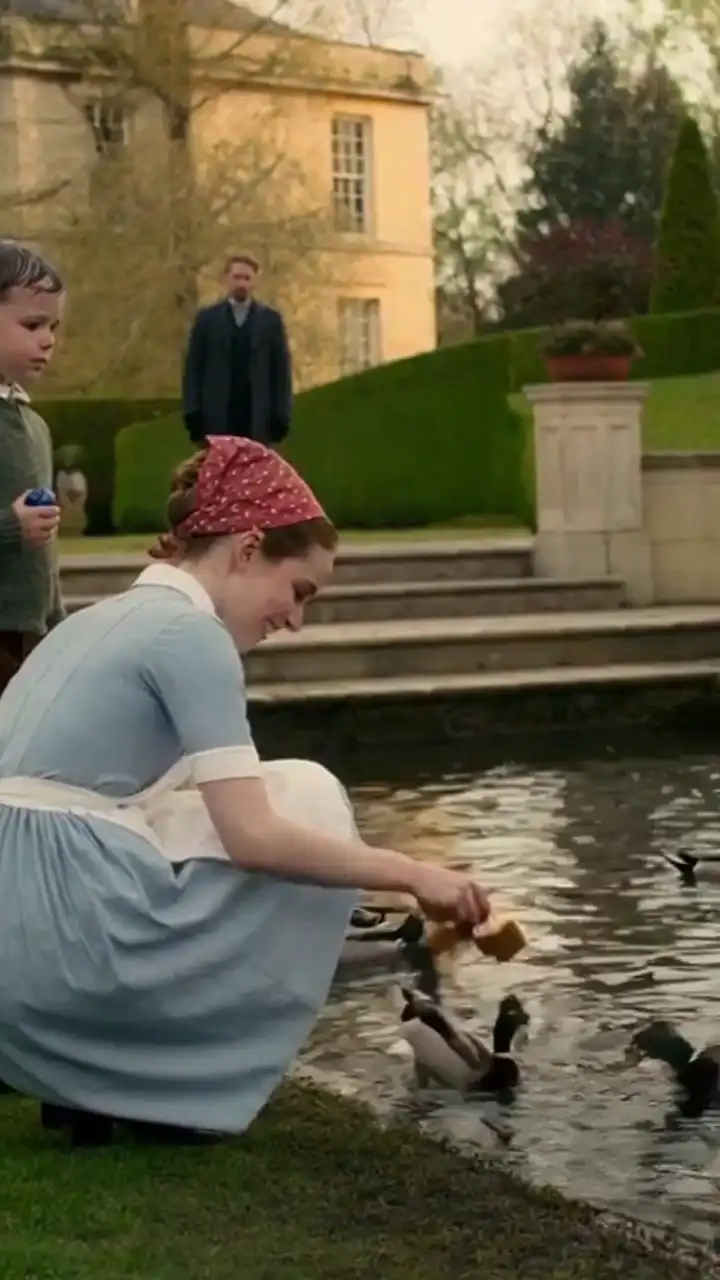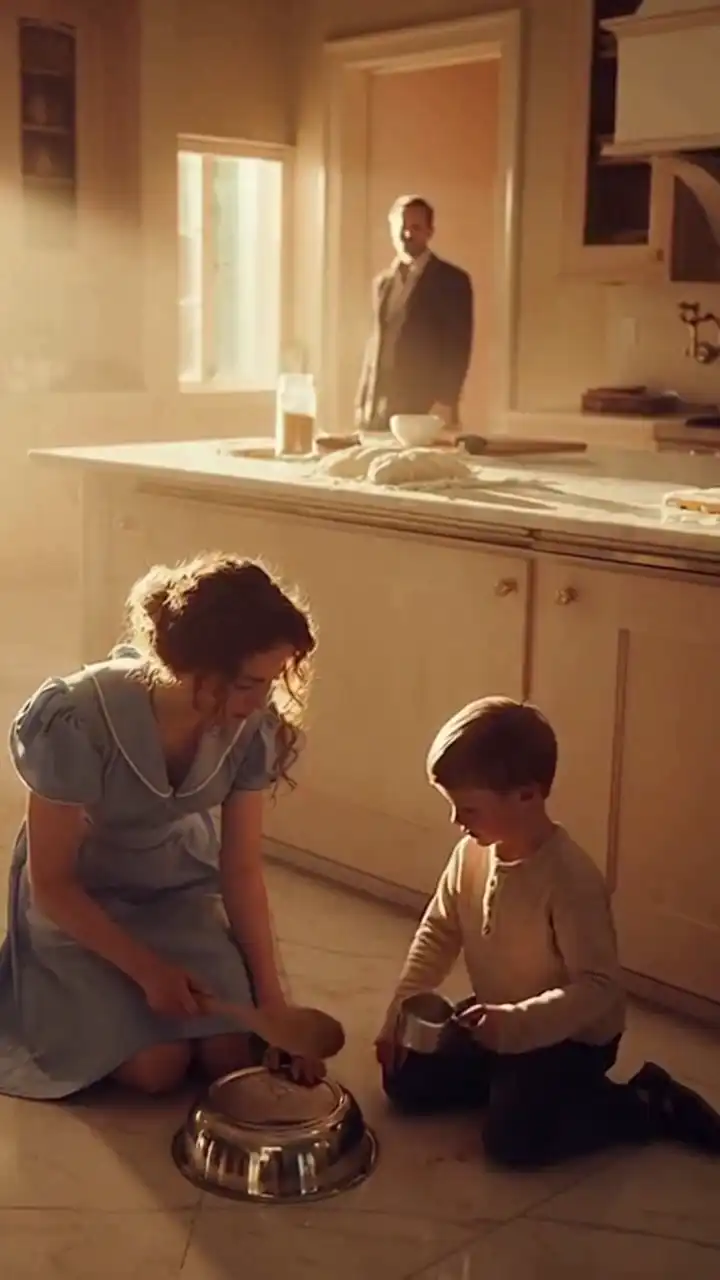
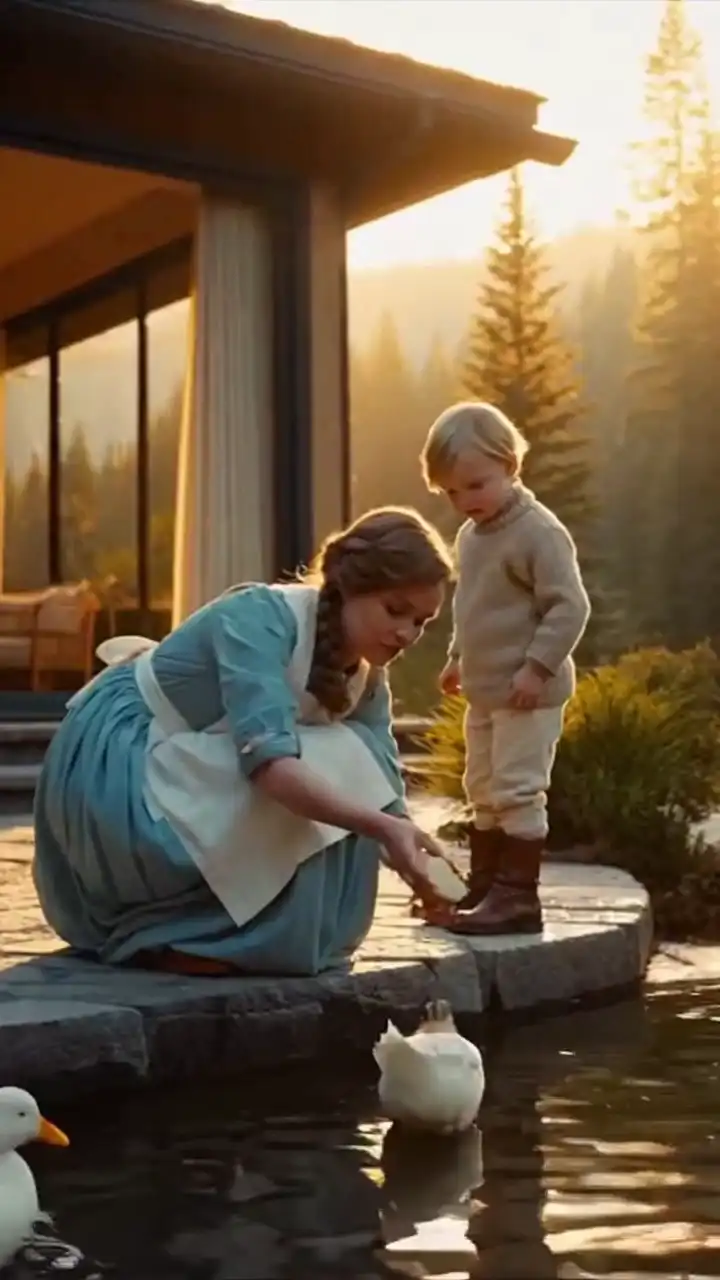
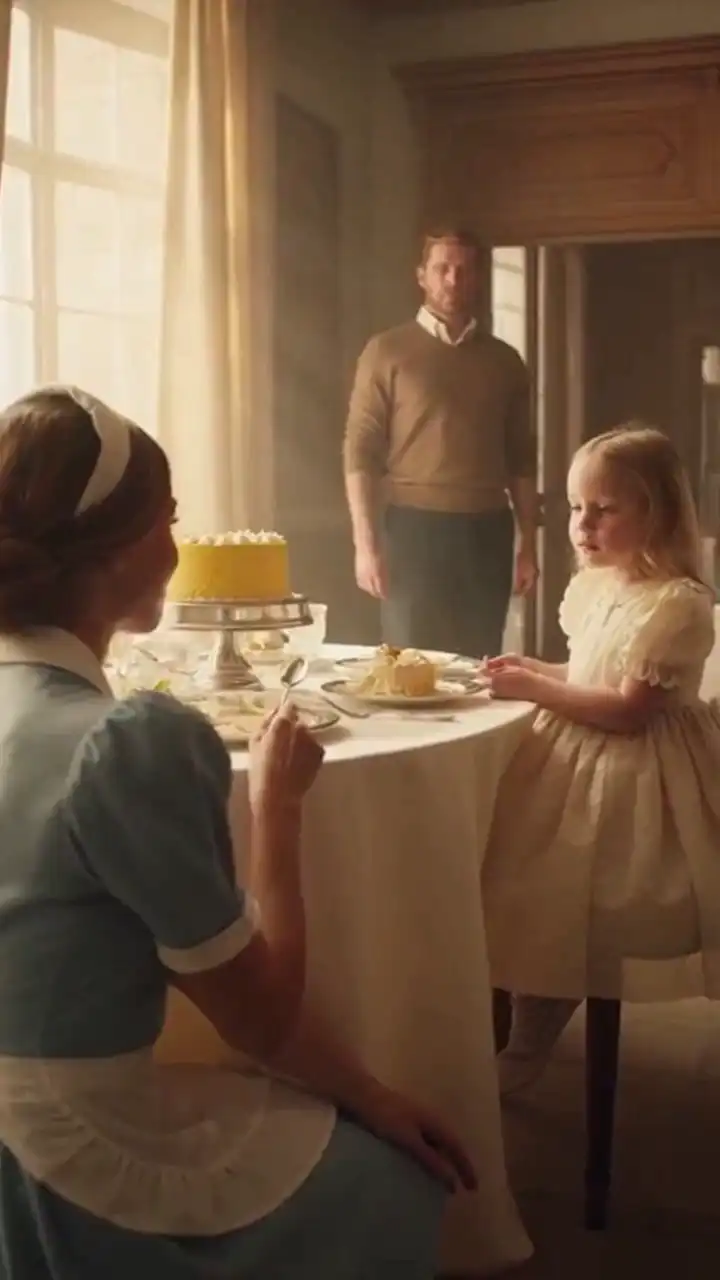

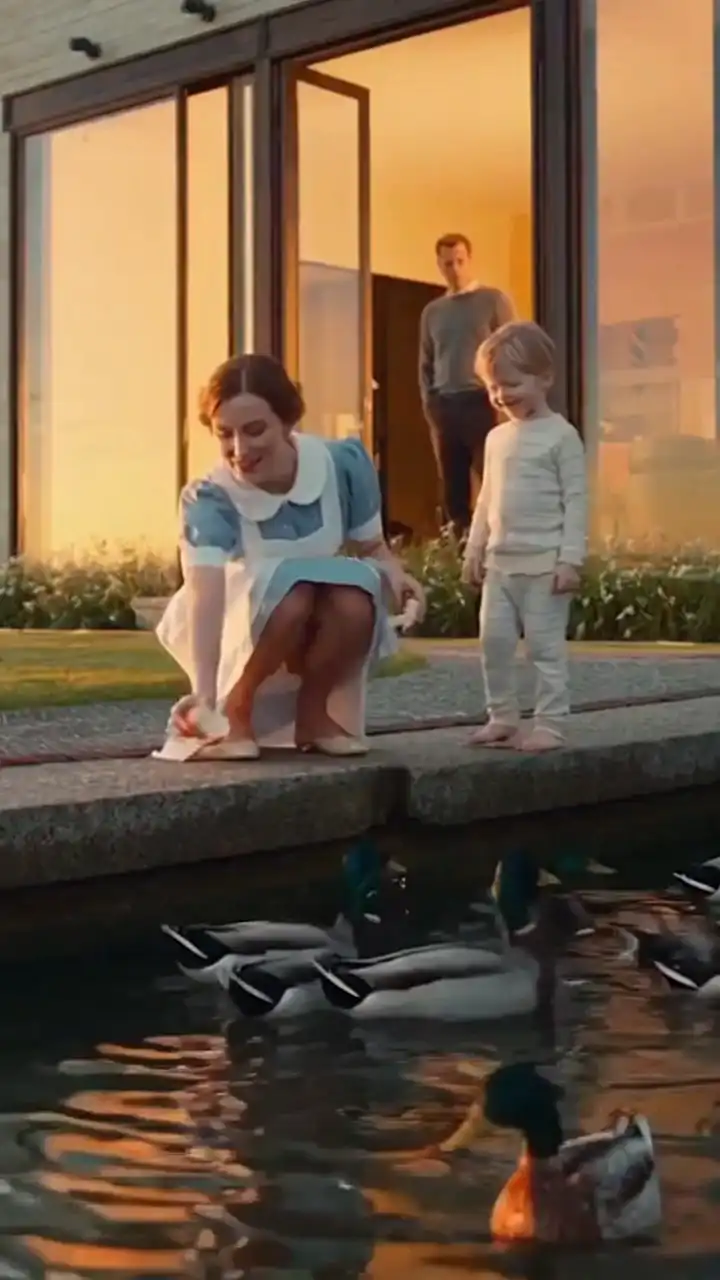
HE FOLLOWED THE NANNY TO THE DUCKS BEFORE HE EVER WALKED TO HIS OWN FATHER
Grant stayed frozen at the terrace doors while the wind came in off the water and lifted the edge of the linen runner on the dining table.
Noah’s fist was bunched in Lena’s jacket.
Not pulling her away. Not fighting. Holding on.
Lena moved slowly, like she understood the difference mattered. She lowered herself to sit on the stone, one sneaker braced against the seawall, and put a few crumbs in Noah’s open palm instead of trying to make him look at her.
“Just toss,” she said.
Noah’s fingers twitched. Half the bread fell straight down by his shoes.
A duck hurried over anyway.
Noah made a sound.
It wasn’t a word. It was more like a small burst of startled air. But it came from him, toward something outside himself, and Grant had not heard that in months.
The estate manager, Hollis, recovered first. “Mr. Mercer, I need to insist. If the child slips on that stone—”
“Not now,” Grant said quietly.
Hollis actually stopped talking.
Lena stayed there with Noah until the bread was gone. She never demanded eye contact. Never said, good job. Never touched him unless he leaned first. When the gulls got too loud, she shifted farther down the wall where the ducks moved slower and the fish flashed near the surface.
Noah followed.
That was the second shock.
He followed in a line of his own choosing, three careful steps, then five, then a little awkward hurry when Lena crouched and tapped the water. Silver fish gathered below. She pulled a bag of plain crackers from her pocket.
“You came prepared?” Grant asked when he finally stepped outside.
She glanced up. “The marina has kids. Kids like feeding things.”
It was such an ordinary answer that it embarrassed him.
In his house, every object around Noah had become specialized, approved, optimized. Weighted blankets. therapeutic putty. imported visual systems. Noise-masking panels. Everything had a purpose. Everything had a price. And his son had met all of it with the same flat distance.
But ducks did not ask him to perform. Fish did not praise him. Birds did not lean over him with concerned eyes.
They moved. They splashed. They came close and then away. They gave him a reason to track, wait, reach, repeat.
Lena seemed to know that without needing to explain it like a consultant.
That afternoon she did something else nobody in the house had done.
She didn’t drag Noah back inside to preserve the schedule.
She built a crooked little station near the side garden with an overturned wooden crate, an old beach bucket she found in the garage, cracked cereal bowls from the staff kitchen, and a faded umbrella tied to the fence with twine. It looked like something a child from a regular neighborhood would make in one summer and destroy by fall.
Hollis looked personally insulted.
“What is this?” he asked.
“A feeding spot,” Lena said. “For when the tide’s too high at the wall.”
“It looks messy.”
“It is messy.”
Noah stood beside her while she set it up, not helping exactly, but not drifting away either. He watched each bowl get filled with water. He watched the crumbs scatter. When a sparrow landed on the fence, he lifted his face so fast it was almost eager.
Grant saw it.
He also saw something uglier in himself: his first instinct was still to ask whether the bowls had been sanitized.
That night Lena asked for a meeting at the kitchen table, not in Grant’s office.
He almost told her to use the office. Then he heard Noah in the next room making soft tapping sounds against the window, tracking birds in the dark reflection, and he let her choose the room.
“He’s not responding to people because people have been too big,” she said. “Too direct. Too emotional. Too careful. He’s getting flooded.”
Grant sat across from her, jacket still on from work, staring at the scratch in the old wooden table left by some delivery box years ago. Nobody important ever sat there.
“He needs side entry,” Lena went on. “Rhythm before language. Shared attention before instruction. Movement that comes from his curiosity, not from us placing demands on him.”
“You figured that out in one day?”
“No,” she said. “He showed it in one day.”
That answer stayed with him.
Over the next week, Lena turned the edges of the estate into Noah’s world.
Not the expensive playroom.
Not the tutoring suite.
The edges.
The cove at low tide, where little crabs sidestepped between rocks.
The side garden where she hung cheap shiny pinwheels and left seed in saucers.
The stretch behind the guest house where rabbits sometimes appeared at dusk.
She never forced Noah into an activity. She set a living thing in motion and waited for him to enter the pattern.
If he stood and watched, that counted. If he took one step, that counted. If he reached for the bucket because the fish were gathering, that counted most of all.
Grant became a quiet witness to all of it.
He watched Noah start anticipating sound. The shake of the cracker box. The rustle of Lena’s windbreaker. The flap of wings beyond the terrace.
He watched his son begin moving before being moved.
The first time Noah tugged at the back door on his own, Hollis nearly dropped a tray.
The first time he brought Lena an empty bowl, the chef turned and stared.
The first time he stood by Grant’s chair at breakfast instead of retreating to the sunroom, Grant had to put down his coffee because his hand shook too hard.
Noah still didn’t speak. He still had long stretches where he retreated, flapped, hummed, or curled up on the rug with his face to the floor. Nothing about him became easy overnight.
But he was no longer unreachable every minute of the day.
Then the interruption came.
It arrived in a polished black SUV and expensive perfume.
Vanessa Cole had been circling Grant’s life for almost a year, close enough that the staff already treated her like the likely future Mrs. Mercer. She came from the right world. Charity boards, museum dinners, the kind of smile that could survive a photographer’s flash.
She had always been “understanding” about Noah as long as understanding meant distance. She sent educational toys still sealed in crisp paper. She spoke in a lowered voice about “stability” and “appropriate structure.” She avoided being alone with the child.
When she stepped out onto the terrace and saw Noah crouched beside Lena over a tray of fish scraps, she stopped dead.
Lena had tied lengths of bright ribbon to driftwood and planted them in the sand patch by the lower path. Birds kept swooping in and out. Noah was watching, then dropping tiny pieces into the water whenever the fish flickered near the surface.
His knees were dirty. His sweater sleeve was wet. There was a streak of cracker dust on his cheek.
Vanessa looked at Grant as if the staff had set fire to the formal dining room.
“What happened to him?”
Grant’s answer came before he could soften it. “He went outside.”
Vanessa’s eyes moved to Lena. “This is exactly the kind of inconsistency specialists warn about.”
Lena didn’t answer. She kept her body angled toward Noah.
Vanessa hated that more than defiance. She hated being treated as irrelevant.
“Grant, he needs discipline and measurable progress, not… seagulls.”
“Ducks,” Lena said without looking up.
Vanessa let out a sharp laugh. “I’m sorry?”
“Mostly ducks,” Lena said. “Some fish. A few gulls if they’re rude.”
Grant almost smiled, and Vanessa saw it.
That was when the real problem started.
Vanessa began making calls.
A developmental center in Connecticut with residential evaluation. A new consultant who had never met Noah but reviewed reports. A family friend attorney who mentioned liability issues around unlicensed care. A board member from one of Grant’s foundations who kindly suggested a more formal treatment environment before “public incidents” damaged the family’s reputation.
The pressure was elegant, social, external. No screaming scenes. No slammed doors.
Just polished people trying to restore order.
Grant had spent years succeeding in exactly that world. He knew how these pressures worked. They didn’t attack directly. They framed interference as concern.
By Friday he had a folder on his desk with brochures for an elite inpatient developmental program overlooking a lake and charging more per month than most people’s annual salary.
He carried it home and found Noah in the service courtyard behind the kitchen.
Lena had made what looked like a ridiculous little “bird cafe” from a beach chair laid on its side, a crate, string, muffin tins, and a child’s red shovel. Noah was on his knees dropping seeds into one tin with slow concentration while two pigeons watched from the wall.
Noah looked up at the sound of the folder hitting the metal patio table.
Only for a second.
But he looked.
Grant sat down.
“What if she leaves?” he asked quietly.
Lena understood at once that he wasn’t talking about the birds.
“He’ll be upset,” she said. “Maybe more than upset.”
“He’s attached.”
“Yes.”
Grant stared at Noah’s hand opening and closing over seed. “Everyone told me attachment would make treatment harder.”
Lena gave him a long look. “Harder for who?”
He had no answer.
The decision was made for him two mornings later.
Vanessa arrived with the consultant and a car already waiting.
She had not told Grant the timing clearly because she knew if she left room for discussion, Lena would still be there, and Noah would still be in motion, and the house itself would argue against her.
Hollis met them at the front and called Grant, voice tight. By the time Grant came down the stairs, the consultant was in the sunroom speaking in slow clinical tones while Noah sat on the floor pressing his forehead to the glass.
Lena had been sent to the staff entrance to “avoid confusion.”
Vanessa stood in pale cream, calm and composed. “This is just an assessment day.”
Grant looked at the overnight bag by the door.
“Assessment?” he said.
The consultant kept talking about transition support and best practices.
Noah began humming. Loud. Fast.
Grant had heard that hum before. It meant overload. It meant the world was closing in.
“Where’s Lena?” he asked.
Vanessa’s expression sharpened. “Grant, this dependence is exactly why a proper setting is necessary.”
Then Noah heard it.
The metallic rattle of the side gate.
Lena, outside.
He jerked upright so suddenly the consultant stepped back.
Vanessa reached toward him. “Noah, sweetheart, we’re going for a little ride—”
He screamed.
Not a tantrum. Not anger. A raw tearing sound from deep in his chest. He crawled, then stumbled to his feet, then dropped, then forced himself up again, driving toward the hallway with wild, unsteady urgency.
Everyone in the room froze.
Because they had never seen him fight to get to anyone.
He hit the side corridor wall with one shoulder, rebounded, kept going. Grant moved on instinct to steady him, but Noah pushed past him. Past the consultant. Past Vanessa.
Toward the back of the house.
Toward Lena.
By the time Grant reached the service terrace, Noah was at the locked screen door, both hands slapping the glass, breathless, crying in huge silent heaves between broken sounds.
Lena was outside with the feed bucket, eyes wide, not touching the handle.
She looked at Grant, waiting for permission in a house that still was not hers.
Grant opened the door.
Noah lurched straight into Lena and clung with his whole body.
Not the back of her jacket this time.
Her waist. Her arm. Anything he could hold.
She crouched around him carefully as if handling something sacred and frightened at once. “Okay,” she whispered. “Okay, I’m here.”
Vanessa had followed them out. “This proves my point,” she said. “He is dysregulated. This is unhealthy.”
Grant turned to her.
For months he had let polished voices organize his grief, his home, his son’s care, even his future. He had called that stability because it looked respectable from the outside.
Now his son was trembling in the arms of the one person who had brought him back into the living world, and the truth was too plain to dress up.
“No,” Grant said. “This proves mine.”
Vanessa stared at him.
“You wanted a child who could be managed,” he said. “She wanted a child who could feel safe enough to move.”
The consultant quietly closed her folder.
Vanessa’s face changed first to disbelief, then insult, then something colder when she realized the staff had heard every word.
“This is because of her?” she asked, glancing at Lena like she was dirt tracked into the house.
“It’s because of him,” Grant said, nodding toward Noah. “And because for the first time, someone listened to what he was actually doing instead of what looked best on paper.”
Vanessa left that afternoon without another argument. People like her rarely lost control in public if they could preserve an exit.
The consultant left too, though not before privately telling Grant, with more honesty than she had shown in the sunroom, that attachment-driven motivation was often a bridge, not a problem.
Hollis, to his credit, never again complained about the bowls, crumbs, or secret feeding stations. Two days later, Grant found him placing a shallow pan of water near the side garden because “the smaller birds seem to prefer it there.”
Change spread through the house in embarrassing little ways.
The chef saved stale bread instead of discarding it. The gardener stopped removing every fallen feather or shell Noah collected. The formal breakfast room was used less. The kitchen table was used more. One corner of the terrace filled with old baskets, seed jars, a hose nozzle, hand towels, and a cheap plastic stool Lena bought herself and later found replaced by a proper bench Grant had ordered without asking.
Grant changed slowest.
That was fitting.
He had loved his son, but mostly in administrative ways. Through appointments. Through approvals. Through expensive readiness. Presence had become something he outsourced because every failed attempt to reach Noah made him feel like his own grief was poison.
Lena did not excuse that.
One evening, while Noah sat nearby dropping pebbles into a bucket of water and watching the rings spread, Grant said, “I was there when they told us Emily was gone. Noah was in the car behind mine. He heard everything after. The sirens. Me shouting. I kept thinking if I got enough experts, enough protection around him, I could undo that day.”
Lena kept her eyes on Noah. “You tried to remove every hard feeling after the hardest feeling already happened.”
He let out one short, bitter breath. “That sounds terrible.”
“It sounds scared,” she said. “Terrible would be not trying.”
Then, after a pause: “But he still needs his father. Not a system.”
So Grant began doing what felt almost humiliating in its simplicity.
He sat on the seawall with stale bread in his expensive coat pocket.
He waited in silence.
He learned not to crowd, not to praise too fast, not to turn every response into a milestone.
Sometimes Noah let him sit close. Sometimes he didn’t. Sometimes he handed the bread to Lena and ignored Grant completely.
Grant stayed anyway.
The first private victory was small enough that nobody else would have noticed. Lena had gone inside to rinse bowls. A duck waddled closer than usual. Noah looked from the duck to Grant’s hand, where the bread was, then touched two fingers to Grant’s sleeve.
Not affection exactly.
A request.
But it was direct, and it was to him.
Grant gave him the bread like it was the most precious transfer in the world.
Spring moved into summer. Noah’s world widened with the season.
He began making rough sounds that started attaching to things.
“Duh” for duck. “Fih” for fish. Once, after a gull stole from the bowl and Lena laughed, Noah burst out something that sounded like “bad bird,” and Lena had to sit down because she was crying and laughing at the same time.
Grant heard his son laugh before he heard him say Daddy.
That came later, on a windy evening when the sky turned pink over the water and Lena was trying to gather the feed tins before the weather changed.
A sudden clap of thunder startled the birds up from the fence all at once. Noah flinched hard. Grant was closest and dropped to one knee without thinking.
“It’s okay,” he said.
Noah looked right at him, face pinched, and said, “Da-dee.”
The word was uneven and effortful and perfect.
Grant bowed his head like he’d been hit.
Lena turned away to give him that moment, but he saw her wiping her eyes with the heel of her hand.
By then, loving Lena had become the least surprising thing in the world and the most dangerous thing he had ever allowed himself to feel since Emily died.
Not because she was the nanny.
Because she had walked into a house arranged around avoidance and made everyone in it choose life over control.
He did not rush it. Neither did she.
Their closeness grew in plain sight of work and routine: coffee left for each other before dawn feedings, late talks at the kitchen table after Noah slept, shared relief after hard days, the simple trust of handing over what mattered most.
Noah settled the rest in his own time.
One Saturday near the end of summer, Grant’s sister came with her twins. The side garden was loud with children and bread crumbs and bright cheap pinwheels clicking in the wind. Noah stood between Grant and Lena at the bird station they had rebuilt twice already.
One of the twins asked, “Is she your teacher?”
Noah looked at Lena. Then at Grant.
He reached out and took one hand of each.
“Family,” he said.
The yard went completely still for one beat.
Grant’s sister covered her mouth.
Lena’s face crumpled first. Grant’s chest did something painful and grateful at once.
Children often say things without understanding the weight of them. But Noah understood enough. He had chosen the word.
That winter Grant made the change public the only way his world fully respected: with action.
He ended Vanessa’s lingering social assumptions for good. He formally restructured the household so Lena was no longer staff living at the edge of the property under temporary contract conditions. He funded the marina special-needs program where she had first learned to work with children like Noah, expanding its animal-assisted sessions so other families who could not afford private care could use it. And months later, in a small ceremony by the water with only family and a few staff present, he asked Lena to stand beside him not as an employee who saved his son, but as the woman they both already waited for at the door.
Noah did not like crowds, so the wedding was short.
He wore a tiny navy jacket for exactly eleven minutes before throwing it on a chair.
When the vows were done, a flock of gulls cut across the shoreline, rude as ever, and Noah laughed out loud. Then he took Lena’s hand, then Grant’s, and pulled them both toward the seawall because the ducks had gathered and, ceremony or not, they were waiting.
So the photos from that day did not happen under flowers or chandeliers.
They happened on cold stone by the ocean, with bread crumbs on tailored clothes, birdseed in Lena’s pocket, and Noah standing between them, steady on his feet, pointing at the water like the world had finally become worth calling someone over to see.
For a house that once measured care in schedules, invoices, and polished silence, that was the truest ending anyone could have built.
Disclaimer: Mention of any brand or trademark is for identification only and does not imply partnership or endorsement
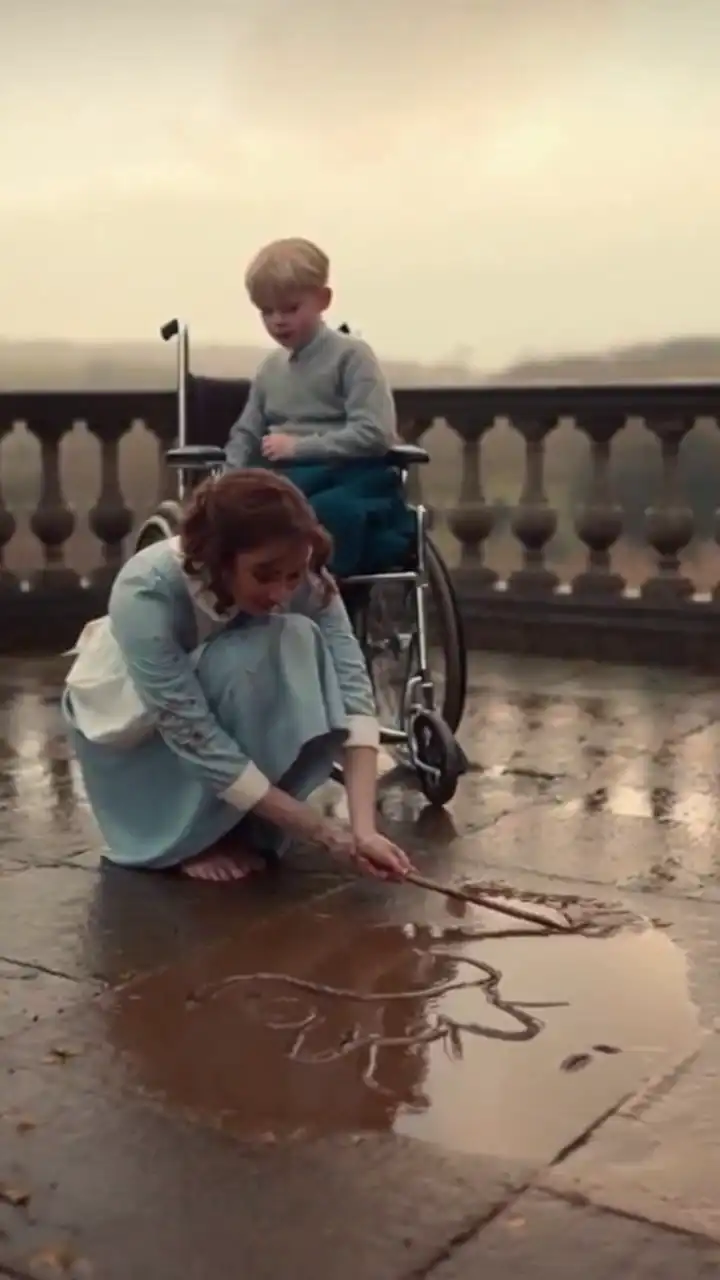
WHEN THE BILLIONAIRE’S SON DRAGGED HIS USELESS LEGS INTO THE MUD FOR THE FIRST TIME, HIS FATHER’S GIRLFRIEND SCREAMED FOR THE NANNY TO STOP
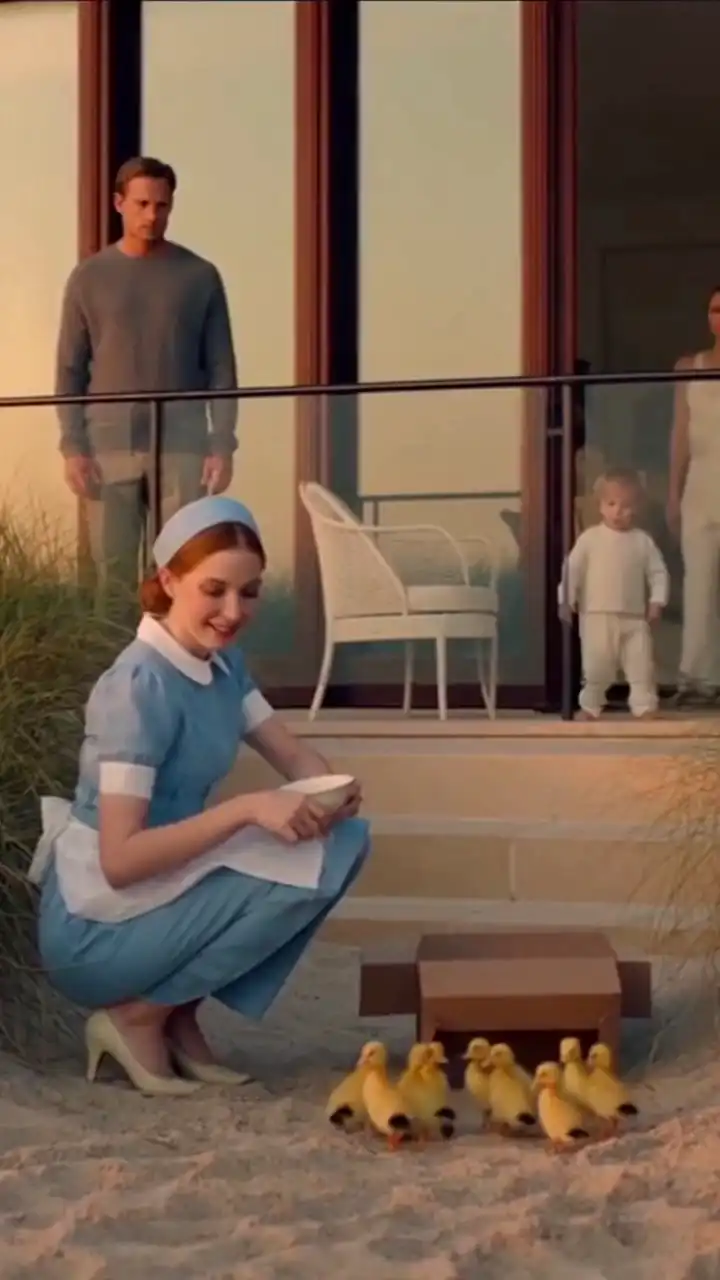
THE NANNY WHO BROUGHT DUCKS TO THE OCEAN HOUSE AND MADE A CHILD WALK TOWARD LIFE

WHEN THE RICHEST MAN ON THE HILL HIRED THE WRONG NANNY, HIS SILENT SON CRAWLED ACROSS THE FLOOR FOR HER