
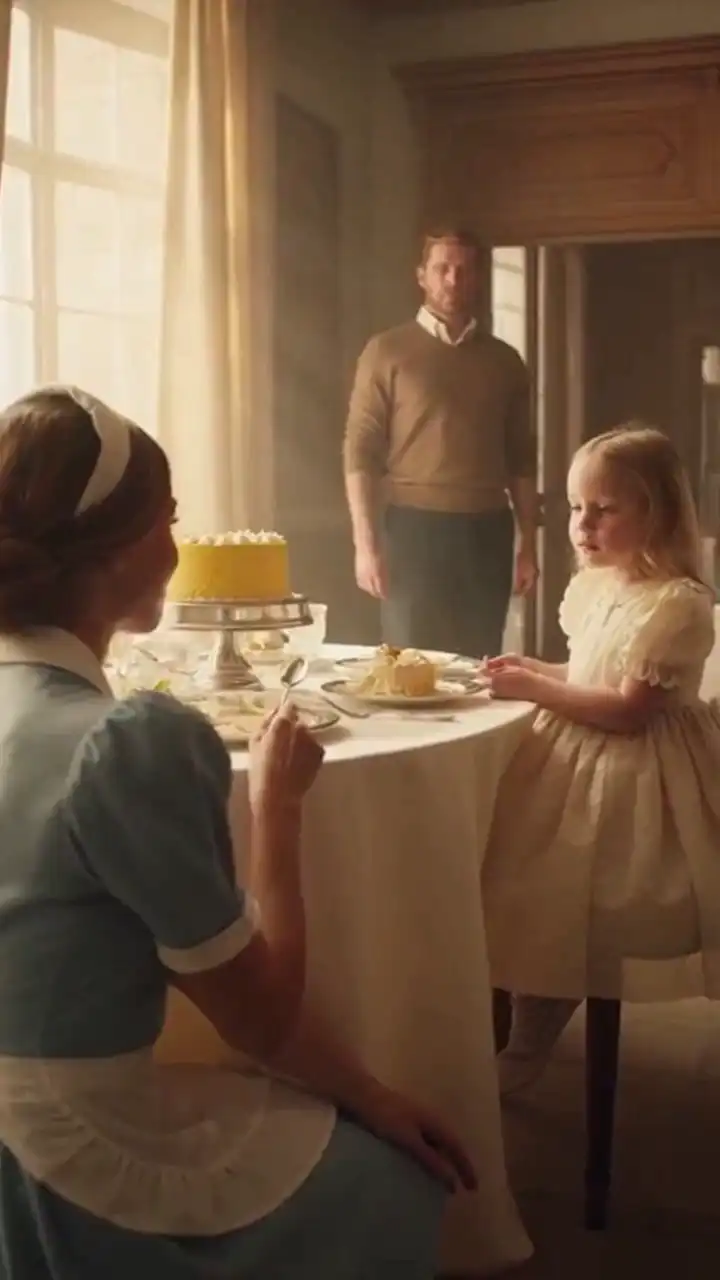
THE LITTLE MESS THAT BROUGHT A DEAD HOUSE BACK TO LIFE
The spoon shook in Sophie’s hand.
Not because it was heavy. Because she hadn’t reached for anything in so long that the movement itself looked strange, like a door opening on rusty hinges.
Daniel did not breathe.
Lily didn’t rush her. That was the first thing she did differently from every expert Daniel had hired. No praise explosion. No, “Good job, Sophie!” No adult panic dressed up as encouragement.
She just held steady.
Sophie touched the spoon, then pulled back hard, shoulders lifting toward her ears. Her eyes darted to the fog drawing on the glass, then to the white smear on Lily’s face.
Lily took another tiny bite herself.
Then she dragged the spoon lightly through the melting edge of Sophie’s bowl and drew a crooked line on the tabletop.
Mrs. Beaumont made a strangled noise. “Absolutely not.”
It was an antique French breakfast table. Daniel knew the history because he’d heard it all his life.
Lily looked at the line, then at Sophie, and added two dots and a smile.
A sticky face.
Sophie’s lips parted.
She pressed the spoon down beside the drawing and made another line.
Daniel had spent nearly a year being told to create stability, routine, low stimulation, clean transitions, careful language. Every room in the house had become softer, quieter, safer, and somehow more dead.
Now his daughter was making a mess on imported wood and paying attention.
“Get cloths,” Mrs. Beaumont hissed to a maid.
“No,” Daniel said.
It came out before he had time to think.
Everyone looked at him, including Lily.
He had not said no to his aunt in this house since the funeral.
Mrs. Beaumont’s chin lifted. “Daniel.”
“She’s using her hand,” he said, and hated how desperate he sounded. “Leave it.”
That afternoon, Sophie regressed so hard Daniel thought the miracle had broken.
That was the second thing nobody had prepared him for: trauma did not move in a straight line. The laugh had happened, yes. The reach had happened. But by lunch Sophie was back in her room under the window seat, knees to chest, face turned to the wall. When Lily entered, Sophie kicked once at the air and clamped both hands over her ears.
The old Daniel would have taken this as proof the morning had been too much.
Mrs. Beaumont did.
“She was overstimulated,” she said. “The girl pushed her. Of course this would happen.”
Daniel almost believed it, because control had always sounded intelligent in his family.
But Lily came downstairs with a red mark on her wrist where Sophie had knocked away her hand, and instead of defending herself, she asked, “What happened the day her mother died?”
The question landed hard.
Daniel had told doctors, lawyers, insurance people, school administrators, and one magazine editor who wanted to run a tasteful piece after the memorial donation. He had never answered it in his own kitchen with melted ice cream still drying on the table.
“It was raining,” he said.
Lily waited.
“We were supposed to all go to Connecticut. I stayed behind for a board call. My wife took Sophie alone.” His voice flattened the way it always did over this part. “There was a jackknifed truck. Sophie was in the back seat. She was trapped there with her for forty-three minutes before emergency services got her out.”
Lily closed her eyes for half a second.
Not dramatic. Not performative. Just taking in the shape of it.
“And after?” she asked.
Daniel looked toward the stairs. “After, everyone told her she was safe.”
Lily nodded once. “She probably was safe. But her body didn’t agree.”
Mrs. Beaumont, still in the doorway, said, “She needs structure, not amateur theories.”
Lily turned to her with a calm Daniel hadn’t expected. “Children like Sophie don’t come back because a room is clean. They come back when their nervous system stops feeling ambushed by every feeling they can’t control.”
The aunt’s expression hardened. “You have known her for six hours.”
Lily answered, “And in six hours she laughed.”
That should have sounded arrogant. It didn’t. It sounded like fact.
Daniel let Lily stay.
The next morning she did something else the house found offensive.
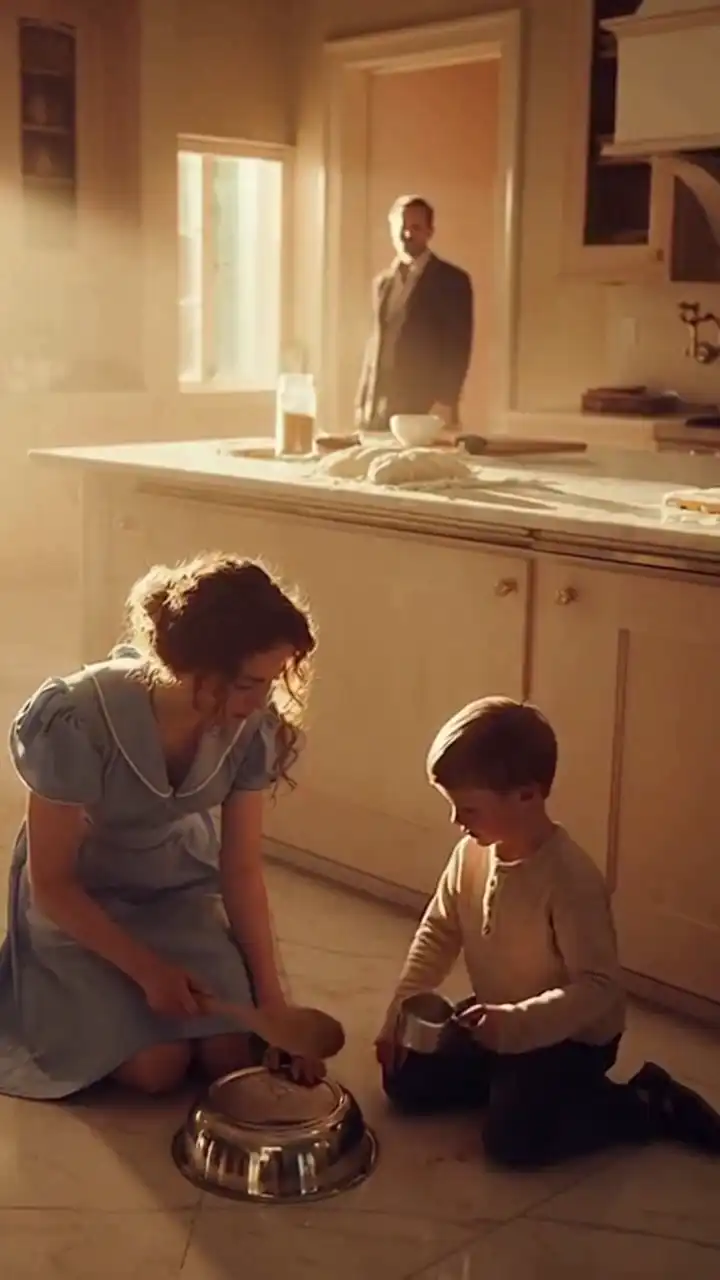
Instead of bringing Sophie to the schoolroom where every toy had been sorted into pale bins by category, Lily opened the kitchen pantry and pulled out cheap paper cups, a squeeze bottle of chocolate syrup, a bag of marshmallows, and a can of whipped cream the staff normally never served the family.
Mrs. Beaumont stared at the counter as if witnessing vandalism.
“What is all this?”
“Snack,” Lily said.
“This is junk.”
“This is fun.”
Sophie stood in the doorway in her socks, eyes flat, arms folded tight. She still had long stretches where she vanished inside herself. That morning was one of them.
Lily shook the whipped cream can. “This could go very wrong.”
No response.
She squirted some straight onto her own wrist by accident on purpose. Then onto the counter. Then she gasped like a scandalized cartoon and wiped it with the back of her hand, leaving a white streak on her nose.
Sophie blinked.
Lily poured hot cocoa too fast, let it spill over the cup, and whispered to the puddle, “You had one job.”
The cook turned away to hide a smile.
Sophie took one step closer.
That became Lily’s method: not demanding performance, but making the room survive small mistakes.
Dropped napkin? No problem.
Spilled milk? Wipe and continue.
Crooked sandwich? Better.
A child whose world had shattered inside twisted metal was being shown, over and over, that disorder no longer had to mean disaster.
It was so simple Daniel wanted to hate himself for missing it.
For months every adult around Sophie had tried to prevent the wrong sensation. No sharp noises. No rushed movement. No chaos. No surprises.
But grief had made the whole house feel like one giant held breath. Even kindness arrived stiffly, with caution all over it. Every face around Sophie said: don’t break further.
Lily’s face said something else.
Oops. Try again. Still here.
Three days after the ice cream, Daniel came home early from the city and heard a sound in the west hall that didn’t belong in his house.
Scraping.
Then a whisper-laugh.
He followed it to the library corridor and stopped.
Lily was on all fours on the Persian runner, crawling backward like a crab. Sophie, also on the floor, was following her. Not smiling widely, not healed, not transformed into a different child. But following.
Her hair had fallen into her face. Her palms were flat on the carpet. Her eyes were locked on Lily.
“Slow crab race,” Lily whispered. “Very elite sport.”
Daniel leaned against the doorway because his knees had gone weak.
Then a grandfather clock chimed the quarter hour.
The sound snapped through Sophie like a wire. Her whole body jerked. Her mouth opened but no sound came. She scrambled backward so fast her heel caught the rug, and she hit the baseboard hard.
Daniel rushed forward.
Wrong move.
She flinched from him with pure terror.
The look on her face cut deeper than anything he had endured since the funeral. Not because she was upset. Because in that second he saw what he had become to her: another large adult body arriving fast when her world already knew what fast could do.
Lily reached one arm out, low and loose, not touching Sophie.
“It scared you,” she said quietly. “That clock was too loud.”
Not “you’re okay.”
Not “it’s alright.”
Just truth.
Sophie’s breath came in tiny, shallow catches.
Lily lowered herself all the way to the floor and put her own cheek against the rug. “Floor’s still here,” she murmured. “Rug’s still ugly. Wall’s still boring. Lily’s still here.”
Daniel would later remember that ridiculous line for the rest of his life, because it worked.
Not instantly. Not cleanly. But Sophie’s eyes moved from the clock to the rug fibers near Lily’s face. Then to Lily’s hand. Then to the wall.
Her breathing slowed one notch.
Then another.
Lily stayed there for ten full minutes.
Daniel stayed too, on the opposite side of the hall, learning how useless his old kind of authority was.
That evening he sat alone in his study, jacket off, tie loosened, staring at a framed photo from before the accident. His wife, Claire, barefoot on the lawn, laughing at something outside the frame. Sophie in her lap. Daniel standing beside them with one hand in his pocket, half turned toward a phone vibrating on the table.
He had loved them. He knew that.
But he had loved while delegating. Scheduling. Providing. Optimizing.
Claire had been the one who lay on kitchen floors and let batter get on her sleeves. Claire had made faces in steamy windows. Claire had once built a blanket fort in the formal sitting room and laughed when his aunt nearly fainted.
After Claire died, Daniel had tried to honor her by preserving everything. The routines. The house. The dignity.
He had embalmed the family instead.
He found Lily in the laundry room later, folding small towels.
“How did you know?” he asked.
She looked up. “About what?”
“That mess would help.”
She smiled faintly. “It wasn’t the mess. It was the recovery.”
He said nothing.
“My mom cleaned houses,” Lily said, smoothing a towel flat. “Single parent. We moved a lot. One apartment had a man downstairs who threw things when he drank. You could hear the crashes through the vents. My little brother used to freeze every time a pan hit the floor.”
Daniel listened.
“So I started making little accidents on purpose when he was calm. Dropped spoons. Sloshed water. Then I’d laugh, wipe it up, keep going. Nothing huge. Just enough for his body to learn that not every jolt meant danger.” She folded another towel. “Kids remember with their nerves before they remember with words.”
It was not a degree on a wall. It was lived knowledge.
And it was changing his daughter.
By the end of the first week, Sophie still did not speak. She still woke crying from dreams she could not describe. She still sometimes hid in closets or stopped eating halfway through a meal. But she also began to appear in doorways.
Watching.
Then staying.
Then joining tiny pieces of life.
She helped Lily stir pancake batter and got flour on her sweater.
She pressed her finger into the fog on the greenhouse windows and drew lopsided circles.
She let the Labrador from the estate next door lick whipped cream off her knuckles and did not pull away.
Each gain came with backlash. A laugh in the morning could mean shutdown by afternoon. A good night could mean a terrible one after.
Mrs. Beaumont called it instability.
Lily called it movement.
The real fight came ten days in.
Daniel had invited two trustees from the foundation for a quiet lunch, partly from habit and partly because he was trying to prove to himself that life could resume some normal shape. Mrs. Beaumont oversaw the dining room like a general. The silver gleamed. The flowers were changed. The old order stood at attention.
Sophie was not supposed to come in.
She hadn’t sat through a meal with adults since the accident.
But Lily, carrying a plate of grilled cheese cut into crooked stars, paused at the doorway when Sophie stopped beside her.
The room stilled.
One trustee gave Daniel a sympathetic glance, the kind wealthy people use when trying to be humane without getting uncomfortable.
Mrs. Beaumont murmured, “Not now.”
Sophie’s face went blank instantly. Daniel saw her starting to disappear.
Then the butler, trying to be helpful, dropped a serving spoon. It hit the hardwood with a crack.
Sophie jolted so violently her plate tipped. One star slid onto the carpet. Another landed upside down on the polished edge of the tablecloth.
Every muscle in the room seized.
Mrs. Beaumont stood. “Take her out.”
Lily didn’t move.
She looked at the fallen sandwich, then at Sophie.
Then, in front of trustees, staff, and Daniel’s horrified aunt, Lily calmly picked up the upside-down grilled cheese star, took a bite from the clean corner, and said, “Still tastes like grilled cheese.”
One of the trustees actually laughed.
Not mocking. Just startled.
Sophie stared.
Lily crouched and picked up the other piece from the carpet before a maid could rush in with panic. “This one, however, has chosen a different life.”
A tiny sound escaped Sophie’s nose.
Then another.
Daniel watched his daughter fight it, lose, and laugh in the middle of a formal lunch.
The room broke with her.
Not chaos. Not scandal. Something better. Air.
Even one trustee smiled. The cook in the hall covered her mouth. A maid looked down because she was crying.
Mrs. Beaumont sat back slowly, and for the first time since Claire died, she looked old instead of formidable.
Because the authority she had built in this mourning house was based on one idea: that order was the same thing as care.
And everyone had just seen that it wasn’t.
After lunch, Daniel found his aunt in the blue parlor.
“You’re letting a servant turn this family into a spectacle,” she said.
He surprised himself by answering without heat. “No. I let this family turn into a mausoleum.”
Her eyes flashed.
“I was trying to help,” she said.
“I know,” he replied. “But helping Sophie disappear quietly is not helping.”
The next morning he did something no one expected, least of all Lily.
He canceled two meetings, took off his watch, went into the kitchen, and asked, “What’s today’s disaster?”
Lily looked at him for a long second, then handed him a mixing bowl.
“Pancakes,” she said. “High risk.”
He almost smiled.
Sophie was at the table. She watched him crack the first egg too hard and get shell into the batter.
He stiffened automatically, reaching for perfection.
Lily touched his wrist lightly. “Leave it.”
He looked at her.
Then, in front of his daughter, Daniel Vale picked out half the shell, shrugged at the rest, and kept stirring.
Sophie’s eyes lifted to his face.
It may have been the first time she had ever seen her father make a mistake without turning cold around it.
The real breakthrough came from fear.
A week later a summer storm rolled over the estate, sudden and loud. Thunder hit so close the windows rattled.
Sophie dropped to the floor and covered her head.
Daniel was in the foyer. He started toward her, stopped himself, and lowered instead.
Lily was beside Sophie in seconds, not touching, just near.
“Big sound,” she said.
Another crack of thunder. Sophie let out a raw, trapped noise.
The old panic rose in Daniel’s chest, the need to fix, contain, command.
Instead he got down on the floor too, three feet away.
Rain lashed the windows.
Lily exhaled onto the marble entry tile, absurdly, making a tiny fog patch from the cold air near the threshold where the storm had blown in. She drew a crooked smiley face with her fingertip.
Daniel understood instantly. Not a distraction. A bridge.
He looked around, found the silver umbrella stand, and tapped it lightly with a spoon.
Once.
Then waited.
Another tiny tap.
Predictable. Small. Chosen sound.
Lily glanced at him with surprise and approval.
Sophie’s fingers loosened from her hair.
Thunder boomed. Daniel tapped the stand again after it passed. One little chime in answer, like the house itself was learning a new language.
Sophie’s breathing staggered, then steadied.
Lily rolled a clementine gently across the floor toward Daniel. He rolled it back.
Again.
Again.
A stupid little game on marble in a million-dollar foyer while rain beat the windows.
Sophie’s eyes tracked the orange ball of color.
Then, slowly, she pushed herself forward on her knees and rolled it back to Lily.
Daniel felt something crack open so sharply inside him he had to look down.
Lily smiled at Sophie but said nothing.
The storm eased.
Water ticked from the gutters outside.
And in the soft quiet after thunder, Sophie looked straight at her father for the first full second he could remember since the accident.
Her lips trembled.
He did not move too fast. Did not reach.
He just stayed where he was, open and terrified.
Sophie swallowed once and whispered, hoarse and small, “Again.”
It was her first word in eleven months.
Not Mama.
Not no.
Again.
Lily covered her mouth. Daniel closed his eyes because tears had come too fast.
Then Sophie rolled the clementine toward him one more time.
Again became the rule of the house.
Again pancakes.
Again fog faces on windows.
Again crawling races down inappropriate hallways.
Again cocoa with too much whipped cream.
Again sitting through hard moments instead of sealing them away.
Sophie did not heal in a miracle line. She still had setbacks. There were doctor visits, difficult nights, quiet relapses, tears in closets, days when the old freeze returned. But now the house knew what to do when she went away.
Not crowd.
Not perform.
Stay. Ground. Repair. Continue.
Daniel changed with her. Staff noticed first.
He came home earlier.
He ate in the kitchen sometimes.
He stopped correcting every spill.
He once let Sophie stir berry jam with a wooden spoon while standing on the marble counter island in stocking feet, an image that would have given his late grandmother apoplexy.
Mrs. Beaumont tried for a while to maintain the old code. Napkins. Scheduling. Proper rooms for proper activities.
Then one Sunday morning she walked into the conservatory and found Sophie asleep with her head in Lily’s lap, Daniel reading on the floor nearby, and a trail of paper cups, crayons, and orange peels across the rug.
No one leaped up to restore appearances.
No one apologized.
Even the light in the room felt different.
She stood there longer than usual. Then she quietly picked up an empty cup and took it to the trash.
That was all. But it was surrender.
By fall, Sophie could manage half days at her private school with support. She still sometimes pressed herself against walls when hallways got too loud. She still preferred windows, corners, and Lily’s steady presence. But she also laughed now. Often enough that staff no longer stopped in doorways to listen in disbelief.
One afternoon Daniel found Sophie in the kitchen with finger paint on her sleeve and ice cream on her chin. Lily was beside her, trying not to laugh.
Sophie looked up and held out a spoon to her father.
An invitation.
He took a bite.
She studied him very seriously, then smeared a dot of vanilla on his cheek.
Lily gasped theatrically. “Sir. A scandal.”
Sophie grinned.
Daniel, heir to a polished old family that had hidden every ugly thing behind doors and money, dipped his finger into the melting ice cream and put a white streak on his own nose.
Sophie laughed so hard she had to grab the counter.
The sound traveled all the way down the hall.
That winter, on the first birthday of Claire’s after the accident, the house was set again with flowers and cake.
But this time the kitchen was noisy. Butter softening on the counter. A radio playing low. Sophie licking frosting off a spoon. Daniel letting her. Lily frosting one side of the cake badly on purpose so Sophie could “fix” it with extra swirls.
When it was done, they carried it to the sunroom together.
No one whispered.
No one acted like joy was betrayal.
Daniel lit the candles and looked at the two people who had taught him what all his power had failed to do.
Then Sophie, with frosting still near her mouth, reached for Lily’s hand with one hand and for her father’s with the other.
The old house did not become simple. It became alive.
And for the first time since the crash on the rainy highway, warmth did not feel like disrespect to the dead.
It felt like the only way to love them.
Disclaimer: Mention of any brand or trademark is for identification only and does not imply partnership or endorsement
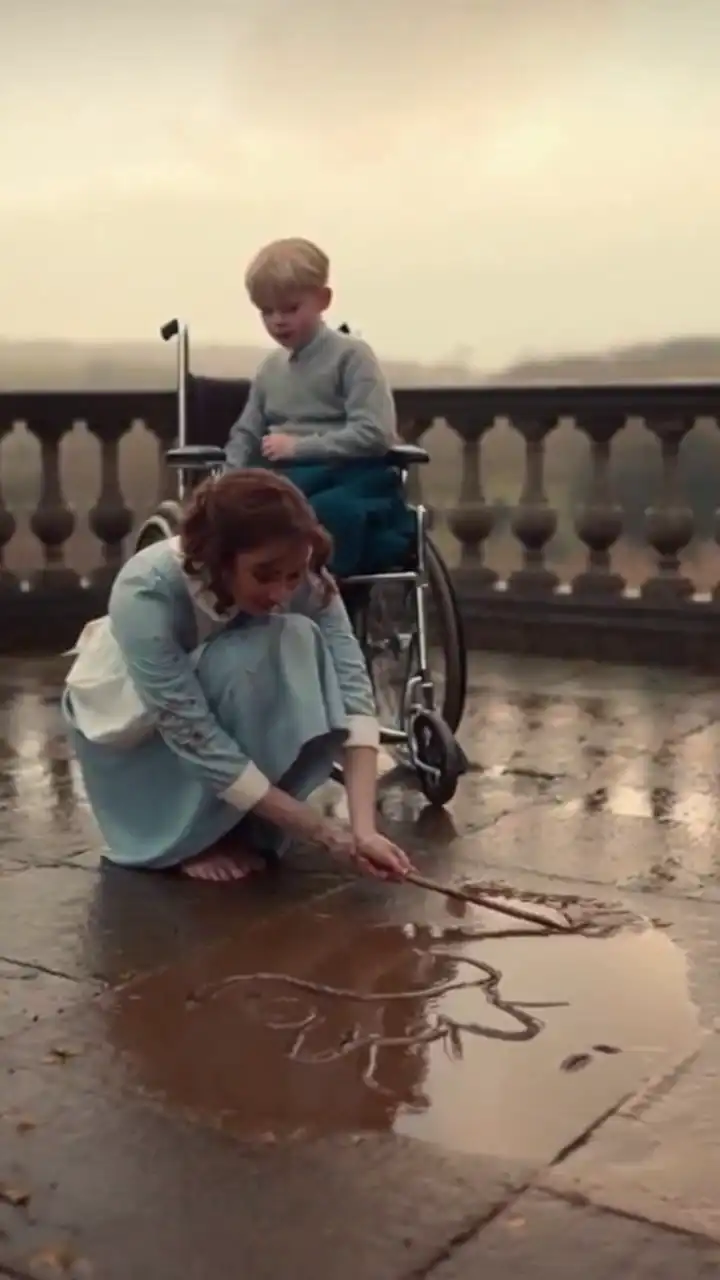
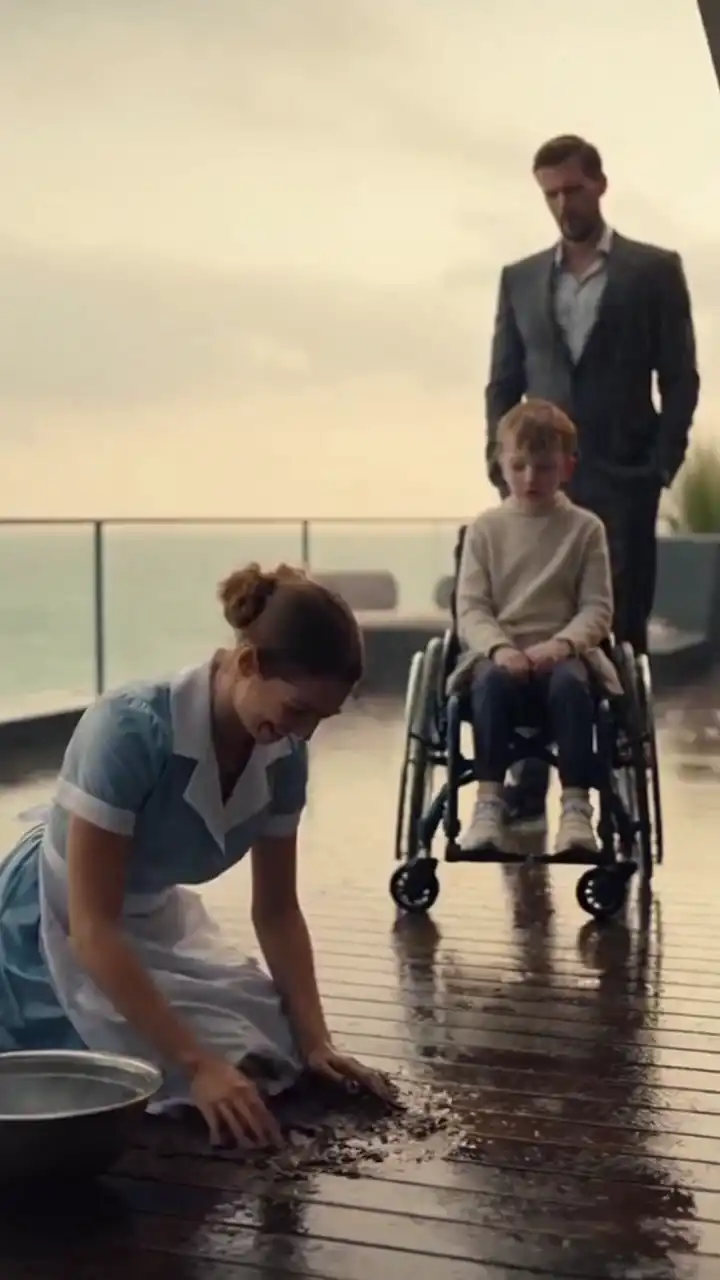
WHEN THE BILLIONAIRE’S SON DRAGGED HIS USELESS LEGS INTO THE MUD FOR THE FIRST TIME, HIS FATHER’S GIRLFRIEND SCREAMED FOR THE NANNY TO STOP

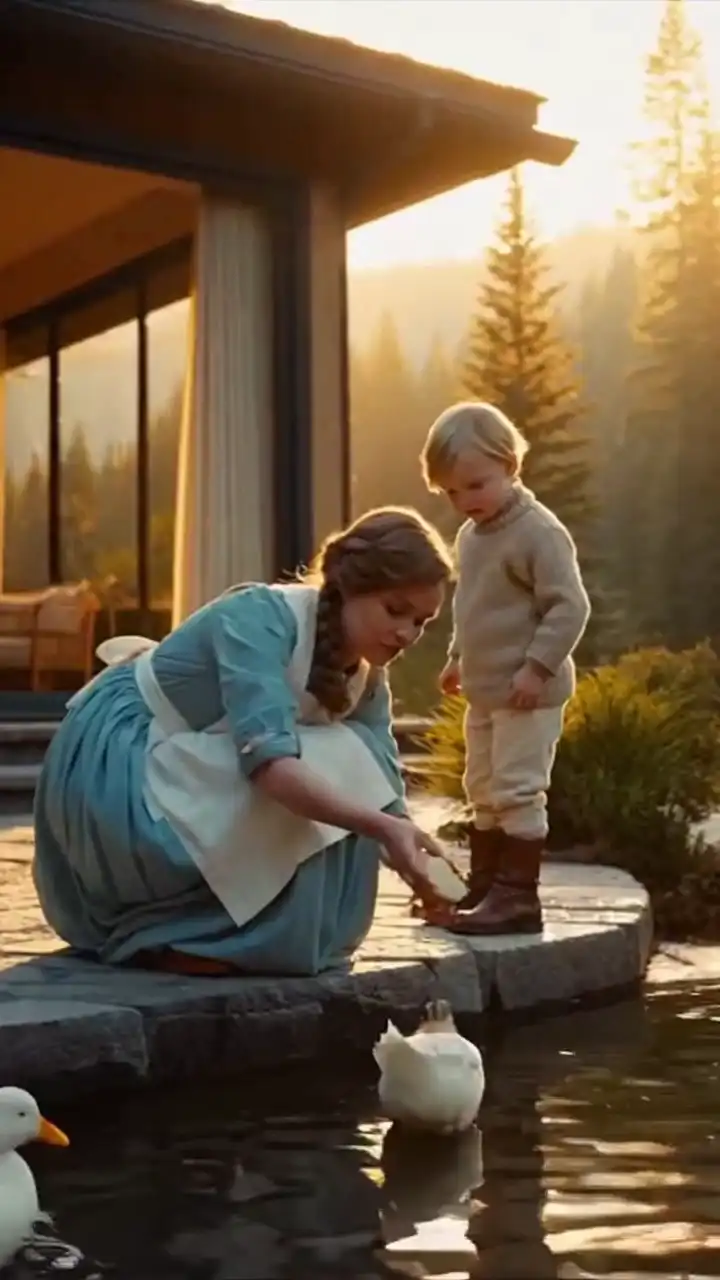
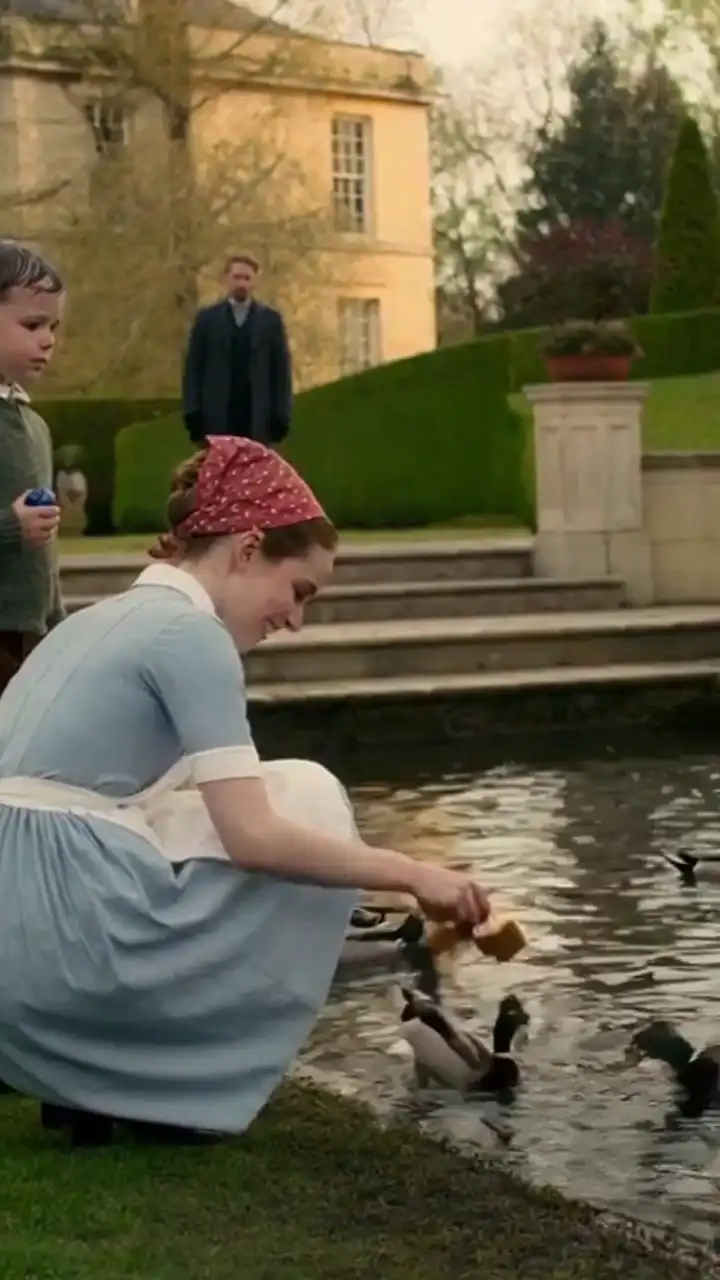
THE NANNY WHO BROUGHT DUCKS TO THE OCEAN HOUSE AND MADE A CHILD WALK TOWARD LIFE

WHEN THE RICHEST MAN ON THE HILL HIRED THE WRONG NANNY, HIS SILENT SON CRAWLED ACROSS THE FLOOR FOR HER