
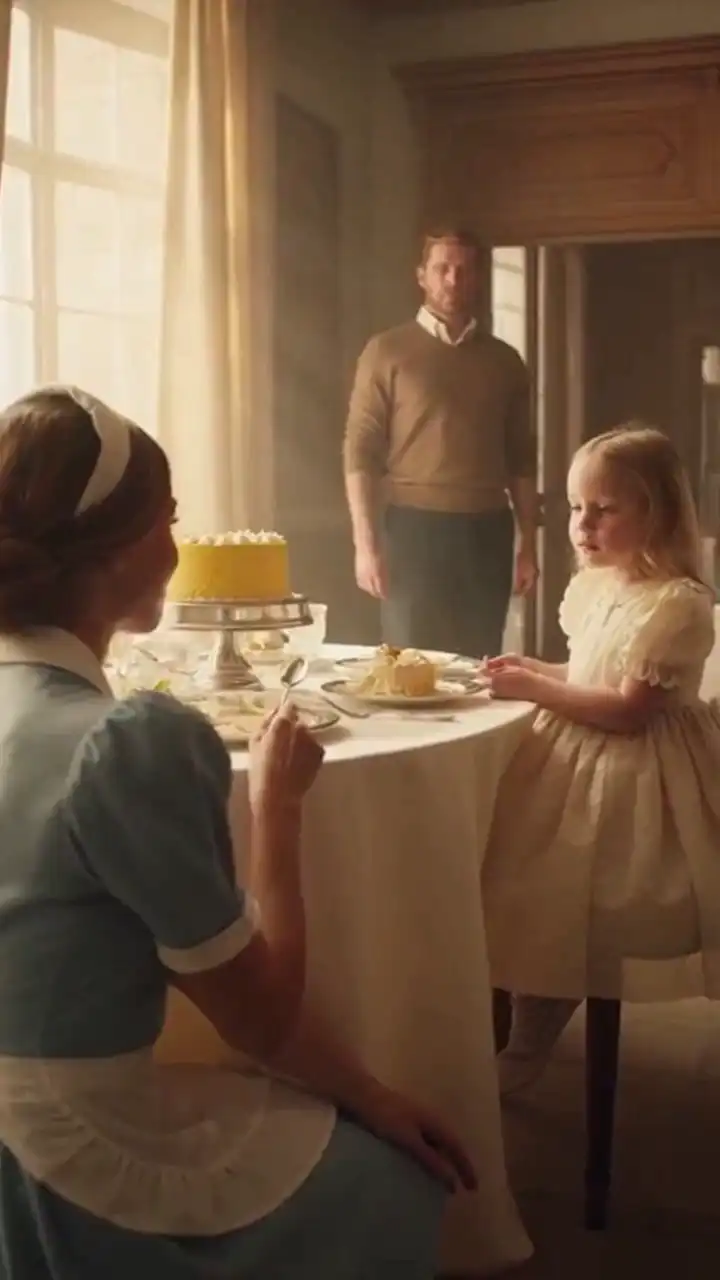


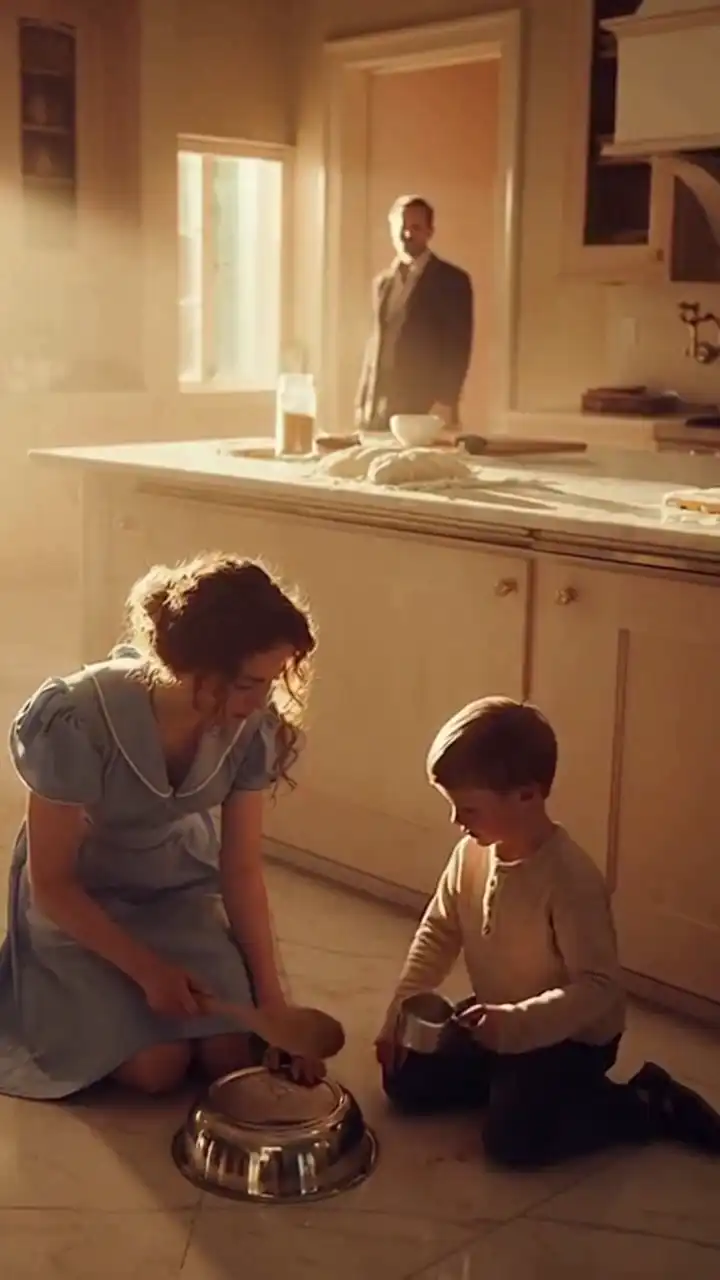
THE YOUNG NANNY BANGED ON POTS IN A MILLION-DOLLAR KITCHEN—AND THE SILENT BOY SPOKE FOR THE FIRST TIME
The word hung in the kitchen long after the sound itself was gone.
No.
For most families, it would have been nothing. A stubborn little refusal. A child being difficult.
Inside Ethan Hale’s house, it landed like a miracle.
Oliver had not spoken in eleven months.
Not at school. Not in therapy. Not to his father. Not when he had a fever. Not when he woke shaking from bad dreams and stood in the doorway of the master suite, silent as a ghost, until a maid noticed him.
And now he had spoken to stop Vanessa from taking away two dented measuring cups.
Vanessa recovered first. “That was a sound,” she said sharply. “Let’s not turn this into theater.”
Ethan looked at her as if he had never seen her clearly before.
Oliver’s shoulders had gone stiff again. His hand tightened around the cup. His eyes dropped to the floor.
Lily set the spoon down and crouched, keeping her distance. “No one’s taking them,” she said, not asking anything from him.
The boy’s breathing slowed.
That mattered more to Ethan than Vanessa’s opinion, the chef’s nerves, or the polished order of the house.
“Everyone out,” Ethan said.
The kitchen staff scattered. Vanessa didn’t move.
“Ethan,” she said in a low voice, “you cannot let a random girl from the service entrance bang around your kitchen and experiment on your son.”
Lily stood up then, clearly ready to leave. “I didn’t come here for this.”
Oliver made a second sound, smaller than the first.
“Stay.”
It was breathy and broken, but it was there.
Ethan shut his eyes for one second, because if he didn’t, he might actually lose control in front of everyone.
When he opened them, he said, “Lily stays.”
Vanessa stared at him. “Over my objection?”
“Over everyone’s objection.”
That was how it started.
Not with a contract. Not with a perfect plan. Just with a silent boy speaking twice in one afternoon and a billionaire father so desperate he was willing to break his own rules.
Lily was not trained the way the others had been. She had done part of an art education degree before leaving school to care for her sick mother, then pieced together work wherever she could—children’s classes, bakery help, event painting, elder companion shifts. She understood rhythm, texture, hands, repetition. She understood what people did when words were too much.
She told Ethan that evening, standing at the far end of his enormous study, “He doesn’t trust questions.”
Ethan, exhausted and raw, asked, “How do you know that after one hour?”
“Because every person around him is waiting for performance,” she said. “Look at me. Look here. Say this. Answer that. He hears pressure before he hears love.”
No one had spoken to Ethan that plainly in years.
He should have been offended.
Instead he asked, “And the kitchen?”
“He reacted to rhythm before he reacted to people. Kitchens are honest. Sound means something there. Tap means bowl. Whisk means batter. Dough means hands. Nothing in there asks him to be fixed.”
That night, Ethan watched from the doorway while Lily sat on the tile floor with Oliver again.
She didn’t demand eye contact.
She lined up wooden spoons, silicone spatulas, lids, muffin tins, and two overturned mixing bowls. She made a pattern. Tap-tap. Pause. Slide. Tap.
Oliver listened.
Then he copied one piece of it.
Lily copied him back.
That was the game.
Not instruction. Not correction. A shared build.
He made a sound with a spoon. She answered with a lid. He dragged metal lightly against tile. She turned it into tempo. At one point he tapped too hard, startled himself, and froze. Lily just lowered the whole room with her own hands, softer, slower, until his shoulders dropped again.
For nearly forty minutes, he stayed.
That was longer than he had stayed present with anyone in months.
The next morning Vanessa tried to stop it.
She came into breakfast in cream silk and cold anger, carrying a list from Oliver’s therapist. “He has a schedule. Sensory regulation at nine. Guided language cues at ten. Controlled outdoor exposure at eleven. You can’t simply replace medical structure with kitchen games.”
Lily was rolling dough on the island with Oliver standing on a low stool beside her. He wasn’t helping much yet. Just pressing two fingers into the flour and watching the marks stay there.
Lily didn’t answer.
Vanessa turned to Ethan. “Say something.”
Ethan looked at his son’s hands. White flour on pale skin. Two tiny finger dents in a sheet of dough. Oliver was watching them like they mattered.
No tablet had done that. No specialist worksheet had done that.
“He’ll keep the schedule that works,” Ethan said.
Vanessa heard the insult in that.
From then on, the resistance changed shape.
It wasn’t loud all the time. Vanessa was too polished for that. She fought through rules, tone, and class lines.
She complained that Lily was too familiar.
She complained that Oliver’s clothes got dirty.
She complained that the kitchen no longer looked “presentable” by noon.
She told the house staff not to indulge “these improvised sessions.”
She replaced the metal bowls with decorative ceramic ones too fragile to play with.
Lily found stockpots in the pantry.
She sent the old aprons to storage.
Lily tied one of the cook’s oversized aprons around Oliver twice and rolled the straps into knots.
She told the staff to keep the radio off in the kitchen because “the child needs quiet.”
Lily opened a drawer and made rhythm from wooden tools alone.
The more Vanessa pushed for control, the more obvious it became that what she wanted was not Oliver’s healing. She wanted the house to look healed.
That difference started to shame Ethan.
He had built his whole life around solutions that could be measured, managed, outsourced. If a team failed, he hired better. If a system broke, he bought a stronger one.
But grief had entered his home and sat down at his own table, and his answer had been to keep handing his son to professionals while he buried himself in work.
He had called it providing.
Lily, with flour on her sleeves, called it absence without ever using the word.
The biggest change came through repair.
On the fifth day, Oliver was at the kitchen table with Lily and a box of chipped wooden utensils she had asked the staff not to throw away. She let him sort them by sound. Hollow, flat, dull, bright. A game only half visible to anyone who didn’t understand what she was doing.
One spoon had a cracked handle wrapped in old tape.
Oliver picked it up and stared at the split.
Lily didn’t reach for a new one. She brought over glue, sandpaper, and blue painter’s tape.
“We can fix it,” she said.
He looked at her, then at the spoon.
That was all.
They sat there together while she sanded the rough edge and guided his hand to hold the tape steady. Not hand over hand, not forcing. Just offering. Letting him choose each tiny contact.
The spoon mattered because his mother had once let him drum with kitchen tools while she cooked during the worst months of her illness. Ethan knew that suddenly, with a punch of memory so hard he had to grip the back of a chair.
Mara had laughed when Oliver beat on a pot. Ethan had asked them to keep it down because he had a call.
That memory nearly broke him.
Oliver pressed the tape down with fierce concentration. Then he tapped the repaired spoon against the table.
One sound.
Then another.
Lily answered from the bowl.
Tap. Tap.
Oliver’s lips parted.
“Mama.”
The room stopped.
Not because anyone spoke. Because no one dared move.
He wasn’t crying. That was the hardest part. He said it like a finding. Like he had reached into wreckage and touched something still there.
Lily’s eyes filled, but she kept her voice even. “Did she do this with you?”
Oliver swallowed. His throat worked visibly.
Then, hoarse and slow, he said, “Mama... cook.”
Ethan made a sound that did not belong in boardrooms or investor calls or the life he had built. It came out of him rough and helpless.
He turned away too late.
Lily looked up and saw him wipe his face with the heel of his hand like a man who no longer cared who saw.
That night he sat in Oliver’s room for the first time in months without trying to make the boy talk. He just sat on the rug near the window seat while Oliver held the repaired spoon and tapped it softly against his knee.
After a while, Ethan said, “I should have come in here more.”
Oliver didn’t answer.
Ethan continued anyway. “I thought if I kept everything stable, it would help. I thought if I brought in the best people...” He stopped and looked at the floor. “I was wrong.”
Oliver still said nothing.
But he didn’t leave.
That became Ethan’s education.
Presence without extracting.
The next week Lily expanded the kitchen sessions into small rituals that made the house feel less like a museum and more like somewhere a child could live.
Morning batter mixing.
Fruit washing in a metal colander with splash sounds Oliver liked.
A “quiet beat” before lunch using fingertips on the underside of the table.
Dough nights every Thursday.
Evening tea steeping with cups lined up by tone.
Sometimes Oliver spoke. Mostly single words.
“More.”
“Hot.”
“Blue.”
“Again.”
Sometimes he only hummed the pattern back.
That hum nearly wrecked Ethan every time.
Because it wasn’t perfect, and it didn’t need to be.
Vanessa, meanwhile, was losing ground.
The first real public shift happened at a small dinner she had organized for a foundation couple and a private school board member. She had planned the evening for weeks, hoping to restore normality, image, control.
She specifically instructed the staff to keep Oliver upstairs.
Halfway through cocktails, a soft metal tapping drifted in from the back corridor.
Then another.
Then the unmistakable rhythm of bowl, spoon, pause, spoon.
Guests turned.
Vanessa’s smile locked in place.
Oliver walked into the breakfast room doorway wearing a child’s apron over pressed trousers, Lily a step behind him but not leading him. He was carrying a tray of uneven dinner rolls he had helped shape.
He looked terrified.
He also kept walking.
Ethan rose so fast his chair scraped.
Vanessa hissed, “This is not the moment.”
But Oliver reached the table, looked at the rolls, then at his father, and whispered, “Made.”
One of the guests put a hand over her heart.
Ethan took a roll with shaking fingers. “You made these?”
Oliver nodded once.
It was the first time he had ever brought something into a room full of adults instead of hiding from them.
Vanessa laughed tightly. “How adorable. Lily, take him back before he gets overwhelmed.”
Oliver’s hand went backward without looking.
Lily was there, and he caught two of her fingers.
It was a small gesture.
It ended everything Vanessa thought she controlled.
The guests saw it. The staff saw it. Ethan saw it.
The child had chosen who felt safe.
After the guests left, Vanessa exploded.
In the blue sitting room, with the doors shut and her voice no longer elegant, she said, “Do you have any idea what this looks like? The servants are discussing household decisions. Your son is attached to a kitchen girl. This entire house has become casual, noisy, embarrassing.”
Ethan was tired enough to be honest. “You’re upset because he’s healing in a way you can’t direct.”
“I’m upset because this is turning into chaos.”
He looked at her for a long moment. “No. This is turning into life.”
She went still.
That was the first sentence Ethan had spoken in months that did not belong to the man she had married.
Vanessa tried one last move. She contacted the therapy team without telling Ethan and arranged for Oliver to be evaluated for an intensive residential child program in Connecticut. Safe, elite, discreet. The sort of place powerful families used when they wanted difficult pain handled elsewhere.
Ethan found out because Oliver heard the word “leave” from the hall and shut down so hard he crawled under the kitchen table and would not come out.
Not speaking was one thing. This was worse.
He flinched when anyone but Lily came close. He covered his ears. When Vanessa approached, he made a low panicked sound that Ethan had never heard before.
Lily slid onto the floor a few feet away and did not coax him.
She reached under the table and placed one metal whisk on the tile.
Then one wooden spoon.
Then the repaired spoon.
She tapped once.
Waited.
Nothing.
She tapped the repaired spoon against the whisk in the old pattern Oliver knew from the first day.
Tap-tap. Pause. Tap.
Under the table, his breathing hiccuped.
Lily answered with the rhythm his mother used to cook to—the one Ethan now remembered hearing in the background of a hundred calls he had taken while passing through his own home.
Tap. Slide. Tap-tap.
A small hand emerged.
It grabbed the repaired spoon.
Then, from under the table, Oliver scraped out one broken word.
“Stay.”
Lily closed her eyes for half a second.
Ethan did not. He heard it all the way through himself.
He turned to Vanessa. “You did this?”
She lifted her chin. “I was trying to get him proper treatment.”
“You were trying to remove what you don’t like.”
“That girl is not family.”
Oliver struck the spoon hard under the table.
“No!”
The shout was thin, torn, and terrified.
But it was a shout.
Ethan dropped to his knees on the tile, not caring that his suit cost more than some people’s rent. “No one is sending you away,” he said, voice shaking. “No one.”
Oliver didn’t come out.
Ethan looked at Lily. “How do I fix this?”
It was the first truly helpless question he had asked another adult in years.
Lily answered quietly. “Tell the truth in front of him.”
So he did.
Still on the floor, face level with the darkness under the table, Ethan said, “I let other people make too many decisions because I didn’t know how to survive losing her. I thought keeping everything controlled would protect you. It didn’t. I am sorry.”
Silence.
Then the spoon tapped once.
Ethan kept going. “You are staying here. Lily is staying here if she wants to. And no one is sending you anywhere.”
A long minute passed.
Then Oliver crawled out.
Not to Ethan.
To Lily first.
He pressed his forehead into her side and stood there, shaking.
Lily held him carefully, one hand at his back, one at his hair.
Ethan nearly fell apart right there on the kitchen floor, but this time he stayed in the moment instead of leaving it.
Vanessa knew she had lost. Not just the argument. The moral ground. The future she imagined in that house.
Within a week, she moved into the guest wing. Within a month, she moved out entirely.
There was no screaming scene at the gate. No dramatic public disgrace. For people like Vanessa, losing looked cleaner than that.
It looked like no longer being obeyed.
It looked like staff waiting for Ethan’s instructions instead of hers.
It looked like a child turning away when she entered a room.
It looked like a husband finally understanding the difference between polish and care.
Spring moved in slowly after that.
The estate changed in practical ways first.
One corner of the giant kitchen was set up with low shelves for Oliver’s bowls, spoons, aprons, and safe mixing tools.
The formal breakfast room was used less than the kitchen table.
A chalkboard went up near the pantry for rhythm marks, shopping doodles, and the few words Oliver began writing before he could comfortably say them.
Lily stayed officially at Ethan’s request, with a contract, salary, benefits, and one thing she almost cried over in private: tuition support if she wanted to return to school.
“I’m not buying gratitude,” Ethan told her when she tried to protest.
“No,” she said carefully. “But you are changing my life.”
He answered, “You changed ours first.”
The healing wasn’t clean or total. Some days Oliver retreated again. Some words vanished for hours or days. Crowded rooms still frightened him. Grief still hit him in waves, especially when a smell or a recipe reminded him of his mother.
But now there was a way back.
Rhythm.
Hands.
Repair.
And people who stayed.
Months later, on the first evening cool enough to open the long kitchen windows, Lily was kneading dough while Oliver stood beside her, pressing blueberries into small rounds of sweet bread. Ethan came in late from the office, loosened tie, tired face.
Old Ethan would have passed through, kissed air, asked for updates, gone upstairs to take one more call.
This Ethan washed his hands and stood at the counter.
Oliver looked up.
“Dad,” he said.
Clear. Simple. Unforced.
Ethan froze.
The word was not dramatic. It was not his first ever. But it was the first time Oliver said it casually, safely, as if it belonged in the room.
Ethan put one hand on the counter to steady himself.
“Yeah?” he managed.
Oliver pushed a piece of dough toward him. “Help.”
So Ethan did.
Badly.
He ruined the first one, overworked the second, and made Lily laugh when he tried to copy Oliver’s careful thumb press and flattened an entire roll. Oliver watched, then made a small sound that turned into a laugh of his own.
Not loud.
Not long.
Enough.
The kitchen held it.
The sound bounced off copper pans and window glass and all the places silence had once sat like a weight.
Lily looked between father and son and said nothing, because she knew some scenes did not need help.
At the end of the night, after the bread was rising and Oliver had gone up calmer than usual, Ethan found Lily wiping down the counter.
“You could still go back to school full-time,” he said. “You don’t have to stay because you feel responsible.”
Lily leaned against the island. “Is that what you want?”
He looked toward the staircase. “I want what keeps him growing.”
She studied him for a moment. “Then yes. I want to stay.”
There was no dramatic confession. No rushed kiss across the granite countertop. What held more weight than that was simpler.
A place had been offered.
A place had been chosen.
In a house that once tried to solve pain by managing it away, the young woman who came in through the service entrance was no longer temporary.
She was part of the life inside it.
And upstairs, in a bedroom that had once felt sealed shut, a little boy slept with the repaired wooden spoon on his nightstand and the smell of fresh bread still in the air.
Disclaimer: Mention of any brand or trademark is for identification only and does not imply partnership or endorsement
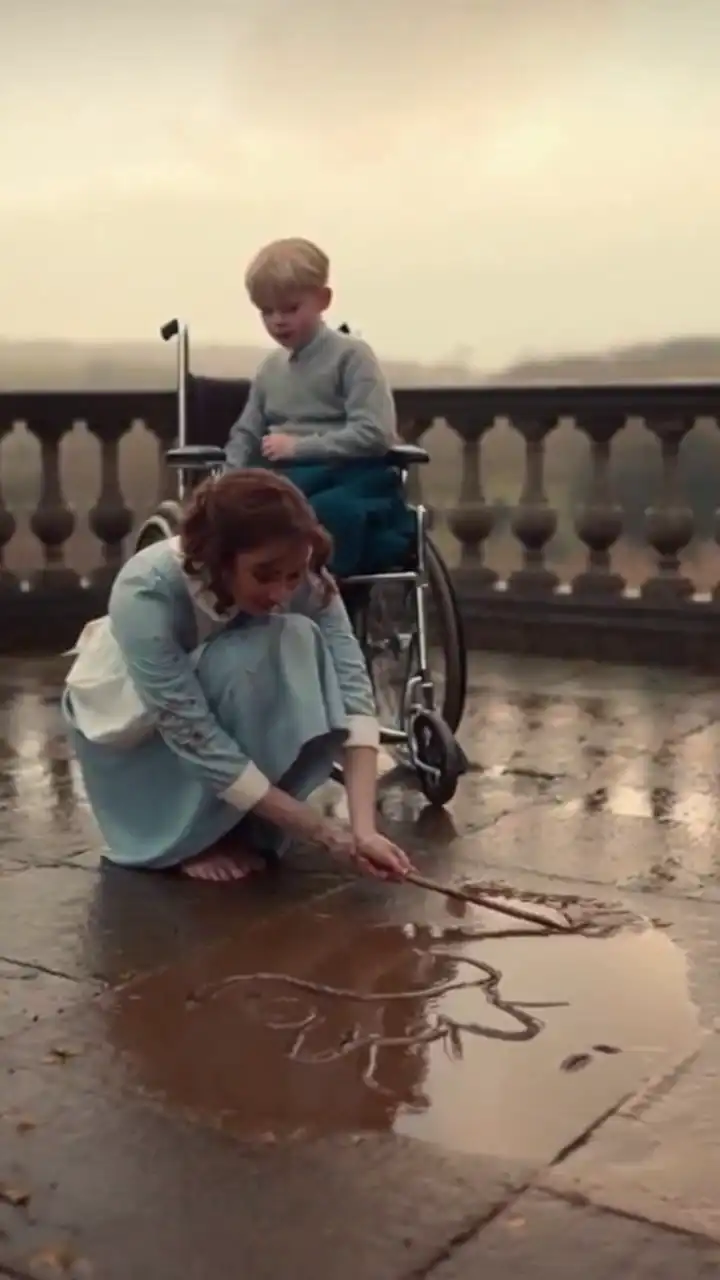
WHEN THE BILLIONAIRE’S SON DRAGGED HIS USELESS LEGS INTO THE MUD FOR THE FIRST TIME, HIS FATHER’S GIRLFRIEND SCREAMED FOR THE NANNY TO STOP

THE NANNY WHO BROUGHT DUCKS TO THE OCEAN HOUSE AND MADE A CHILD WALK TOWARD LIFE

WHEN THE RICHEST MAN ON THE HILL HIRED THE WRONG NANNY, HIS SILENT SON CRAWLED ACROSS THE FLOOR FOR HER