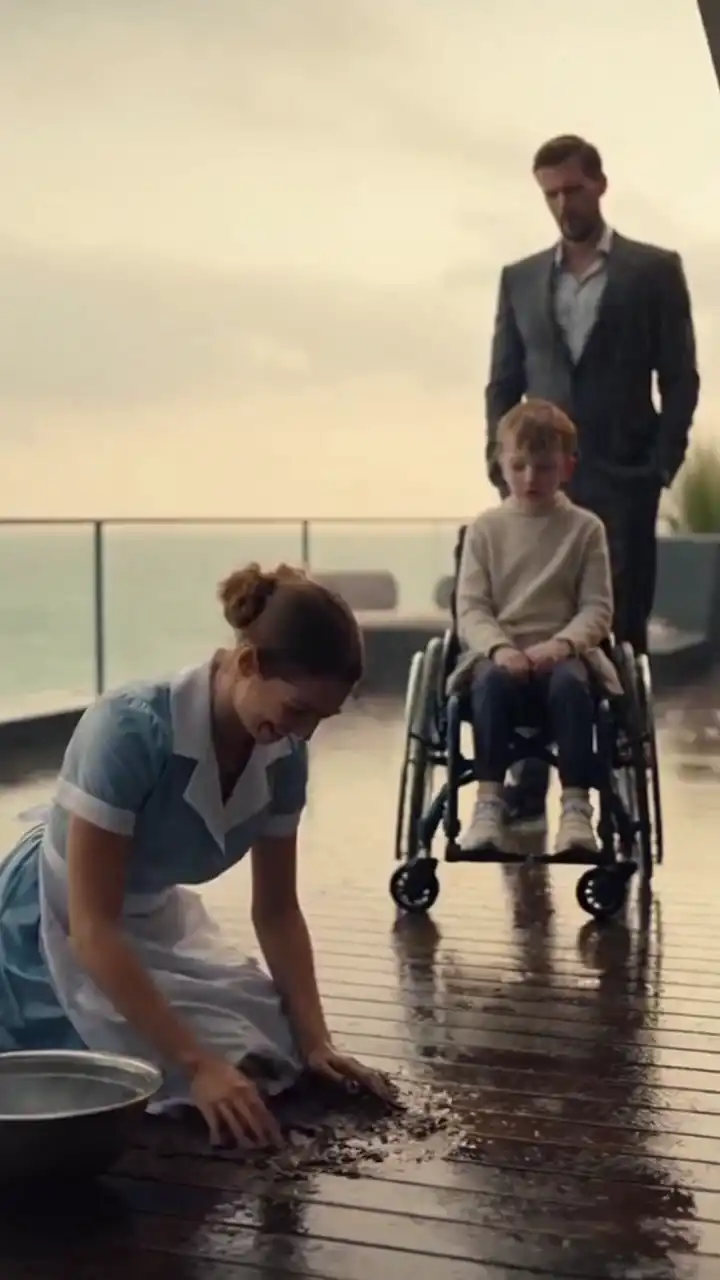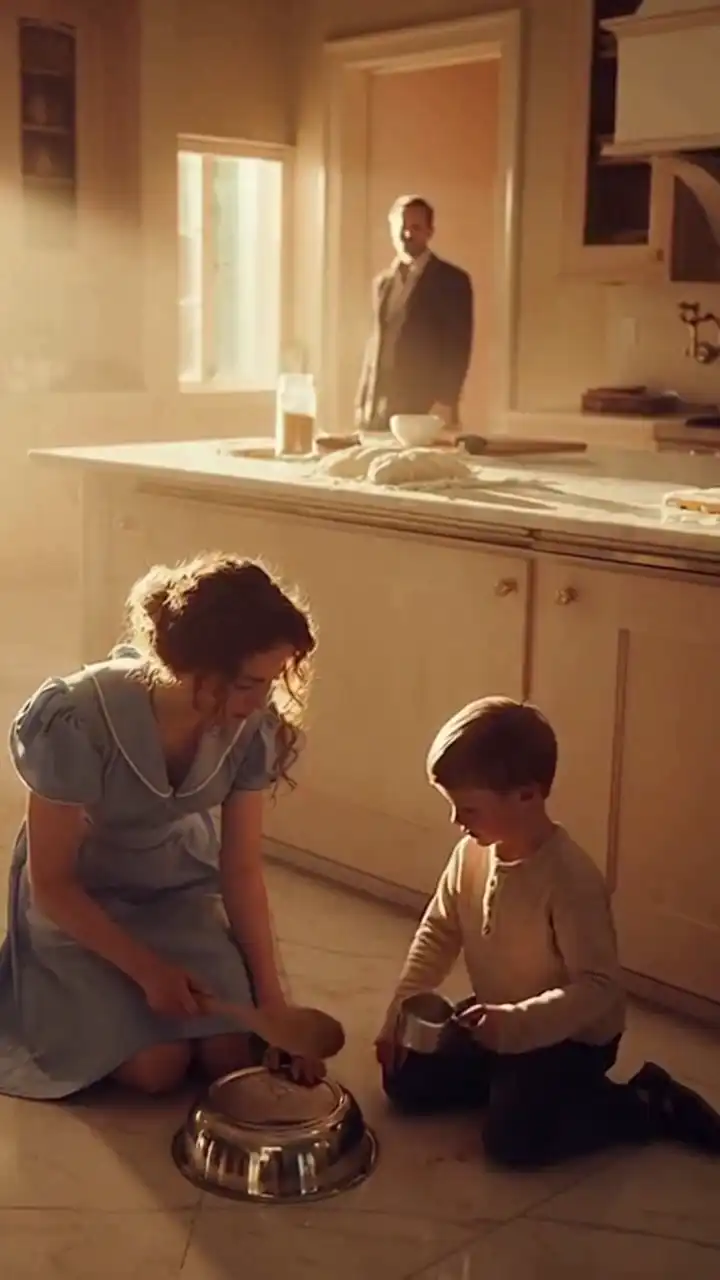
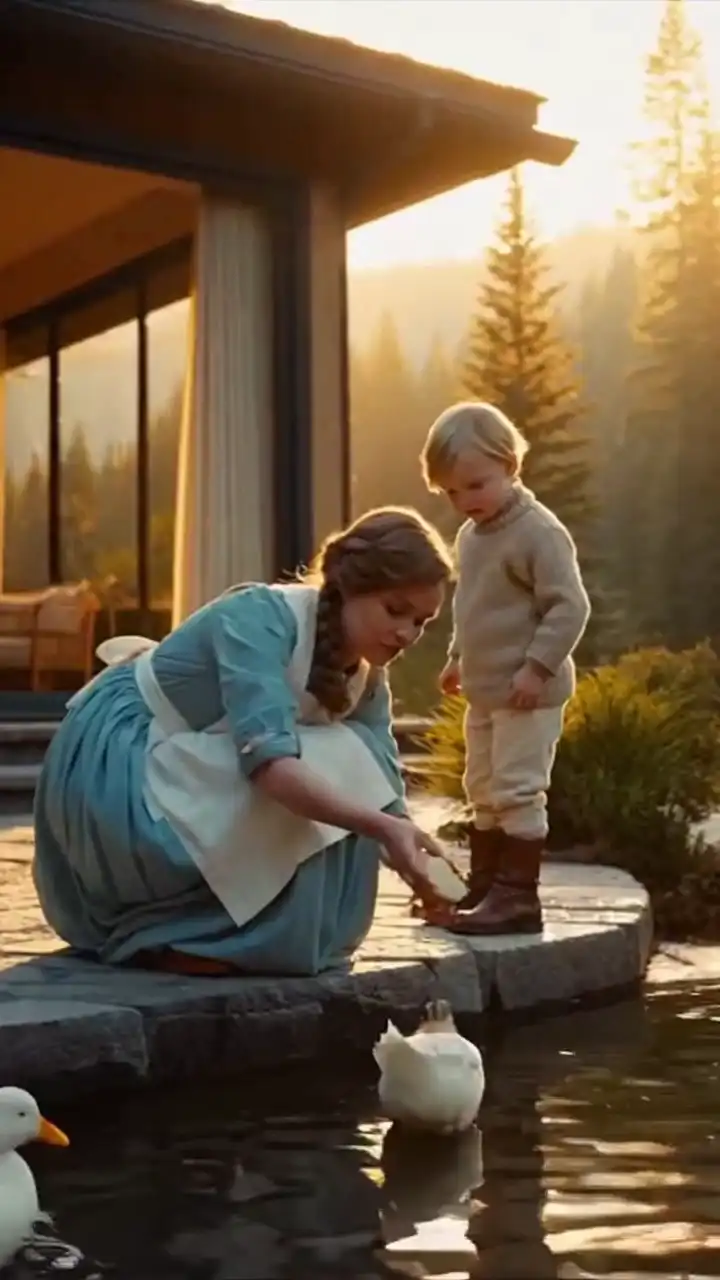
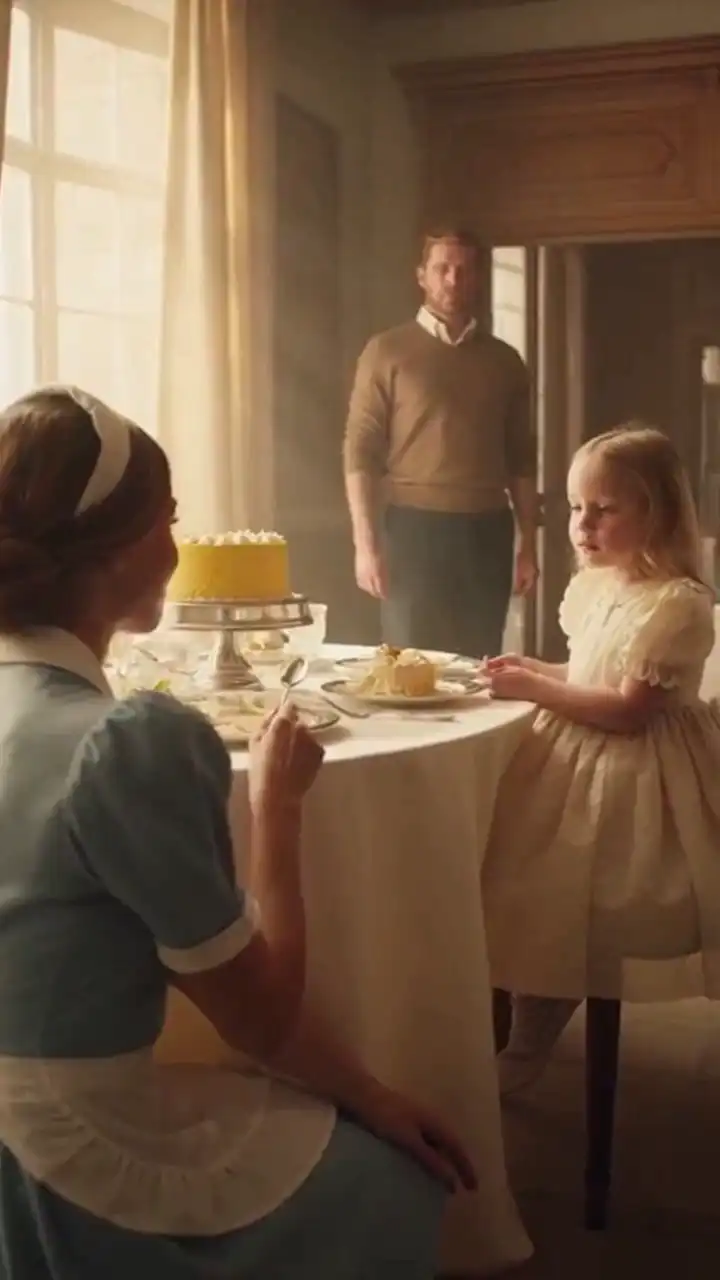

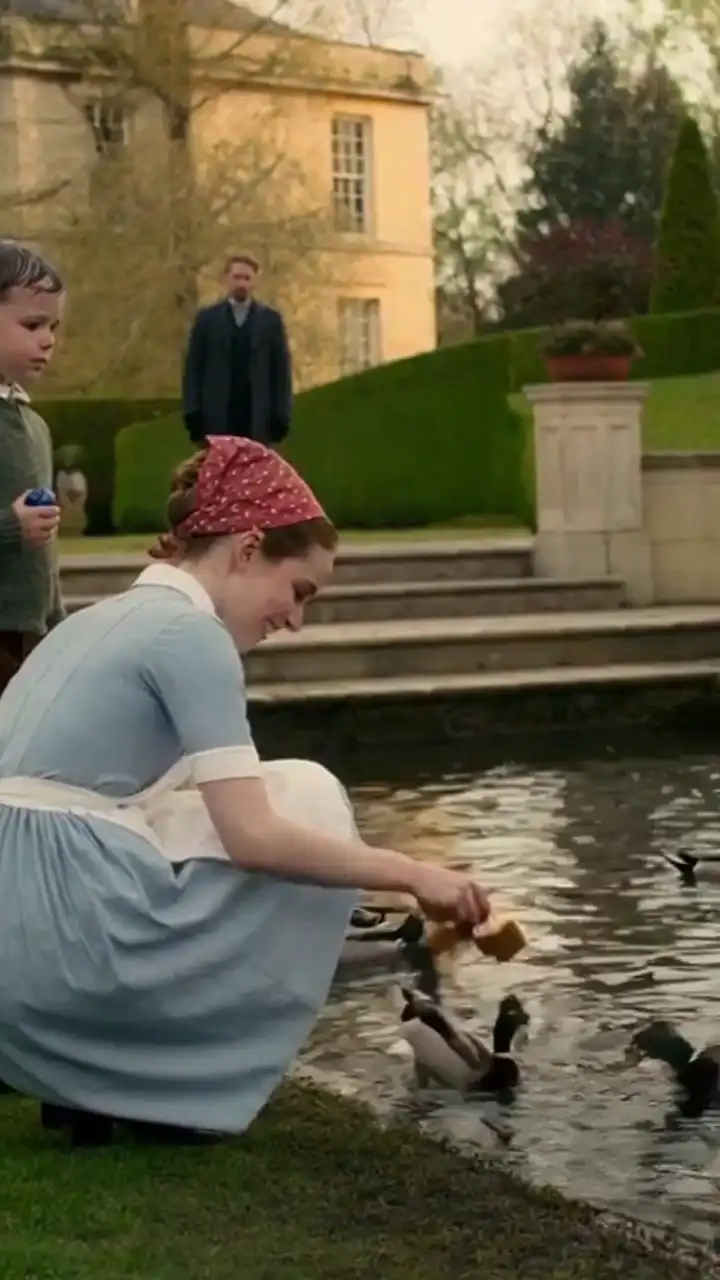
THE RICH MAN’S SON HADN’T FOLLOWED ANYONE IN TWO YEARS—THEN THE NEW NANNY OPENED THE GATE AND LET HIM CHASE DUCKS
The fabric of Clara’s sweater stayed twisted in Noah’s fist for almost a full minute.
Nobody spoke.
The ducks kept crowding the edge of the pond, bumping each other, pecking at the bread in the mud. One greedy goose shoved in, and Clara clicked her tongue at it like they had known each other for years.
“Back off, sir,” she said.
Noah looked at the goose.
Then he looked at Clara’s face.
It wasn’t a full, steady gaze. More like a flash. A hit of contact. But Grant saw it. Mrs. Dalton saw it too, and that made it real.
“Inside,” Mrs. Dalton said sharply. “Now. He’s overstimulated.”
Clara did not stand yet. “If he was overstimulated, he’d be shutting down.”
“He shouldn’t be near pond water, mud, wild birds, or noise.”
“He shouldn’t be living like a lamp in a showroom either.”
Mrs. Dalton turned to Grant, expecting the usual thing: a decision made in a clean voice, the worker corrected, the order restored.
Grant was still staring at Noah’s hand gripping Clara’s sweater.
“Five more minutes,” he said.
Mrs. Dalton blinked. “Mr. Whitmore—”
“Five.”
That was the first rule that broke.
Clara didn’t make a victory out of it. She just tore the bread into smaller pieces and placed some in Noah’s open palm. He flinched at the wet softness, almost dropped it, then held still as a mottled duck waddled close and took the bread with a quick snap.
Noah jerked backward.
Clara laughed again. Not at him. Just with the moment. “Rude, right?”
The corner of Noah’s mouth moved.
It was not a smile anybody would post about. It was tiny. A twitch. But in that family, it might as well have been fireworks.
Grant stayed on the terrace until Clara led Noah back in. He watched the grass stains on the boy’s pants and the muddy edge on his socks and felt something ugly and simple at once: shame.
Because the mess looked like life.
That evening, the chef asked whether Noah should be changed before dinner. Mrs. Dalton said immediately yes. Clara asked, “Why? He did something today.”
Noah usually ate alone, with a tray left outside the sunroom. The food came back half-touched.
Clara ignored the tray system. She took a grilled cheese from the kitchen, cut it into rough strips, and sat on the back steps where the dogs used to wait when Eleanor was alive. Hollow Creek no longer had dogs. Mrs. Dalton had said they were too unpredictable after Noah’s diagnosis.
Clara patted the step beside her.
Noah did not sit.
So she started feeding crumbs to the sparrows and talking to them like nosy old men. She made up complaints in different voices. This one thought the bread was stale. That one wanted legal representation. A third one was stealing from the others and denying it badly.
Noah stopped midway through his pacing.
By the time Grant came out after a call, his son was sitting two steps above Clara, watching the birds hop near her shoes. One grilled cheese strip was missing.
Grant had no idea when Noah had taken it.
He stood there quietly, the way he had stood beside hospital doors, lawyers, specialists, accountants. Always one step away from the actual thing.
Clara glanced up. “He eats better when nobody turns it into a conference.”
Grant almost answered defensively. Instead he said, “He hasn’t sat on those steps since his mother got sick.”
Clara nodded once, like that explained everything and nothing. “Then maybe the house remembers what he misses.”
That line stayed with him all night.
The next morning the interruption came.
Not from inside the estate. From outside.
A pediatric development center in Connecticut had finally opened a place for Noah in a residential assessment program. Grant had put his name on the list nearly a year before, after the last specialist told him Noah needed a more structured environment than home could offer.
The intake coordinator called during breakfast.
Mrs. Dalton treated it like salvation. “This is excellent timing.”
Clara, pouring cereal Noah would probably ignore, said nothing.
Grant took the call in his study while Noah turned a spoon in circles on the tabletop. The program was elite. Private cottages. clinical team. speech pathologists, occupational specialists, behavior plans, measured outcomes. Everything sounded expensive, controlled, impressive.
Everything sounded like all the things that had already failed him in prettier language.
Still, Grant told them he would confirm by evening.
When he came downstairs, Mrs. Dalton was already talking about packing.
“He’d benefit from consistency,” she said. “Professional consistency.”
Clara was kneeling on the kitchen floor with a sheet pan full of birdseed, peanut butter, and oats. Cheap mess. Sticky hands. No approved therapeutic objective anywhere in sight.
“What is this?” Mrs. Dalton demanded.
“Winter cakes for the feeder.”
“It is April.”
“The birds don’t care.”
Noah was standing nearby, watching the oats fall from Clara’s fingers into the pan.
Mrs. Dalton lowered her voice. “Mr. Whitmore, this cannot continue. Yesterday was one thing. But if you let household routines be dictated by a temporary nanny with no boundaries, one small reaction will be mistaken for progress.”
Clara kept working.
Grant should have sided with the estate manager. That was what he always did—defer to polished certainty. But he heard himself ask, “Why temporary?”
Mrs. Dalton stiffened. “Because she was emergency help.”
Noah suddenly made a small sound.
Not a word. More like a protest caught in his throat.
All three adults looked at him.
His eyes were on the pan in Clara’s hands. When Mrs. Dalton reached to lift it away, he slapped the table once. Hard.
It was the strongest refusal he had shown in months.
Clara froze, then slowly slid the pan closer to him. “You want to help?”
Noah touched the oats. Rubbed them between his fingers. Then, awkwardly, he dropped a whole fistful into the tray.
Peanuts bounced onto the floor.
Mrs. Dalton took a step back like the child had broken crystal.
Grant did not intervene.
That afternoon Clara asked if there were fish in the lower pond beyond the orchard. The groundskeeper said yes, plenty. She borrowed an old coffee can, punched holes in the lid, filled it with feed, and took Noah outside again.
This time Grant followed at a distance before anyone could ask him not to.
The lower pond had been part of Eleanor’s favorite walking path. Not manicured. Not formal. Cattails, low grass, dragonflies skimming the surface. The rich parts of the estate all faced away from it. Too wild. Too damp. Too alive.
Clara sat on the dock and tapped the coffee can. Fish feed rattled.
Noah stood behind her, rocking once on his heels.
“You can throw it,” she said.
Nothing.
A minute passed.
She tossed some herself. Rings spread over the water. Fish broke the surface in sudden silver mouths.
Noah leaned forward.
Clara did not praise him. Did not flood the moment. She just held out the can and looked at the pond.
That seemed to matter more than any expert script ever had. There was room in her silence. No demand inside it.
Finally Noah stepped closer and put his hand into the can.
The pellets poured too fast from his fingers. Fish surged. Water popped. A gull dived low, stealing one piece in midair.
Noah startled so hard he almost fell.
Grant moved forward on instinct, but Clara’s hand shot out, not to restrain Noah—just to let him choose. Noah steadied himself against her shoulder.
Then he stayed.
Another handful. Another throw.
By the third, he had inched past her knees and was standing near the edge of the dock, following the movement he had caused.
Grant sat down on an overturned rowboat and watched in absolute silence.
That was how he reacted to the biggest things in life: not with speeches, but with the kind of stillness that means a wall is cracking.
Over the next week, Clara did not “run sessions.”
She invaded the dead zones of the estate.
She opened windows in rooms that smelled expensive and empty.
She dragged kitchen bowls onto the floor and let Noah sort lemons by size while soup simmered and the staff pretended not to stare.
She hung a cheap bird feeder outside the sunroom window and refilled it with him every morning.
She borrowed the groundskeeper’s old rain boots and let Noah stomp puddles after a storm while Mrs. Dalton watched like civilization was ending.
And once, on a gray afternoon, she spread butcher paper on the back terrace, poured out children’s paint from the estate schoolroom, and used apple slices and leaves to make prints because the garden was blooming and Noah had been circling the same rug for an hour.
The first fifteen minutes looked pointless. Smears. Refusal. Paint on stone. Clara’s hands stained green and blue.
Then a finch hit the feeder window lightly and fluttered to the rail.
Noah looked from the bird to the paint to Clara.
She pressed a leaf into yellow and stamped it onto the paper.
He took the leaf from her.
Yellow dripped onto his wrist. He did not pull away.
Then he slapped the leaf down himself.
A crooked burst of color bloomed across the page.
Clara made a fake gasp like he’d invented fire.
Noah let out a laugh.
Real this time. Short, sharp, shocked by itself.
Grant heard it from the hallway and stopped so suddenly his phone slid from his hand onto the floor.
That image stayed with everyone in the house: the billionaire father standing in an open doorway while his son laughed over paint mess on a terrace that had only hosted silent wine dinners for years.
But the outside interruption hadn’t gone away.
The residential center wanted an answer.
Grant’s sister, Vanessa, came up from Manhattan to push the point. She had helped him through Eleanor’s illness, handled logistics, raised money for pediatric hospitals, and believed fiercely in experts.
She also believed Clara was a dangerous emotional accident.
Vanessa arrived in a cream SUV, walked into the terrace paint scene, and stopped dead at the sight of Noah barefoot in old boots, one hand yellow, one hand blue, a bird feather stuck to his sleeve.
“What on earth is happening?”
Noah flinched at her voice.
Clara lowered hers. “Maybe don’t start with ‘what on earth.’”
Vanessa stared. “You must be Clara.”
“And you must be loud.”
Grant should have stepped in. Instead he picked up a rag and wiped paint from the edge of the table.
Vanessa turned to him, furious. “The center called me because they couldn’t get a commitment. They’re holding the place for twenty-four more hours. This is not a hobby, Grant. If he needs treatment, you don’t keep him home because a girl with ducks and crafts got one reaction.”
Noah had gone still again.
That was the problem with every adult war around him. He disappeared first.
Clara saw it and did something that nearly made Vanessa choke.
She scooped paint onto her own palm and pressed a handprint right onto the butcher paper. Then she pressed a second one beside it and looked at Noah, not forcing, just inviting.
A visible action. Simple. Low. Human.
Noah looked at the paper.
Then at Clara’s painted hand.
Then he stepped forward and put his own hand in the blue tray.
Vanessa kept talking. “This is absurd—”
Grant cut in, finally sharp. “Stop.”
The word sliced the air.
His sister looked at him, stunned.
Grant rarely raised his voice. When he did, it meant he had passed his limit.
“Not one more sentence over him,” he said.
Vanessa stared at Noah’s hand trembling above the paper. She closed her mouth.
Noah pressed down.
When he lifted his hand, a blue print sat beside Clara’s red one.
He looked at it for a long second, then turned—actually turned—and leaned his shoulder lightly against Clara’s side.
Voluntary. Public. Clear.
Vanessa saw it. Mrs. Dalton saw it from the doorway. Grant saw it and understood, maybe for the first time, how many things his son had been capable of all along if nobody tried to manage the life out of him.
That night he canceled the residential placement.
Vanessa called him reckless.
Mrs. Dalton called it emotional decision-making.
Grant called the center himself and said, “He’s staying home. We’re rebuilding around him, not sending him away because it’s easier to categorize him elsewhere.”
It was the first parental sentence Clara had heard from him that did not sound outsourced.
There was fallout.
Mrs. Dalton requested a formal meeting about household boundaries. She had served the Whitmores for fourteen years and believed she was protecting order, reputation, and the estate itself. Clara arrived in clean jeans and sat at one end of the breakfast room while Mrs. Dalton listed complaints.
Unapproved outings.
Use of staff areas.
Food outside dining protocol.
Animal feed near designer stone.
Paint on terrace slate.
Informal language with family members.
Excessive emotional dependence risk.
Grant listened the whole way through.
Then he asked one question.
“When my son stopped speaking to the world, which of those rules helped him?”
Mrs. Dalton had no answer.
He was not cruel to her. He thanked her for holding the household together during Eleanor’s illness and after. But he changed the structure that day. Fewer command layers. More flexibility. Staff meetings that included Clara, the chef, the groundskeeper, and Noah’s therapist—who, to her credit, admitted Noah’s progress at home was more significant than anything in the clinic.
Mrs. Dalton stayed on, but she no longer got to define what belonged.
That was her concrete loss. Not her job. Her authority over the emotional terms of the house.
Clara’s change came more slowly, and deeper.
She did not turn into a princess. She did not magically become polished. She remained herself: blunt, alive, impossible to fit into a silver-tray role. But she was no longer treated like temporary labor filling silence.
Grant asked what training she actually wanted. She admitted she had dropped community college because her mother got sick and she needed money. She had worked summer camps, farm stands, pet boarding, and one chaotic after-school program where she learned some children answered better to motion than words.
Animals, repetition, ordinary tasks. No pressure at the center. Shared attention instead of forced attention. That was why Noah responded. The ducks, fish, birds, and kitchen work gave him something living to join without being examined.
Grant funded her return to school, not as a favor dangled over her, but as a contract in her name. Early childhood development, if she wanted it. Or occupational support training. Or neither. Her choice.
She cried only once, in private, in the laundry room, angry at herself for crying at all.
Noah’s real changes came in layers.
He began following Clara to the kitchen every morning to refill the feeder.
He sat at the table sometimes, not long, but enough.
He brought marbles to the back steps and lined them up beside sparrows instead of alone in the sunroom.
He touched the old dog leash still hanging in the mudroom and did not recoil when Grant mentioned getting a gentle older retriever someday.
On the anniversary of Eleanor’s death, everyone feared a collapse.
Instead Clara took Noah to the pond with seed, not bread this time. Grant went too.
They stood where the reeds bent in the wind. Ducks cut slow paths through the water. A heron lifted from the far bank.
Grant said softly, “Your mom loved this place.”
Noah’s head tilted.
Grant had learned by then not to flood silence with more words. He waited.
Noah held out the seed can to him.
It was such a small gesture that someone outside the story would miss it. But inside that family, it was an invitation larger than speech.
Grant took the can.
Together, father and son fed the ducks while Clara stood back a few feet, hands in her jacket pockets, watching without claiming the moment.
That was part of why she changed them. She entered the broken space hard, but she never tried to own what healed.
Late that spring the estate hosted its first real outdoor lunch in years. Not a donor event. Not a board dinner. Family, staff, a few neighbors from the surrounding farms, folding tables near the orchard, children running where adults once whispered.
Mrs. Dalton would once have died at the sight of paper napkins beside inherited silver. Now she simply directed traffic and pretended not to notice the groundskeeper teaching Noah how to toss cracked corn to ducks from a bucket.
Vanessa came too. She was still skeptical, but she had softened enough to bring seed packets for the garden.
Noah did not greet people in the ordinary way. But he moved among them. He paused by Clara. By Grant. By the feeder. By the tray of rolls. He stayed in the world.
At one point, a little neighbor girl dropped her cookie near the grass and started crying because birds got to it first.
Before any adult stepped in, Noah walked over, looked at the crumbs, then at the flock of sparrows fighting over them.
He took the extra roll from his own plate and held it out.
Not to the girl.
To Clara first.
A check-in. A bridge.
She nodded once. “Good idea.”
Then Noah gave the roll to the girl.
Grant looked away fast after that, jaw tight, because some men can negotiate billion-dollar deals but still get ambushed by one child offering bread.
By summer, Hollow Creek sounded different.
Windows open.
Kitchen noise.
Boots by the back door.
Bird feed on the shelf next to the fancy imported tea.
Laughter sometimes from the terrace.
A father who no longer flew back to the city before breakfast every Monday.
A child who still had delays, still needed support, still moved at his own pace—but no longer drifted alone beyond reach.
And Clara?
She moved through the estate without lowering herself to fit old ideas of her place. She studied online at night with Grant paying tuition. She worked mornings with Noah, afternoons with a local therapy team that now consulted her instead of dismissing her. By fall, Grant had helped fund a small inclusive animal-and-garden play program on unused estate land for other children who did better with movement than clinic walls.
That was the class crossing no one in that world saw coming.
She had entered through the service door with a cheap box of feed and a bad reputation waiting for her.
Months later, she stood at the center of a program carrying her name on the paperwork.
One evening, as the light went gold over the lower pond, Grant found Noah and Clara by the water.
Noah was tossing pellets in a slow, careful rhythm.
Clara was reading from a textbook, stopping every few lines because he liked turning the pages.
A duck wandered up the bank too boldly, and Noah took one step back, then another step forward on his own.
Grant sat beside them in the grass. Expensive coat, damp ground, no terrace between him and the moment.
Noah looked at him.
Then handed him the feed can.
Grant took it.
Clara went back to reading.
That was how the estate warmed again—not through one miracle, not through wealth finally working, but through a hundred ordinary, messy, living things no one had valued enough before.
The ducks still came loud.
The birds still stole bread.
The fish still broke the pond in silver flashes.
And the house that had once sounded like grief finally sounded like a family.
Disclaimer: Mention of any brand or trademark is for identification only and does not imply partnership or endorsement
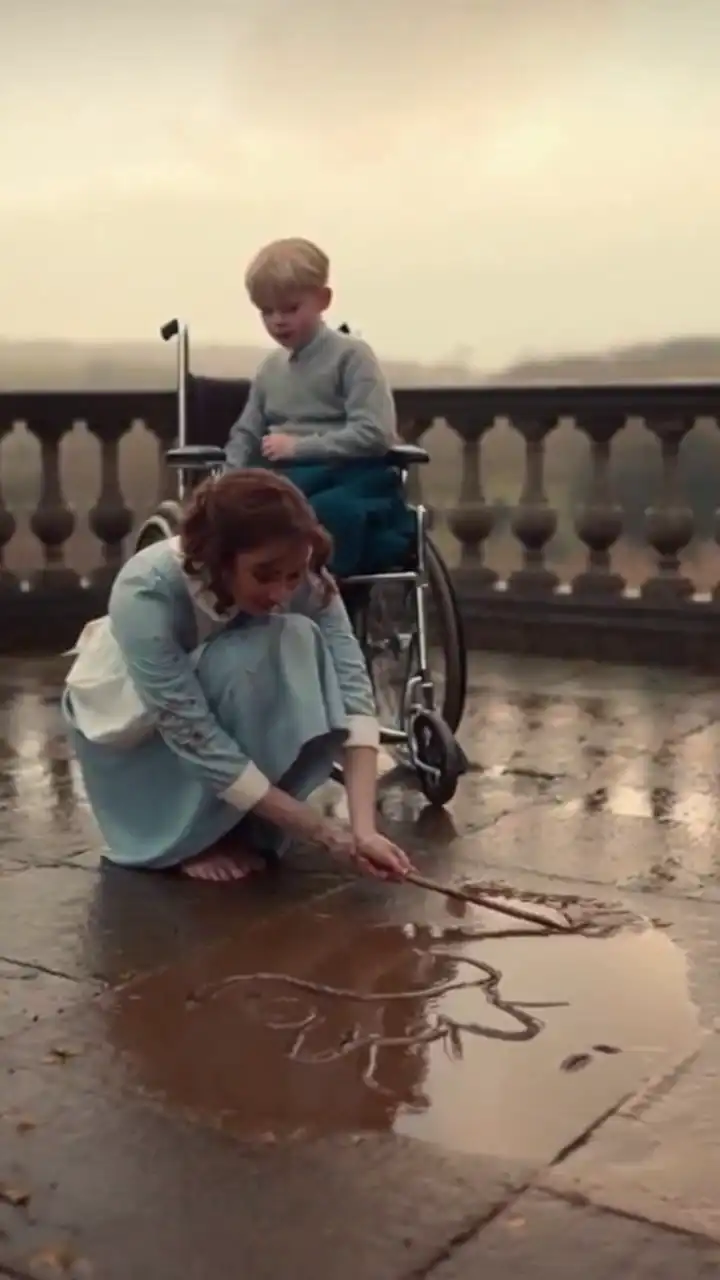
WHEN THE BILLIONAIRE’S SON DRAGGED HIS USELESS LEGS INTO THE MUD FOR THE FIRST TIME, HIS FATHER’S GIRLFRIEND SCREAMED FOR THE NANNY TO STOP
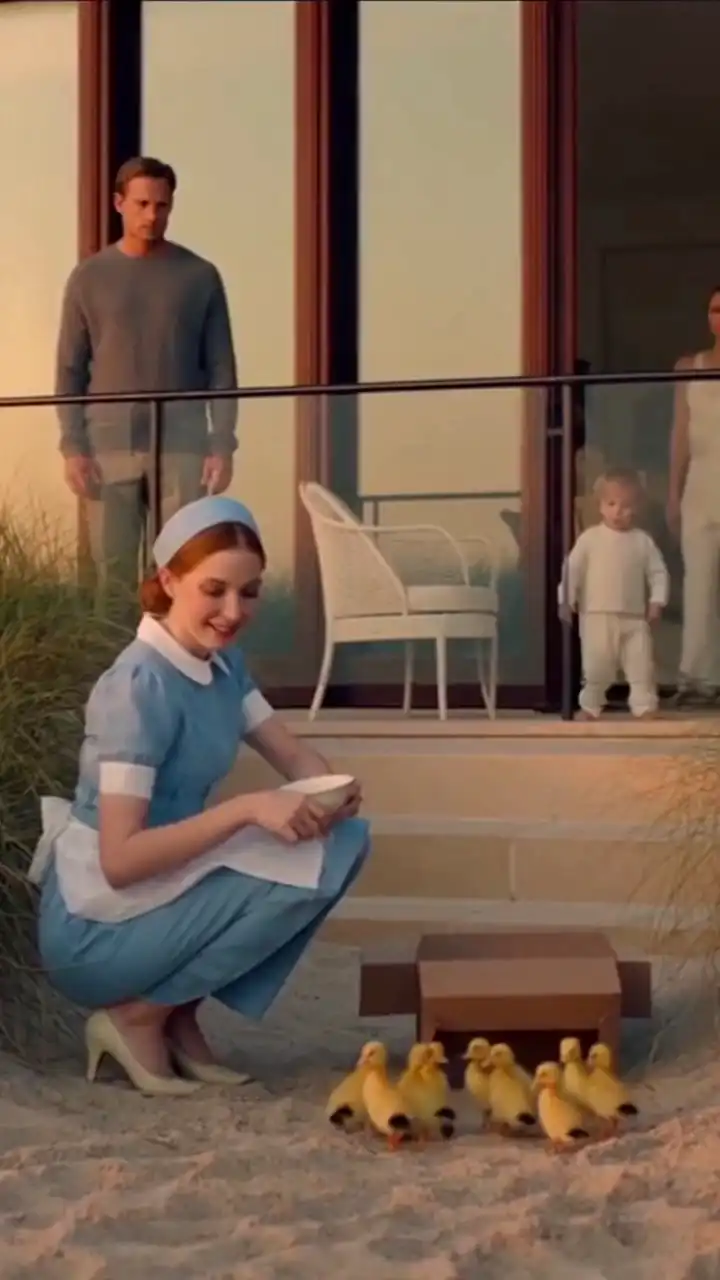
THE NANNY WHO BROUGHT DUCKS TO THE OCEAN HOUSE AND MADE A CHILD WALK TOWARD LIFE
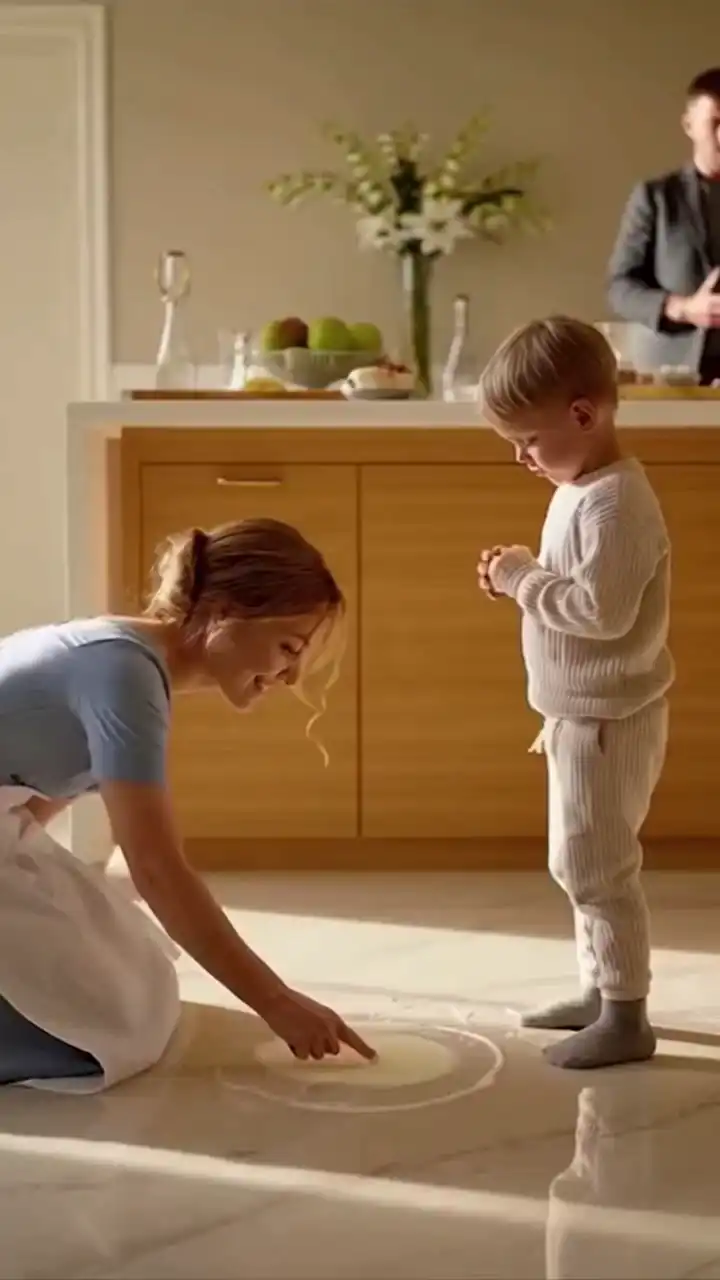
WHEN THE RICHEST MAN ON THE HILL HIRED THE WRONG NANNY, HIS SILENT SON CRAWLED ACROSS THE FLOOR FOR HER