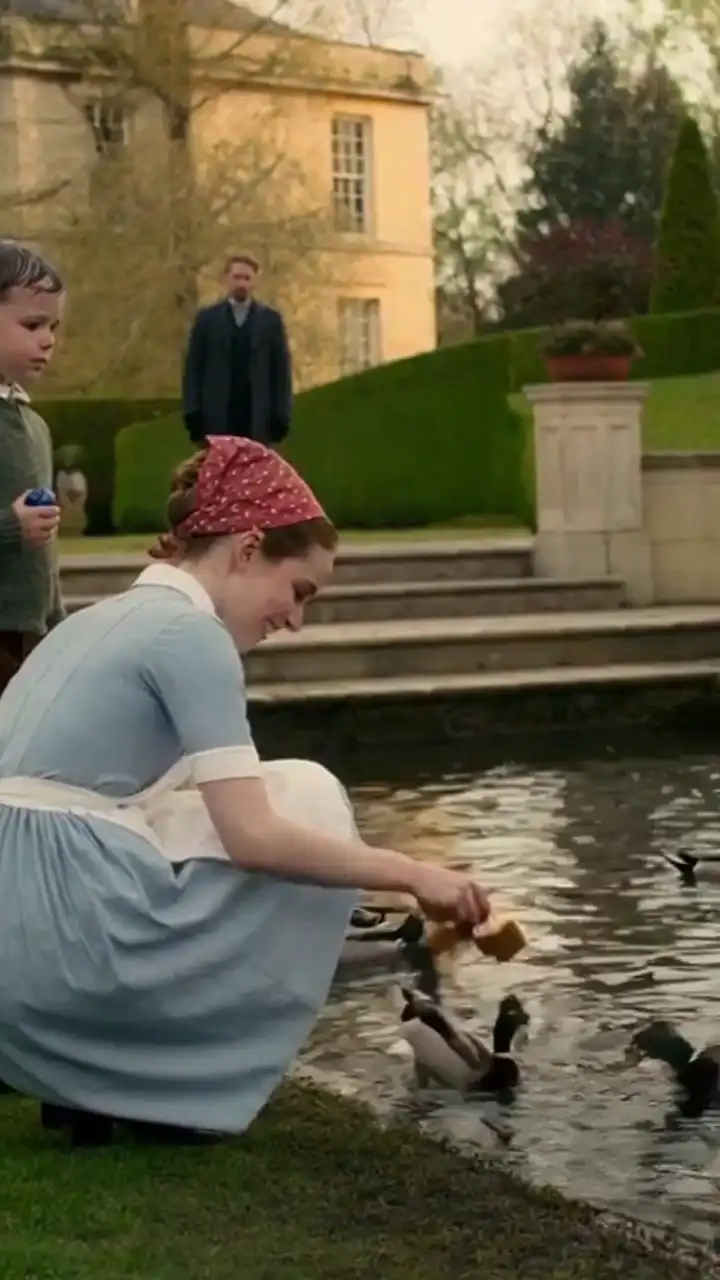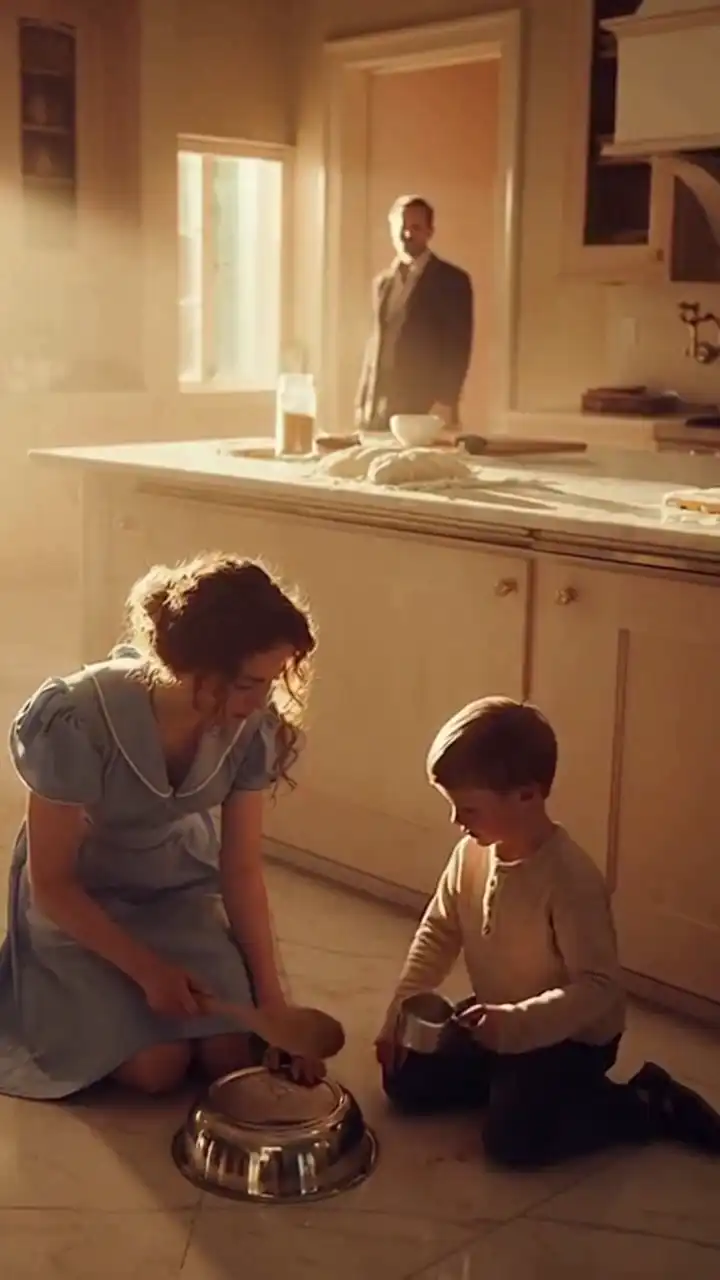
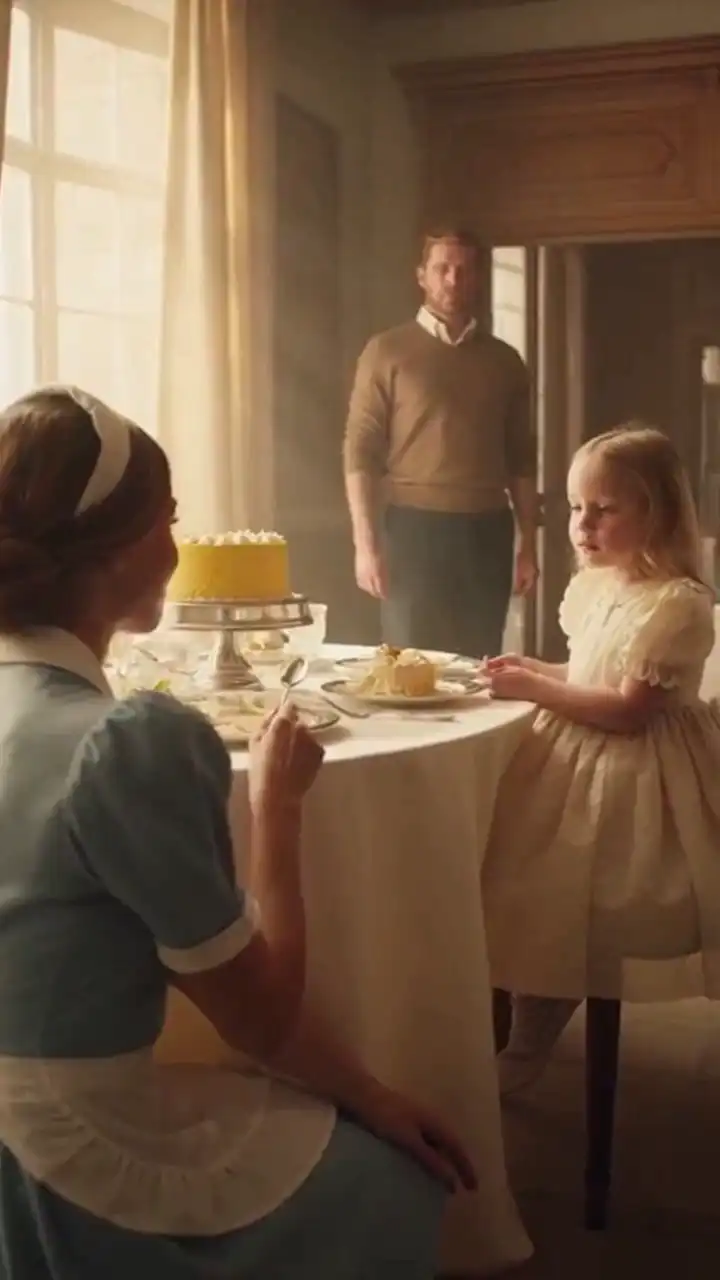

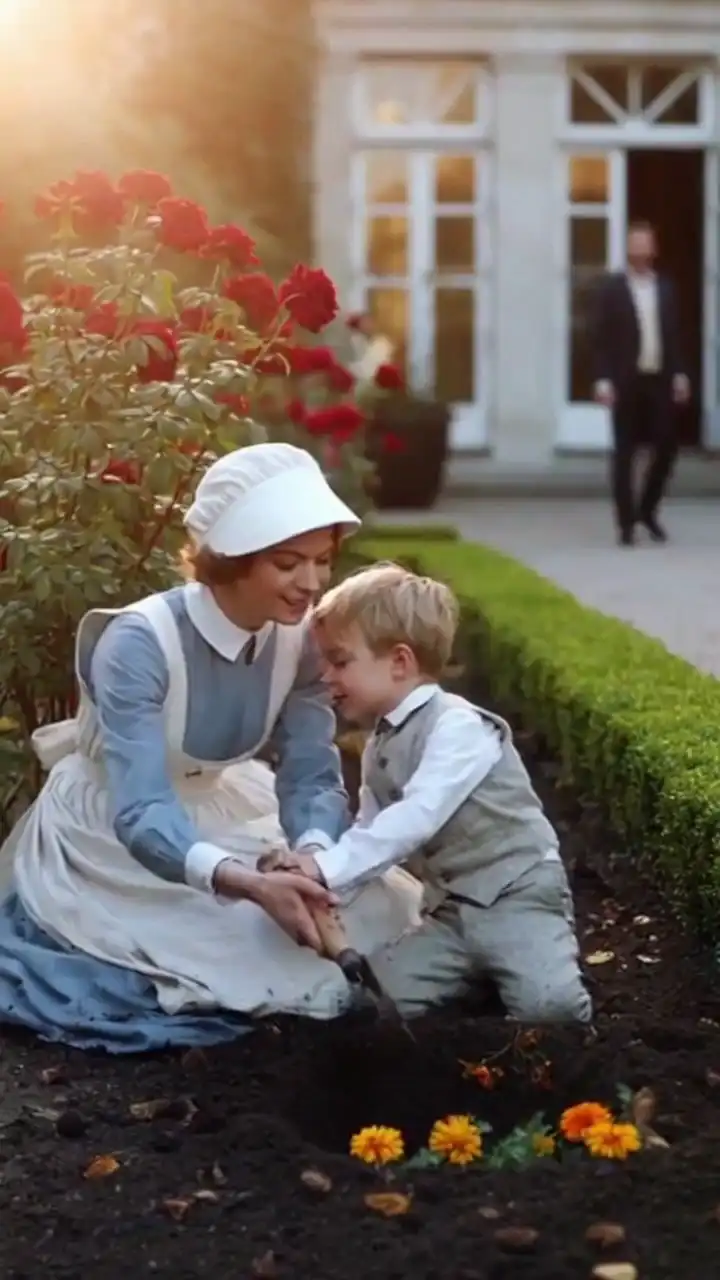
THE BOY WHO WOULDN’T SPEAK REACHED FOR THE NANNY WITH MUDDY HANDS ON HIS DEAD MOTHER’S BIRTHDAY
Daniel did what he always did when something scared him.
He tried to end it.
“That’s enough,” he said, striding across the stone path. “He needs clean clothes. And this is not how he should be introduced to a new routine.”
Emily looked up from the flower bed. Dirt streaked one side of her jaw. Owen was still gripping her wrist.
“Routine?” she asked quietly. “He’s participating.”
Daniel held out his hand to Owen. “Come inside.”
Owen’s body changed at once. His shoulders rose. His fingers tightened. His face shut down so fast it was like a door slamming.
Emily didn’t argue. She only lowered the watering can and said, “You can take him in. But if you do it right now, you’re not protecting him. You’re protecting the house.”
The words hit harder than they should have.
No employee had ever spoken to Daniel like that.
He should have fired her on the spot.
Instead he looked at his son.
Owen was not smiling. He almost never smiled. But he was present. His eyes were on the roots in Emily’s hand. His boots were planted in loose dirt. His breathing, usually thin and held, was deep enough to move his chest.
It was the most alive Daniel had seen him in almost a year.
“Ten minutes,” Daniel said.
Emily nodded once and returned to the bed.
Ten minutes became forty.
Owen carried three empty pots from one side of the path to the other. He crouched beside Emily while she broke apart old root balls and mixed in compost. He didn’t speak, but he watched every step. When a worm surfaced from the dirt, he jerked back, then leaned in.
Emily never turned the moment into a lesson.
She never said good job in that bright, fake voice specialists used.
She treated him like someone helping.
That afternoon the memorial lunch still happened, but not the way Daniel’s mother expected.
Mrs. Hartford arrived in pearls and grief so practiced it had gone hard around the edges. She kissed Daniel’s cheek in the foyer, glanced toward the dining room, and asked the first question that mattered to her.
“Has the child been changed?”
Daniel looked through the back windows.
Owen was still outside, now on a low bench near the herb beds. Emily was wiping his hands with an old gardening towel while he watched drops run from the hose onto the flagstones.
“No,” Daniel said. “Not yet.”
His mother followed his gaze and stiffened.
The scene offended every instinct she had. Her grandson, in expensive clothes, dirty. A nanny from an agency using the formal gardens like a public park. A Hartford child kneeling in soil while guests arrived for a memorial.
“What on earth is that girl doing?”
Something in Daniel wanted to answer honestly.
Bringing him back.
But control spoke first. “Trying something.”
Mrs. Hartford lowered her voice. “The boy needs structure. Not improvisation. If Lila’s death has taught anything, it’s that this family needs steadiness.”
Lila’s death. As if it were weather. As if a truck crossing a median had not split their lives in two.
Daniel said nothing.
He had gotten good at saying nothing.
That was one of the things Emily understood before he did.
Over the next week, she built no miracle program. She built days.
Not polished days. Real ones.
She opened curtains in the morning instead of keeping rooms dim and hushed. She let the kitchen radio play low while breakfast was made. She handed Owen produce to rinse at the sink, one cucumber at a time, one strawberry bowl at a time. She brought him outside before noon and gave him tasks with weight and shape: carry this pot, drop these seeds, pour this scoop, gather those clipped stems.
When he ignored speech, she didn’t crowd him with more speech.
When he flapped his hands from overwhelm, she reduced noise and kept working nearby.
When he lined up gardening labels in perfect rows, she let them become part of the task instead of breaking the pattern just to prove she could.
That was when Daniel began to see how much everyone else had been trying to drag Owen toward normal instead of walking toward Owen first.
Emily never entered his silence like an invader.
She made a place beside it.
She learned his signals before his words. The stiffening before sound became too much. The head turn that meant no. The tapping fingers that meant interest. The way he tolerated side-by-side closeness far better than face-to-face insistence.
The old estate changed in small sounds first.
The scrape of clay pots. The thud of soil bags on flagstone. Water running in the late afternoon. The back door opening and closing. A child’s footsteps moving with purpose.
It changed Daniel too, though he resisted that longer.
He watched from windows. From doorways. From the terrace with his phone in hand and his body still angled toward work calls he kept taking because numbers were easier than grief.
Emily noticed, of course.
One evening, as she washed dirt from Owen’s nails at the mudroom sink, she asked without looking at him, “Does he ever see you do anything that isn’t leaving?”
Daniel bristled. “I’m here every night.”
“He sees your body here,” she said. “That’s not the same thing.”
He had no answer ready.
That irritated him more than if she had been plainly rude.
He doubled down on rules the next day.
No more soil inside. No wet shoes past the side entrance. No skipping speech sessions. No changing meal schedules. No garden tools without supervision. No overexposure to sun. No prolonged mess.
Emily read the list he had asked the house manager to print.
Then she folded it in half and tucked it in her apron pocket.
“I’ll keep him safe,” she said.
“That wasn’t the only point.”
“I know.”
The challenge in those two words stayed with him all afternoon.
That Friday, Owen had a private speech session in the library. The therapist sat with picture cards, reward tokens, and patient professional energy. Owen curled into the armchair and would not look at her.
After twenty minutes, she suggested reducing environmental variability and limiting “non-structured outdoor sensory episodes,” which was a very expensive way of criticizing the garden.
Daniel almost agreed.
Then, through the open library doors, he heard a hollow plastic clatter and the sound of water glugging into buckets.
Owen’s head lifted.
It was immediate.
Not dramatic. Not magical. But immediate.
The therapist kept talking.
Owen slid off the chair and moved toward the hall.
The therapist called his name.
Nothing.
From the terrace below, Emily was sorting cheap nursery pots into stacks while the gardeners unloaded a delivery of soil and spring annuals. She had dragged an old wooden crate into the center of the work area and was filling it with tools: twine, labels, gloves, hand forks.
Work was happening.
Real work.
Owen stood at the top of the stairs listening to the sounds.
Then he went down.
The therapist looked offended. Daniel looked cornered. And for the first time, he chose not to stop what he did not control.
He dismissed the session early.
That night he found Emily in the service kitchen kneading dough with Owen standing on a step stool beside her, pressing the heel of his palm into a small lump she had given him.
“You moved his session,” Daniel said.
“I let him choose a useful hour over a forced one.”
“He still needs professional support.”
“Yes,” she said. “But not at the cost of every good moment he has.”
Flour dusted Owen’s sleeve. He was watching the dough spring back after each push.
Emily placed her own hand flat on the counter. “Press,” she said.
Owen copied her.
It was the same principle as the garden. Weight. resistance. change. action with visible result.
Daniel finally asked the question he should have asked on day one.
“Why does this work on him?”
Emily rinsed her fingers. “Because nothing I give him disappears when he reaches for it.”
Daniel frowned.
She looked at Owen, not at him. “His world changed in one violent second. A car crash. A mother gone. Adults crying, whispering, moving him from room to room, telling him to use words for pain bigger than his body knew how to hold. Since then, everyone has been asking him to perform safety instead of feel it.”
Daniel felt the back of his neck go hot.
Emily continued, still calm. “In the garden, when he pours water, the soil darkens. When he digs, roots appear. When he presses dough, it answers. It’s predictable. It pushes back. It stays. And when I stay with him without demanding a reaction, he doesn’t have to spend all his energy defending himself.”
For several seconds, the only sound was Owen pressing dough.
Daniel had built his whole life on command and correction. Markets answered pressure. Employees answered expectations. Problems answered money.
His son did not.
That was not Owen’s failure.
Weeks passed, and the breakthroughs came the way real ones do: uneven, ordinary, undeniable.
Owen began waiting by the mudroom door in the mornings if Emily was late by even two minutes.
He brought her one glove when she forgot the pair.
He touched the sleeve of her sweater once to pull her toward a seed tray he wanted.
He started making eye contact in flashes, quick but intentional.
One afternoon he pushed a small watering can toward Daniel’s shoes, then looked toward the hydrangeas.
Emily, pruning nearby, said nothing.
Daniel understood anyway.
The invitation was not elegant. It was not spoken. But it was there.
He took the can.
At first he watered too hard and splashed mulch over the edging. Owen flinched at the sudden force.
Daniel stopped. Lowered the can. Tried again more slowly.
Owen watched.
Then, after a moment, he stepped beside his father and placed one hand on the can’s side, steadying it.
That was the breakthrough trigger no specialist had predicted.
Not a speech card. Not a reward chart. Not a command.
A shared task.
From then on, the change spread through the house because Daniel was changing inside it.
He began declining calls during the hour Emily called garden time.
He learned how to transplant basil without tearing roots. How to wait through Owen’s silence without filling it with nervous words. How to sit on the low stone wall while his son sorted seed packets by color and season. How to be present without making his presence into pressure.
Mrs. Hartford hated all of it.
She arrived unannounced one Sunday to find her son in old jeans, carrying a bag of mulch with the groundsman, while Owen and Emily planted nasturtiums in a kitchen bed meant for decorative herbs.
She stood on the terrace as if observing a family breakdown.
“This cannot continue,” she said later in Daniel’s study. “That girl has erased every boundary in this house. Staff are confused. The child is dirty every day. And you—” she looked at his hands, still marked with soil beneath the nails, “—you are behaving like a groundskeeper.”
Daniel sat behind the desk he had once used as armor.
“And my son,” he said, “is eating at the table again.”
She faltered.
He went on. “He sleeps through most nights now. He comes downstairs on his own. He lets me sit next to him. Yesterday he put a tomato seedling in the ground and looked at me to see if I’d seen it.”
His mother tightened her mouth. “Temporary stimulation is not recovery.”
“No,” Daniel said. “But life is.”
She changed tactics. “People are talking. The agency girl is too familiar. It will create dependence. If she leaves, he’ll collapse.”
That fear landed because it was real.
Daniel had thought it himself at three in the morning more than once.
What if Emily was not healing Owen, only becoming another thing he could lose?
He found Emily that evening in the greenhouse potting lavender starts while Owen pushed pebbles into a tray of soil one by one.
“You should know,” Daniel said, “my mother thinks he’s becoming too attached to you.”
Emily didn’t look surprised. “He is attached to me.”
“That doesn’t concern you?”
“It concerns me enough to tell you the truth.” She set down the trowel. “Attachment isn’t the problem. Adults leaving after attachment is the problem. Adults treating attachment like a mistake is the problem. Adults acting like care is dangerous because they can’t control the grief attached to it is the problem.”
The greenhouse went very still.
Owen kept pressing pebbles into the soil.
Daniel said quietly, “And what if you leave?”
Emily held his gaze then. “Then he should already have more than me.”
That sentence opened the door Daniel had been avoiding.
The next morning he canceled a board retreat.
The Hartford executives could survive two days without him. His son had survived nearly a year without a father who knew how to stay in the room.
Daniel asked Emily to show him the full routine from breakfast through garden close.
Not to supervise.
To learn.
He sliced strawberries while Owen watched water boil for oatmeal. He held the bowl steady while Owen stirred. He carried flats of seedlings outside. He knelt in the dirt in trousers he no longer cared about saving. He learned that Owen preferred warnings before transitions, side-by-side instruction, and one task at a time. He learned that his own impatience hit the child like noise.
Emily corrected him more than once.
“Don’t ask three things in a row.”
“Wait.”
“Don’t touch his shoulder from behind.”
“Let him finish lining them up.”
Every correction stung.
Every correction helped.
Then came the moment nobody in the house forgot.
It was late afternoon, almost two months after Emily had first opened the French doors on Lila’s birthday. The gardeners had dug a small patch near the south wall for a memorial bed. Emily had suggested it quietly: not a polished plaque, not a formal statue, just a place planted by hand.
Lila had loved foxgloves, rosemary, and white roses.
Daniel carried the rose canes himself.
Owen stood beside the hole with dirt on his shins, one glove on, one glove off as usual. Emily crouched nearby, guiding only when needed.
“Roots loose first,” she said.
Owen copied the motion.
Daniel set the plant in place. Emily nodded to him to hold it steady.
Owen began pushing soil back into the hole with both hands. Fast at first. Then slower, patting it down.
A breeze moved across the wall. Somewhere behind them, the kitchen door swung shut.
Daniel said, very softly, “Your mom would love this.”
He hadn’t spoken of Lila directly in front of Owen in months. Not like that. Not without rehearsing it in his own head first.
Owen’s hands stopped.
Emily did not move.
Daniel’s chest went tight. He thought he had ruined it.
Then Owen looked up.
Not at Emily.
At him.
His mouth opened. Shut. Opened again.
The word came rough, as if it had to push through something long rusted closed.
“Mom.”
Daniel felt it like an impact.
Emily bowed her head and looked away, giving the moment back to where it belonged.
Daniel dropped to his knees in the dirt without caring who saw. “Yeah,” he said, voice breaking. “Mom.”
Owen touched the rose leaves once, then touched Daniel’s wrist. Not clinging. Not panicked. Connecting.
After that, language did not pour out in movie-scene miracles. But the wall had cracked for real.
“More” came at dinner two nights later, when he wanted bread.
“Water” came in the garden.
“Emily” came one morning at the mudroom bench, half-whispered and startling enough that the housekeeper cried in the pantry afterward.
And “Dad” came on an ordinary Tuesday when Daniel was late tying his work shoes and Owen was already waiting at the back door with two small spades.
The whole household warmed in layers.
The kitchen became louder. The terrace chairs got used. Meals stopped being plated in separate lonely trays. The staff stopped tiptoeing as if grief might shatter if anyone set down a spoon too firmly. Even the old dog, Banjo, who had spent months sleeping in empty hallways, began following Owen into the garden.
As for Emily, her position changed because Daniel made sure it did.
He did not make some dramatic public speech. He did something more serious.
He rewrote the structure of the house around the truth.
Emily was no longer listed as temporary childcare through the agency. Daniel hired her directly as Owen’s developmental caregiver and family support lead, with a salary that made the house manager blink twice, full benefits, paid courses in child development if she wanted them, and one thing she had never had before in any job: authority that did not vanish the second rich people felt uncomfortable.
When he handed her the contract, she read the pages slowly.
“You don’t have to do this,” she said.
“Yes,” Daniel answered, “I do.”
She looked up. “For me?”
He shook his head. “For him. For this house. And because I’m done pretending the person doing the most important work here is somehow less important than everyone in a suit.”
Mrs. Hartford objected, naturally.
Daniel listened, then overruled her with a calmness that ended the matter more completely than anger would have. She still visited. She still disapproved of dirt under nails. But she no longer got to define what belonged in that family.
By summer, the south wall was full.
Rosemary spilled over the stone. Foxgloves lifted in pale towers. White roses climbed where the sun held longest.
Owen helped water every evening.
Some days he spoke. Some days he didn’t. Some days he still folded inward when sounds were too sharp or routines broke too suddenly. Healing had not turned him into a different child. It had let him come back as himself.
And Daniel finally understood the difference.
One evening, after dinner, he found Owen and Emily on the back lawn near the garden beds. The grass was damp from the sprinklers. Owen was carrying a small bucket of weeds to the compost heap, serious as ever, stepping carefully so nothing spilled.
Halfway there, he stumbled.
The bucket tipped.
Weeds, dirt, and one bright marigold bloom dropped across the grass.
A year earlier Daniel would have rushed in, fixed it, cleaned it, apologized for the mess before anyone asked.
Now he stayed where he was.
Owen froze, breathing quick.
Emily crouched beside the spilled bucket and simply began gathering the weeds by hand.
No alarm. No correction. No rescue that turned the mistake into a spotlight.
After a beat, Owen crouched too.
Then he looked over his shoulder toward Daniel.
It was a tiny look. But it held a choice.
Daniel walked over, knelt in the wet grass in his rolled shirtsleeves, and picked up the marigold.
“We can do it again,” he said.
Owen studied his face.
Then, carefully, he put one weed back into the bucket. Then another.
The three of them finished together while the old estate behind them glowed gold in the evening sun, doors open, kitchen noise drifting out, no room shut up against life anymore.
That was how the family came back.
Not through money. Not through rules. Not through perfect words.
Through soil under fingernails. Through work shared side by side. Through one young woman who refused to treat silence like emptiness. And through a father who finally learned that love was not management.
By fall, the house was still grand, still old, still unmistakably Hartford.
But now there were boots by the mudroom door. Seed packets on the kitchen counter. A child’s gloves drying by the sink. And voices, sometimes quiet, sometimes rough, but real.
On the first anniversary of Lila’s death, Daniel did not schedule a formal lunch.
He took the day off.
He, Owen, and Emily went to the memorial bed with new bulbs and hand tools. They dug together in the cool morning earth. Banjo slept nearby in the sun.
When they finished, Owen pressed both palms into the loose soil, stood up, and reached for his father with one hand and Emily with the other.
And this time, neither of them made the mistake of letting go.
Disclaimer: Mention of any brand or trademark is for identification only and does not imply partnership or endorsement
WHEN THE BILLIONAIRE’S SON DRAGGED HIS USELESS LEGS INTO THE MUD FOR THE FIRST TIME, HIS FATHER’S GIRLFRIEND SCREAMED FOR THE NANNY TO STOP

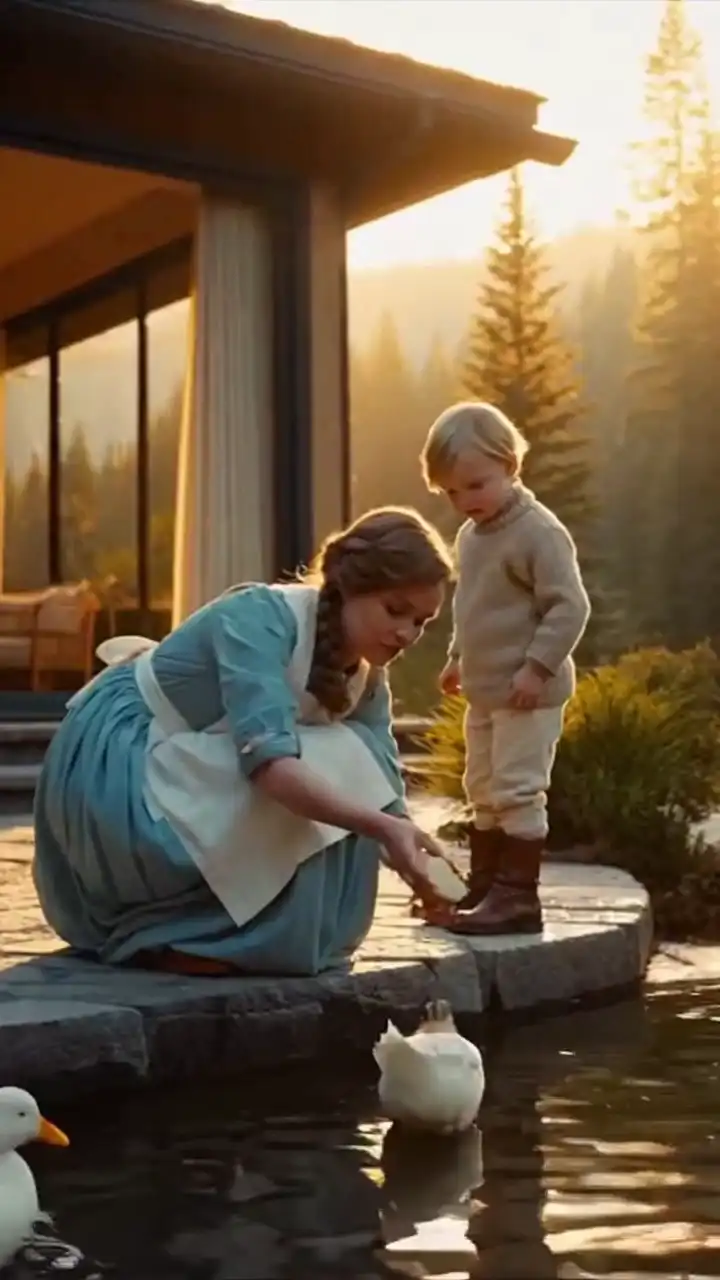
THE NANNY WHO BROUGHT DUCKS TO THE OCEAN HOUSE AND MADE A CHILD WALK TOWARD LIFE

WHEN THE RICHEST MAN ON THE HILL HIRED THE WRONG NANNY, HIS SILENT SON CRAWLED ACROSS THE FLOOR FOR HER