
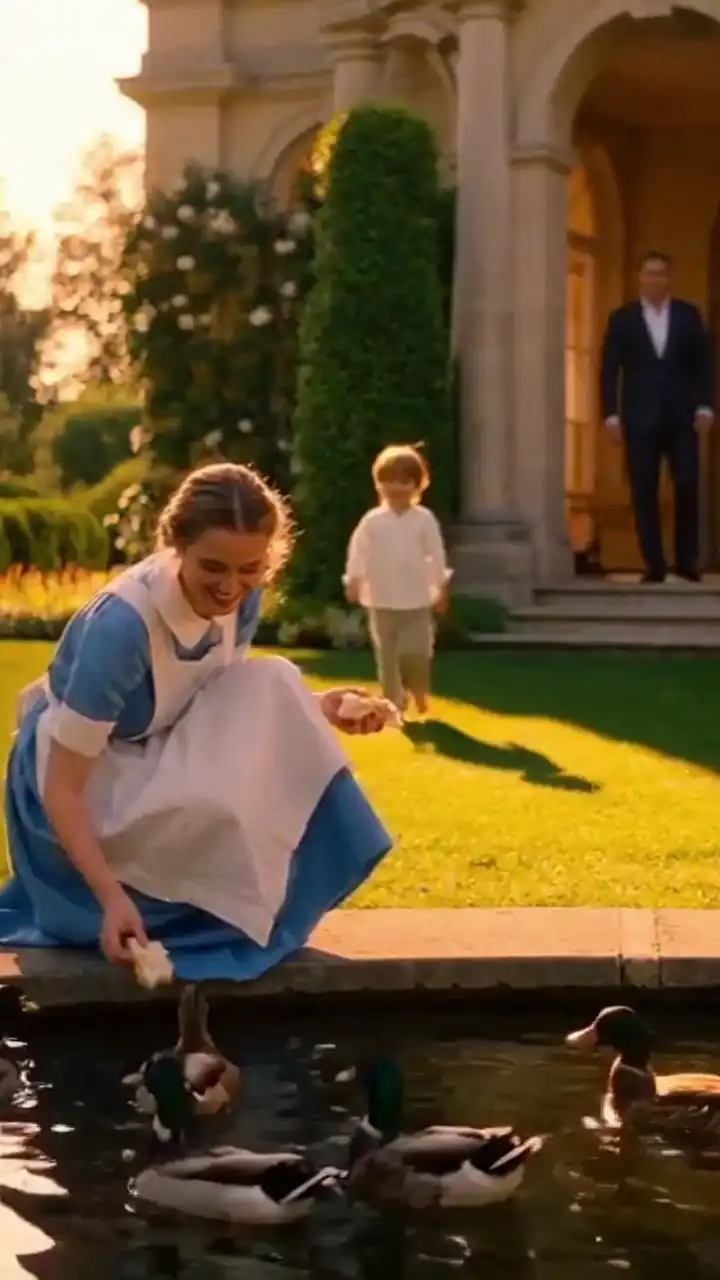
THE DAY THE BILLIONAIRE’S SILENT SON FOLLOWED A NANNY INTO THE GARDEN AND WOULDN’T LET HER LEAVE
The event manager kept talking like the bigger emergency was staffing.
“She’s not cleared to be with the child,” she snapped. “Mr. Cole, this is exactly why there are procedures.”
Maya slowly lowered the bread basket.
Noah’s fist tightened in her shirt.
That was what made everyone go silent.
Not the ducks. Not the fish. Not the fact that a stranger had gotten farther with him in ten minutes than licensed professionals had in a year.
It was the grip.
Noah almost never reached for people. If someone touched him, he usually folded inward or drifted away. But now he was anchoring himself to Maya like letting go of that faded cotton shirt would drop him back into the dead, polished stillness he had been living in.
Ethan crossed the terrace without rushing. He had learned that rushing Noah only closed him up again.
“Maya,” he said carefully, “don’t move yet.”
She nodded once.
The therapist recovered first. “Attachment through a random incident can be misleading. He’s reacting to the animals, not the person.”
Maya looked down at Noah’s hand but kept her voice level. “Then let me step away.”
Ethan said nothing.
Maya gently shifted one foot back.
Noah made a broken sound from deep in his throat and followed instantly, still holding her shirt.
No one in that garden could explain it away after that.
The therapist pressed her lips together. The event manager looked offended, as if Noah had disrupted the schedule on purpose. Ethan just stared at his son, at the small bare feet on the stone, at the sunlight on the top of his bent head.
“Cancel the dinner,” Ethan said.
The event manager blinked. “Tonight?”
“Yes.”
“What about the donor table, the press backdrop—”
“Cancel it.”
He did not raise his voice. He never needed to. But this time it sounded different. Less like control. More like a man realizing he had been protecting the wrong thing for too long.
Then he looked at Maya. “Please stay.”
That should have been the easy part.
It wasn’t.
Maya was not a trained nanny. She had done after-school art programs, pet sitting, summer camp, and one long stretch helping her older sister raise twin boys after a divorce. She had come to the estate because the florist’s assistant was her roommate and needed help carrying boxes.
She should have left with an apology and maybe a security escort.
Instead, she stayed for one afternoon. Then one evening. Then the next morning, because Noah stood by the terrace door at breakfast and hit the glass twice with his palm until staff understood he wanted to go back outside.
Maya did not try to “correct” him into normal conversation.
She entered his rhythm.
That was what none of the expensive adults had done.
When Noah lined acorns across the garden wall by size, Maya lined leaves beside them by color.
When he crouched by the pond and watched ripples for fifteen straight minutes, she sat beside him and watched too, pointing only when a fish broke the surface or a dragonfly landed on a reed.
When he flapped his fingers at sudden noise, she did not trap his hands or tell him to stop. She moved with him, lowered the sound around him, and waited until his breathing changed.
And always, she used something alive.
Ducks. Fish. Birds. The old golden retriever from the gatehouse. Even a line of ants carrying crumbs became a tiny parade she let him follow.
The estate had every toy room money could build. Noah ignored most of it.
But he would follow Maya into the side garden to scatter seed for finches.
He would stand beside her at the shallow edge of the pond and toss pellets to the koi.
He would crouch in the grass while she drew a chalk path on the service courtyard and place tiny found feathers at each turn like markers only he understood.
By the end of the first week, he was not speaking.
But he was moving toward things.
That alone changed the air in the house.
Staff lowered their voices around Maya, not because she ordered them to, but because Noah stayed calmer when she was near. The kitchen started packing plain crackers and fruit instead of only approved nutrition trays because Maya noticed Noah ate more when he could walk and nibble outside.
A boy who had once sat for hours in one room now wandered after one young woman in old sneakers from the pond to the herb beds to the little patch of shade behind the greenhouse.
That place became theirs.
It started with broken shipping crates stacked near the gardeners’ shed. Maya dragged two over, laid an old blanket across the top, tied twine between low branches, and clipped paper pinwheels and bottle caps that spun in the wind.
It looked cheap.
Improvised.
A little ridiculous beside a stone mansion worth more than some resorts.
Noah loved it.
He stood inside that tiny crooked fort and touched every hanging object one by one. Bottle cap. Ribbon. Feather. Smooth rock in a jar. Tiny bell.
Maya called it the bird station.
By the third day, Noah would take her hand for three seconds at a time if she was leading him there.
Ethan saw all of this mostly in silence.
He watched from the terrace before dawn with coffee going cold in his hand. He stood half-hidden by the library doors during therapy and saw Noah shut down the second sessions became a performance. He came home early from meetings and found his son sitting in the dirt beside Maya while she helped him press birdseed into pinecones with peanut butter from the kitchen.
The old Ethan would have stopped that immediately.
The old Ethan would have seen mess, germs, disorder, liability.
Now he saw his son look at a pinecone, then at Maya’s fingers, then copy the motion.
It was still no eye contact. Still no words. Still no miracle fit for a television segment.
But it was connection.
And it made him ashamed.
Not because he had failed to love Noah. He loved him so hard it had turned into management. He had mistaken protection for presence. Every instruction from specialists had become another wall. Keep him regulated. Keep him safe. Keep him on schedule. Keep him from distress.
All the while, Noah had disappeared inside routines built around avoiding the world.
Maya did the opposite.
She made the world small enough to enter.
Naturally, resistance came fast.
It didn’t come from Ethan. It came from outside people who had a stake in the old system.
The therapist requested a formal review, saying Noah’s progress could be “misread,” that an uncredentialed caregiver might create “inconsistent emotional dependency.”
A private educational consultant Ethan had retained pushed hard for a residential developmental program in Connecticut, complete with glossy brochures and smiling children on horseback. “This is the age to intervene aggressively,” she said. “The window is closing.”
Then Ethan’s sister Caroline arrived from Boston and took one look at the little fort behind the greenhouse as if she’d found a homeless camp on the property.
“This is absurd,” she said. “You’ve let some random girl build trash in the garden, and now everyone’s acting like she discovered gravity.”
Maya, kneeling with Noah beside a bucket of fish pellets, kept her focus on the child.
Caroline was not used to being ignored.
She lowered her voice but not enough. “Noah needs structure, not attachment to hired help. And what happens when she leaves? He crashes again.”
That landed because it was the one fear already living in Ethan’s chest.
What happens when she leaves?
Maya heard it too. That evening, after Noah finally slept, she stood in the back kitchen rinsing mud from a plastic bowl while Ethan leaned against the counter across from her.
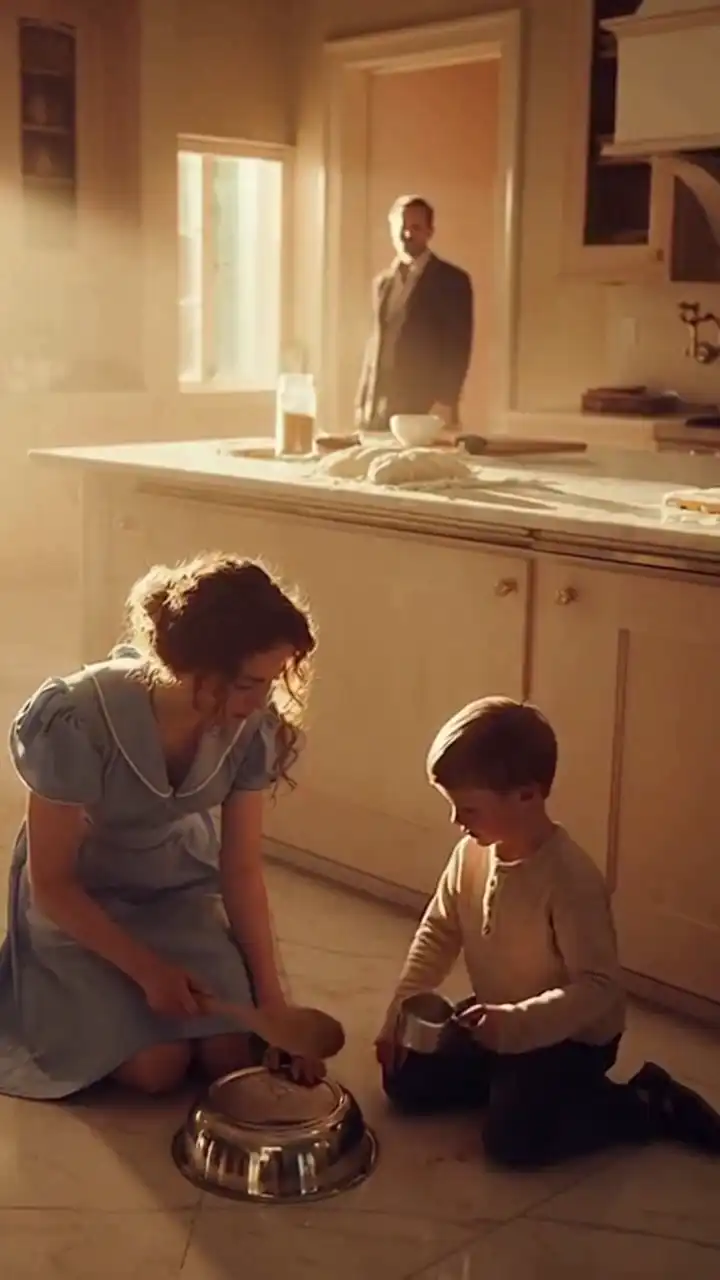
The kitchen was one of the few rooms in the house that still felt human. Scuffed drawers. Warm lights. A dish towel slung over a handle.
“I should probably go before this gets worse,” Maya said.
Ethan looked at her. “Do you want to go?”
She took a second too long to answer. “That’s not the question.”
“It is for me.”
She dried her hands. “Your son is attaching through movement and shared focus. He doesn’t want to be pulled into our world yet. He wants someone to enter his without forcing it. The animals help because they don’t demand anything. They move, they react, they make patterns he can follow. There’s no pressure in them.”
Ethan said nothing.
She went on, quiet but direct. “But if everyone around him treats me like a problem to remove, then eventually I become another rupture. And he has had enough of those.”
Enough ruptures.
His wife dying room by room in a private hospital suite no amount of money could fix. The funeral Noah had endured like a siren trapped under glass. The rotating door of women instructed to soothe him on a schedule. Ethan himself, always there, always paying, rarely kneeling in the dirt long enough to simply stay.
The next week made the decision for them.
The consultant scheduled a trial visit to the residential program without clearly telling Ethan it was more than an evaluation. A car arrived. A driver in a navy suit. A cheerful program director with laminated visual cards and the bright false confidence of someone who had already placed a child into a brochure version of hope.
Noah sensed the disruption before anyone touched him.
He stopped eating breakfast. Stood stiff at the end of the hall. Started hitting his own thigh in a hard, repetitive rhythm.
Maya came down the stairs and slowed immediately.
No fast approach. No cheerful redirection.
She crouched five feet away.
Outside the windows, birds flickered over the hedges. Noah’s head twitched once toward the light, then back to the strange adults.
The program director smiled too wide. “We use transitional support strategies—”
Ethan lifted a hand. “Not now.”
The driver wheeled in a small suitcase one of the house staff had packed the night before. Seeing it broke something open.
Noah made a sound Ethan had never heard before. Raw. Panicked.
Then he ran.
Not far. Not well. More like a desperate bolt on uncertain legs. But he ran straight past the adults, straight through the breakfast room, straight out the half-open terrace door toward the back garden.
Everyone moved at once.
Ethan was fastest to the door.
Maya was the only one who didn’t shout.
Noah reached the bird station behind the greenhouse and stood inside it, shaking so hard the hanging bottle caps clicked against each other like teeth.
Maya stopped outside the little fort.
“I know,” she said softly. “Too much.”
Noah slapped both hands over his ears.
The program director, arriving behind Ethan, whispered, “This proves he cannot handle environmental unpredictability.”
Maya turned so sharply Ethan almost smiled despite the moment. “No. It proves he knows exactly when people are taking him away.”
Then she looked at Ethan.
Not pleading. Not dramatic. Just clear.
Choose.
The whole arc of his life had taught him to solve problems by purchasing expertise and executing decisions. This one felt different. This one exposed him.
His son wasn’t refusing treatment.
His son was terrified of another separation he had not chosen and could not understand.
Ethan stepped in front of the program director. “You need to leave.”
“Mr. Cole, with respect, this level of attachment to a temporary caregiver is precisely why placement can be stabilizing—”
“I said leave.”
Caroline, who had come in from a call on the terrace, looked furious. “You are making a decision based on a scene.”
“No,” Ethan said. “I made every other decision based on fear.”
That shut her up.
He walked to the edge of the little fort and did something he had not done in months.
He sat on the ground.
Not on a chair brought by staff. Not on a cushion. On the dirt, in his suit pants, with one knee bent awkwardly and both hands visible.
Noah was still shaking.
Ethan didn’t tell him to calm down.
He looked at the spinning pinwheels, the crooked twine, the feather jars. “I should have come here sooner,” he said quietly.
Maya said nothing. She knew this wasn’t for her.
A finch landed on the branch above them, quick and light.
Maya reached into her pocket, pulled out a few seeds, and held them on her palm just outside the fort. Noah stared at them through his fingers.
A long ten seconds passed.
Then twenty.
Then Noah moved one hand from his ear.
He looked at the seeds.
Then at Maya’s hand.
Then, with tiny jerking motions, he stepped forward and took them.
The finch startled away before he could offer them.
Noah’s face crumpled.
Maya gently opened her other hand. More seeds.
This time she nodded toward Ethan.
It took him a second to understand.
Then he held out his own palm.
Noah stared at it as if it belonged to a stranger.
In some ways, it did.
Ethan kept it steady.
A minute later, Noah placed three seeds into his father’s hand.
It was almost nothing.
For Ethan, it was unbearable.
The bird didn’t land then either. It didn’t matter. Noah stayed. He did not run from Maya. He did not run from his father. He stood between them in the cheap little fort made of scraps and string while the expensive future other people had planned for him drove back out through the gates.
After that day, nobody spoke about residential placement again.
The therapist resigned two weeks later, wrapping it in polite language about “differences in treatment philosophy.” Ethan let her go.
Caroline still disapproved, but disapproval has less power when it no longer controls the room. Noah would walk past her on the way to the garden and not stop. The first time he tugged Maya’s sleeve in front of Caroline and then glanced back at Ethan as if expecting him too, Caroline saw plainly that she no longer got to define what was proper inside that house.
Progress came in pieces.
Noah began sleeping longer on nights after outdoor play.
He started bringing objects to Maya instead of only collecting them alone: a striped feather, a smooth stone, a cracked blue eggshell from under the hedge.
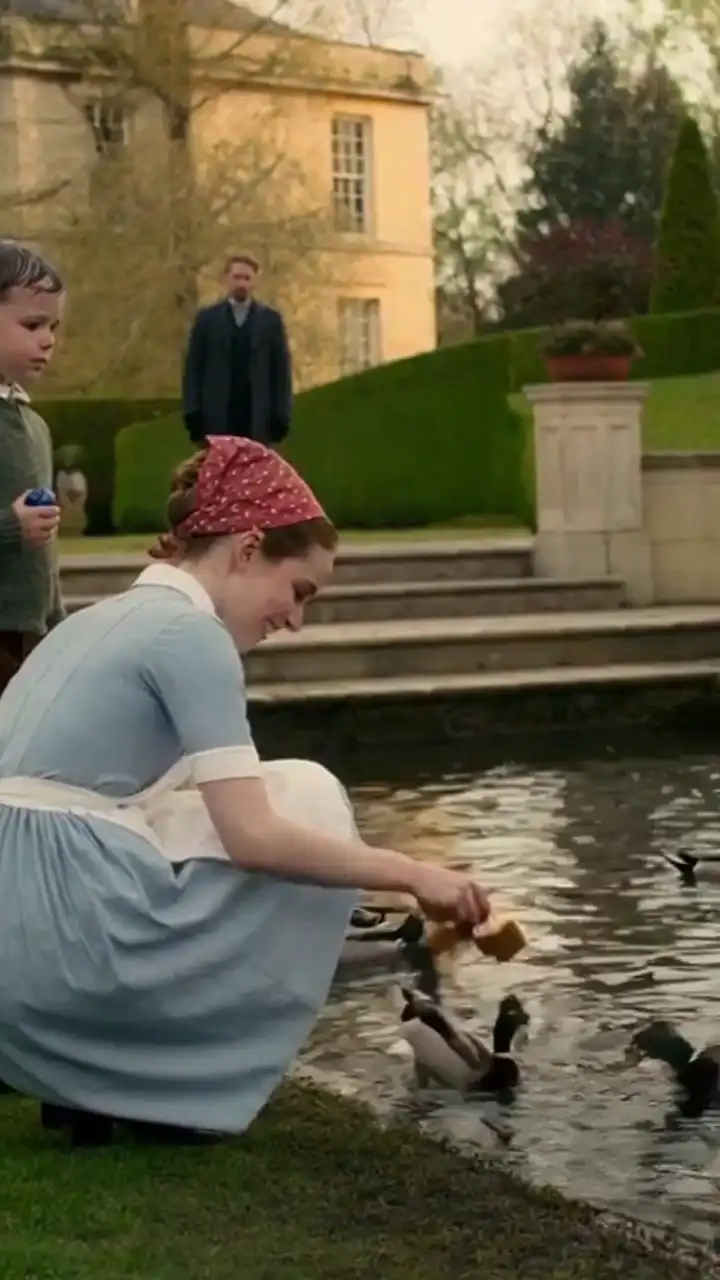
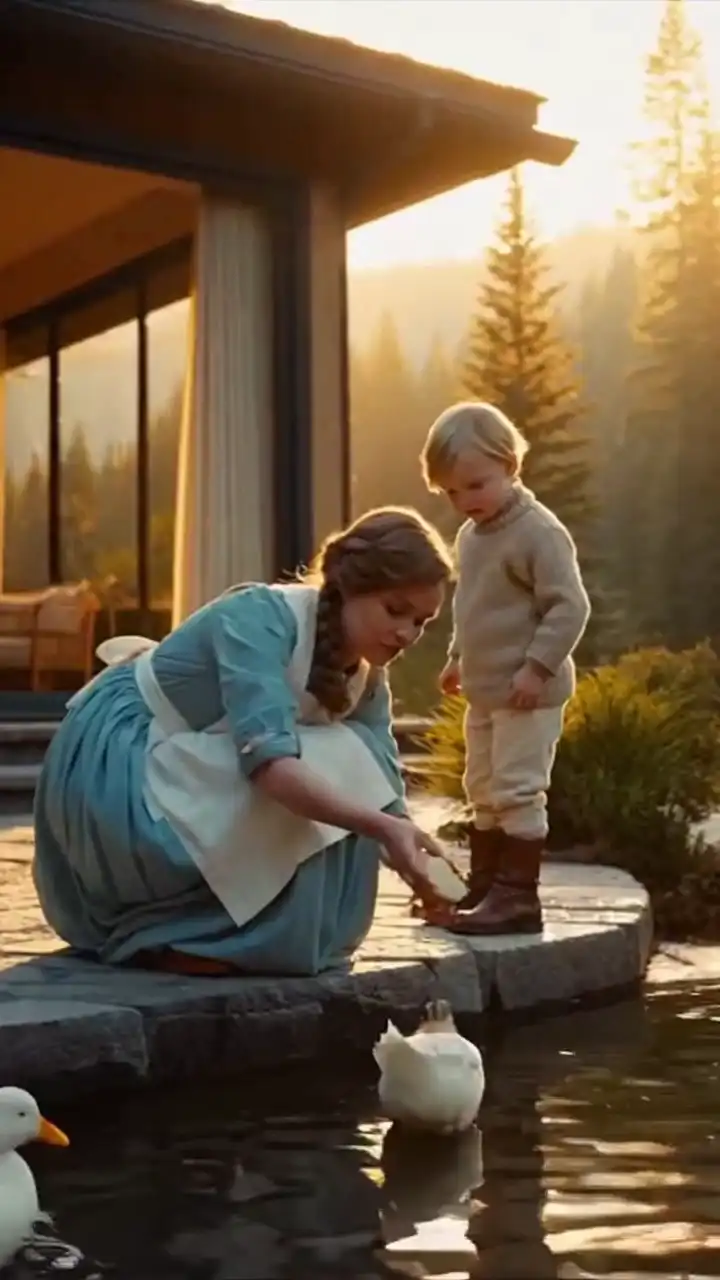
One afternoon at the pond, a duck snatched bread from Maya’s fingers and she yelped. Noah laughed.
It wasn’t a movie laugh. More like a rusty gate opening.
Ethan was standing twenty feet away. He turned so fast he nearly dropped his phone.
Maya didn’t celebrate. She laughed too, like it was the most natural thing in the world, and Noah laughed again.
A week later he followed the old gatehouse retriever all the way across the lawn, then turned and checked that Maya was watching.
Then one morning in the kitchen, while Maya spread peanut butter on apple slices and Noah sat swinging his feet against a cabinet, he made a soft sound.
“Ma.”
Everything in the room stopped.
Ethan, at the far counter reading email, went perfectly still.
Maya did not rush him. “More?”
Noah touched the jar. “Ma.”
It wasn’t mother. It wasn’t a ghost miracle. It was more, the shape he could make, the request he was trying to build.
Maya smiled and handed him another slice.
But Ethan had to look away for a second because grief and relief can hit the same nerve and make a man feel split open.
By fall, the side garden looked less like a formal estate and more like a place where a child actually lived.
There were stepping stones painted with messy fish and bird shapes.
There were seed trays, a weathered basket of pond pellets, chalk circles on the service path, and the repaired little fort behind the greenhouse, no longer hidden or apologized for. Ethan had the gardeners reinforce it properly after a storm knocked one side down, but he kept Maya’s bottle caps, ribbons, and bells exactly where they were.
He was learning not to improve the life out of things.
Then came the question everyone had avoided.
What was Maya now?
Not a florist’s assistant’s roommate. Not a temporary accident.
And not just a servant who happened to matter.
Ethan called her into the library one evening after Noah fell asleep on the den rug with the retriever’s head on his ankle.
Maya stood by the door at first, uncomfortable in rooms built to intimidate.
Ethan slid a folder across the desk.
She didn’t touch it. “What is it?”
“A contract, if you want it. Full salary. Benefits. Housing in the guest cottage if you prefer your own space. And funding.”
She frowned. “Funding?”
“You said you left school.”
Maya had done two years at a state college before money ran out. Art education. Child development electives when she could fit them.
“I’m not buying gratitude,” Ethan said before she could misunderstand. “I’m correcting what this house calls valuable. If you stay, you stay with authority, support, and a future that isn’t dependent on my moods.”
That finally got her to look up at him.
For the first time, he didn’t look like a man hiring help. He looked like a father trying not to repeat an old mistake.
Maya opened the folder. Tuition reimbursement. A formal role designed around Noah’s care and developmental support. Use of the cottage. Paid training if she wanted credentials. Real protection. Real respect.
“This is too much,” she said quietly.
“No,” Ethan answered. “It’s just the first thing that makes sense.”
She laughed under her breath, half from nerves. “And if Noah wakes up one day and decides he hates ducks, birds, fish, forts, and me?”
“Then we adjust,” Ethan said. “That’s what you taught us.”
Us.
Not staff. Not services. Not a managed household.
Us.
Maya stayed.
The cottage lights came on at the edge of the garden by the first cold week of November. Noah began walking there with Ethan in the mornings to knock on the door before breakfast, impatient in his own quiet way, usually carrying something to show her.
A leaf.
A feather.
A piece of ribbon blown loose from the fort.
Months later, at a foundation luncheon Ethan had once cared too much about, he was supposed to give a speech about innovation and resilience. Instead, he cut half of it and told a room full of polished people that the most important change in his house had started with stale bread, noisy ducks, and a young woman everyone was ready to remove.
Some smiled politely because they thought he was being metaphorical.
He wasn’t.
That afternoon he came home early and found Noah in the garden between the pond and the fort, one hand in Maya’s and one hand clutching a paper cup of fish pellets.
Ethan stopped on the path and watched.
Maya pointed toward the water. Noah looked, then back at her, then toward Ethan.
He lifted one pellet, serious as a judge, and held it out.
Ethan walked over and took it.
The three of them stood there while the koi stirred the pond surface into little rings of gold and silver.
Noah tossed the first pellet.
Then he pressed another into Maya’s palm.
Then another into his father’s.
Not cured. Not transformed into someone else. Still a child who moved through the world in his own difficult, careful way.
But connected.
Present.
Choosing.
And when a duck flapped too close and startled Maya into laughing, Noah reached for her sleeve, then for his father’s hand, keeping both.
This time, nobody tried to pull him away.
Disclaimer: Mention of any brand or trademark is for identification only and does not imply partnership or endorsement
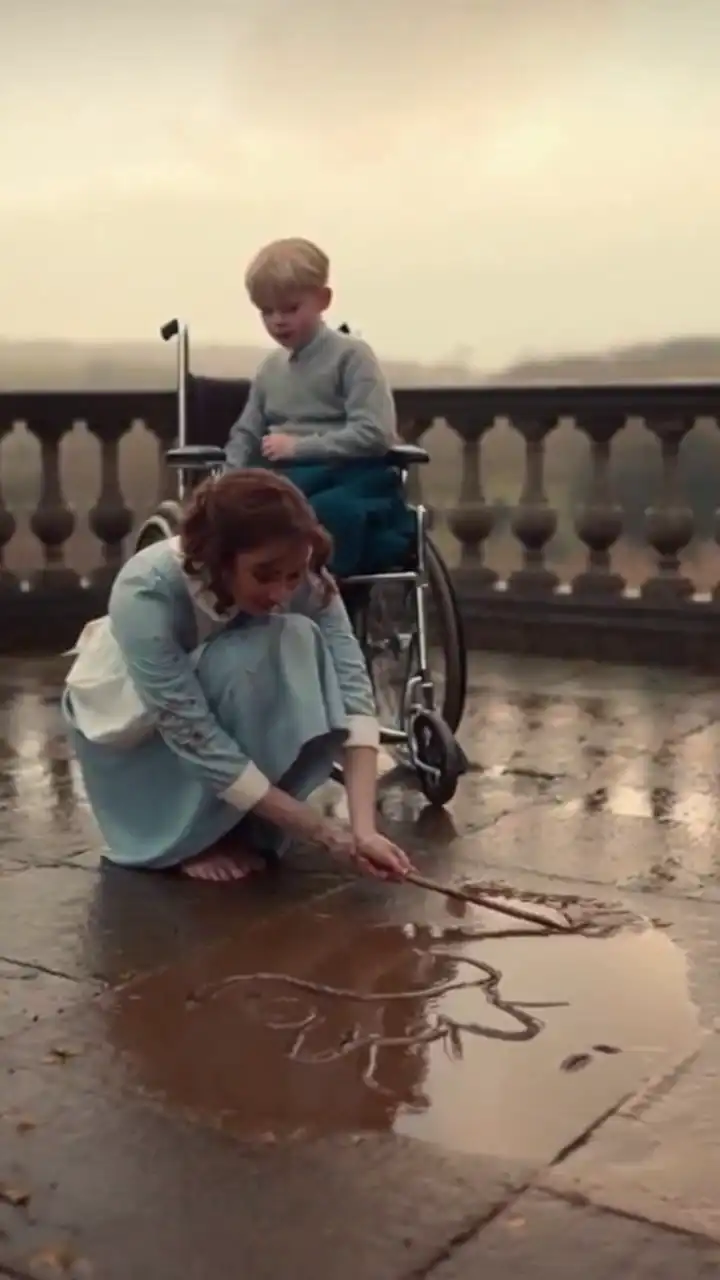
WHEN THE BILLIONAIRE’S SON DRAGGED HIS USELESS LEGS INTO THE MUD FOR THE FIRST TIME, HIS FATHER’S GIRLFRIEND SCREAMED FOR THE NANNY TO STOP
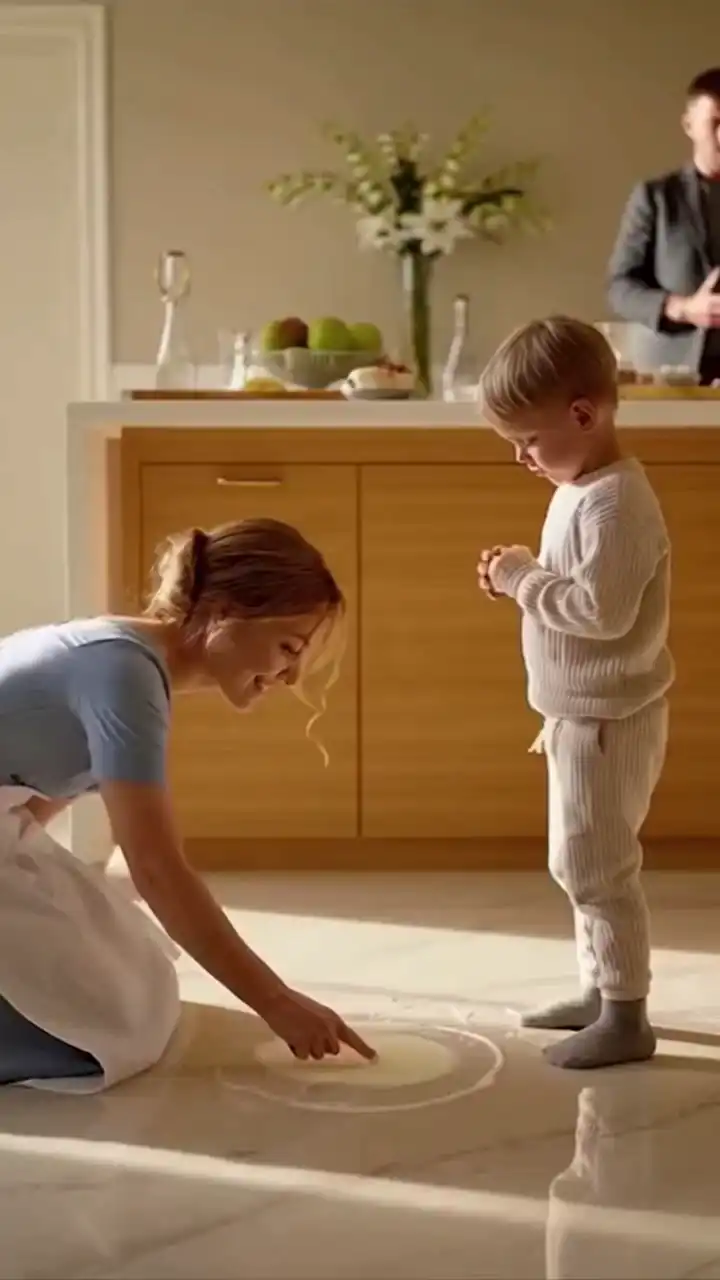
WHEN THE RICHEST MAN ON THE HILL HIRED THE WRONG NANNY, HIS SILENT SON CRAWLED ACROSS THE FLOOR FOR HER
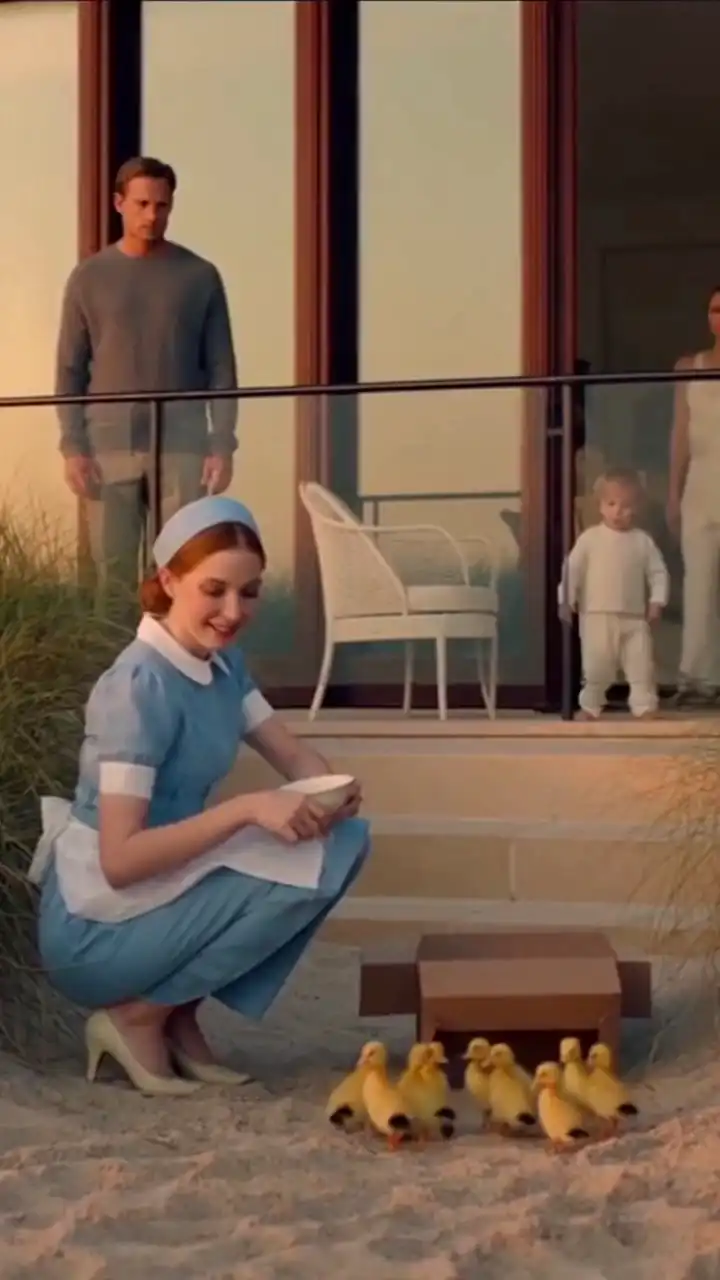
THE NANNY WHO BROUGHT DUCKS TO THE OCEAN HOUSE AND MADE A CHILD WALK TOWARD LIFE