


THE NANNY SMEARED ICE CREAM ACROSS THE HEIR’S FACE, CRAWLED ON A PENTHOUSE FLOOR, AND THE BOY WHO HADN’T REACHED FOR ANYONE SINCE HIS MOTHER DIED SUDDENLY GRABBED HER SLEEVE
Daniel stood there with one hand still on his phone and the other hanging useless at his side.
He had spent twelve weeks being told to track patterns, reduce stimulation, respect thresholds, avoid surprises, maintain consistency. He had followed all of it. He had turned grief into protocols because protocols were the only things that had ever obeyed him.
But his son was clutching the sleeve of a nanny who had just smeared dairy across a ten-foot window.
Lena didn’t look up and celebrate. She didn’t ask for approval.
She just shifted her arm carefully so Eli wouldn’t feel tugged, then picked up the spoon again and tapped the window.
“One dot for me,” she said. “One dot for the boss.”
Eli’s fist tightened.
Then his free hand lifted.
It moved slowly, like the air itself was heavy. He took the spoon from the rug, stared at the melting white scoop, and pressed it against the glass. It slid down in a crooked stripe.
Lena leaned back like she’d just witnessed a masterpiece.
“Oh, wow,” she said. “That’s terrible in a very advanced way.”
A sound came from Eli.
Not a word. Barely even a laugh. More like a broken little puff of air that got caught halfway out.
Daniel felt it hit him harder than any sentence.
That should have been enough for one day. Every therapist in the city would have said stop there, preserve the success, avoid overwhelm.
Lena didn’t push for more. But she also didn’t freeze the moment in gold and turn it into another performance report.
She let it be messy.
When Eli’s hand trembled and the spoon slipped, splattering a white drop on the hardwood, Daniel automatically moved forward.
Lena raised one finger at him without turning around.
He actually stopped.
She took her own finger, scooped the fallen ice cream from the floor before staff could rush in, and drew a tiny smiley face on the wood.
For one awful second Daniel thought she had lost her mind.
Then Eli looked down.
He stared at the smiley face.
And lowered himself to the floor.
Not neatly. Not obediently. He dropped to his hands and knees like a child much younger than six, moving toward the silly smear. He touched it. Smudged it. Then looked at Lena again, fast and sharp, as if checking whether she would ruin it by making it important.
She got down too.
On the polished floor of Daniel Mercer’s penthouse, in the middle of a workday, the nanny crawled two feet and made another tiny face with melted ice cream.
Eli followed.
Daniel’s housekeeper appeared at the entrance and nearly gasped. Daniel dismissed her with a glance he didn’t even have the energy to sharpen.
The rest of that first afternoon was small and huge at the same time. Fog on glass. Fingers in melt. Crawling from one ridiculous little drawing to the next. No speech. No miracle. But when Lena finally stood to wash Eli’s hands, he went rigid.
The old retreat was back in a flash.
His body locked. His chin dropped. He tried to pull inward and disappear.
There it was. The resistance nobody in the house had known how to name properly. Not tantrum. Not defiance. Not simple fear. Every time Eli felt one step of connection, another force yanked him backward. As if moving toward life was a betrayal he couldn’t survive.
Lena crouched in front of him and waited.
No touching.
No cheerful voice.
Just waiting.
“You can hate the ending part,” she said quietly. “Still have to wash the sticky off.”
A long minute passed.
Then Eli let her guide him to the sink.
That night Daniel canceled dinner with investors and stood outside Eli’s bedroom longer than usual. He heard water running in the bathroom. Drawer sounds. Soft footsteps. Then something he hadn’t heard in months: another voice in the room after lights-out, low and ordinary, not therapeutic.
Lena was telling Eli about a bodega cat from her block that stole turkey sandwiches and only liked one old man.
No lesson. No healing language. Just life.
Daniel almost opened the door. He didn’t. He stood there and listened until he heard no answer from Eli and assumed the boy had retreated again.
Then Lena came out twenty minutes later and found Daniel still in the hall.
“He didn’t sleep,” Daniel said.
“He rested,” she answered.
“That’s not the same thing.”
“For adults, no.”
He was tired enough to be honest. “If this goes wrong, he loses ground for days.”
Lena nodded. “I know.”
“You say that like you’ve seen this before.”
“I’ve seen kids pull away after something hurts too big and too fast. Not the exact same. But enough.”
He looked at her more carefully then. Not polished. Not intimidated. Not trying to impress him. She wore one of the apartment’s plain staff aprons over a faded T-shirt and still somehow looked more real than anyone else in the place.
“What are you doing?” he asked.
She leaned against the wall, exhausted. “He got trapped inside one moment.”
Daniel’s face tightened.
She didn’t soften the truth. “Everyone around him has been trying to bring him back with control. Quiet voices. measured choices. clean rooms. no surprise. But the last thing before his life split open was a controlled car, adults being careful, rain on the window, and then impact. His body doesn’t trust stillness the way you think it should.”
Daniel said nothing.
“So I’m giving him low-stakes disorder,” she continued. “Things that move. Melt. smear. happen and don’t become dangerous. Tiny messes he can touch and survive.”
It sounded too simple. Too crude. Too unlike the language of every specialist he’d paid.
And yet his son had held her sleeve.
The next morning, Eli was worse.
That was how the real battle started.
He wouldn’t come out of his room. He kicked when Maria, the housekeeper, tried to change his sheets. He shoved away the breakfast tray. When Daniel entered, Eli turned his whole body to the wall and pressed his forehead against it.
Progress had lit the fuse. Retreat hit back.
Daniel called the child psychiatrist before eight-thirty.
“Regression after activation isn’t uncommon,” the doctor said through speakerphone. “Remove novel stimuli. Re-establish familiar parameters.”
Daniel looked across the kitchen island at Lena.
She was cutting strawberries with a butter knife and not even pretending to care what the specialist said.
“Thoughts?” he asked after he hung up.
“Yes,” she said. “If he had a hard workout and his legs shook the next day, would everyone decide walking was the problem?”
“This is not a workout.”
“No. It’s grief in a six-year-old body.”
He hated how quickly her answers got under his skin.
But he let her try.
She didn’t drag Eli from the bedroom. She moved life closer instead.
She opened his door halfway and sat in the hall with a mixing bowl, flour, water, salt, and blue food coloring stolen from the back of the baking cabinet. Then she started making the ugliest dough in the world.
Not for him. Near him.
The penthouse filled with sounds that usually never belonged there. Bowl scraping. Wet slap. Her annoyed muttering when the dough got too sticky. She blew air through her lips and left a blue streak on her own wrist. She didn’t ask Eli to join.
Daniel, passing in a suit, stopped dead at the sight of a nanny sitting cross-legged on the floor outside his son’s room making blue paste.
“This floor cost more than a car,” he said.
Lena looked up. “Then it can survive flour.”
He should have snapped back.
Instead, to his own disgust, he almost laughed.
For twenty minutes, nothing happened.
Then the bedroom door opened two more inches.
A pale hand appeared at the edge.
Lena kept kneading.
Another minute. Eli came to the threshold and sat there, not crossing over, eyes fixed on the dough.
Lena pinched off a piece and rolled it into a crooked snake. “Rude little guy,” she said to the dough. “No manners.”
She set it down and made another one. This one she flattened with her palm.
Eli’s fingers opened and closed on his knee.
Then he crawled out.
Again on the floor. Again younger than his age. Again humiliating and holy at the same time.
He stopped beside the bowl and looked at the blue dough like it was alive.
Lena waited.
Eli touched it with one finger. Pulled back. Touched it again harder. Then both hands sank in.
The first real sound he made that day was a sharp breath through his nose, almost offended by how soft it was.
Daniel watched from the dining area and felt something inside him crack in a place he had been defending with everything he had.
His son did not need another perfect system.
He needed permission to be a child again.
The days that followed were not a straight climb. They were ugly. That was the point.
Some mornings Eli sat with Lena on the kitchen floor and watched oatmeal bubble over because she let the pot get “accidentally” too full. Some afternoons she breathed on the terrace door and let him draw shapes in the fog. Once she spread butcher paper on the marble island and let him drag toy cars through washable paint, then across the paper, then—when he looked panicked about the mess—across her own forearm first.
See? the gesture said. Nothing bad happened.
At first, Eli only copied her in fragments.
A touch. A crawl. A shared look.
Then came appetite. He licked batter off a spoon. He stole a blueberry from the mixing bowl. He pushed half a banana slice at Lena and waited until she accepted it. Daniel stared at that tiny offering like it was a stock market miracle.
Then came participation. Eli began appearing before she called him. Hovering in doorways. Standing by the counter. Following the sound of cabinet doors and kitchen drawers.
Then came preference. If someone else tried to lead him, he turned away. If Lena tied on an apron, he moved closer.
And every time he moved closer, the backward pull came for him.
A nap would go bad and he’d wake shrieking soundlessly, body arched, drenched in sweat.
A car horn from forty floors below would freeze him for an hour.
Rain against the windows brought back the worst of it. On rainy days he often crawled under the console table in the foyer and shut down so completely that Daniel felt dragged back to the first week after the funeral.
But now Lena understood the pattern.
She didn’t try to talk him out of terror. She gave his body a bridge.
On one stormy afternoon she found him under the table, staring at the dark window while water streaked the glass. Daniel stood nearby in that same helpless, expensive posture he knew too well.
“He was doing better,” he said, as if better had been a contract the world had broken.
Lena disappeared into the kitchen and came back with a can of whipped cream and a box of graham crackers.
Daniel blinked. “What are you doing?”
“Interrupting the room.”
She sat on the floor, sprayed a cloud of whipped cream onto a cracker, and took the most dramatic, ridiculous bite any adult had ever taken in that foyer.
Crunch. Mmm. Fake scandal.
No response.
She sprayed whipped cream onto her upper lip like a mustache and widened her eyes at the rain.
Eli’s gaze flicked toward her.
She made a second cracker. Left it on the floor within his reach. Not too close.
Rain hit glass.
Daniel held his breath.
Eli stared at the cracker for so long Daniel thought the moment had failed. Then Eli stretched one arm out from beneath the table, took it, and crushed half the whipped cream out the sides.
He looked at the mess on his own fingers.
Lena slowly licked whipped cream off one finger like it was the funniest thing in the world.
Eli’s shoulders shook.
Once.
Twice.
A laugh came out, rough and rusty from disuse.
Daniel sat down right where he was, in slacks that cost more than Lena’s monthly rent, because his knees had given up on him.
That night was the first time Eli fell asleep without pacing the edges of his bed with his eyes open.
Lena sat on the rug by the bed while Daniel stood at the doorway. Eli was already drowsy, one hand clutching the corner of his blanket. His breathing was uneven, but he was drifting.
Then his fingers opened in the air.
Searching.
Not fully awake. Not speaking. Just searching.
Lena offered two fingers.
He wrapped his hand around them and slept.
Daniel turned away because he did not want the young woman on his son’s floor to see his face collapse.
From then on, his authority changed shape.
He still signed checks. Still ran meetings. Still had people waiting on his decisions by the minute. But in the penthouse he stopped acting like certainty was the same as care.
He loosened the schedule.
He told staff to stop rushing in at every noise.
He let crayons stay on the breakfast table. Let a blanket fort occupy half the den. Let Lena order dollar-store bubbles, cheap finger paint, and a plastic mixing bowl in bright red that clashed horribly with the kitchen.
He even got on the floor once.
Only once at first. Awkward. Stiff. Looking like a man trying to merge with an alien species.
Lena handed him a marker and pointed at the fogged terrace door.
“Draw something.”
“I can’t draw.”
“Perfect.”
He drew a pathetic square with windows.
Eli looked at it, then at him.
Daniel, suddenly reckless in a way he had never been in business, added smoke coming out of the chimney even though they lived in a skyscraper.
Eli leaned against Lena’s shoulder and made the smallest huffing sound. Close enough to a laugh that Daniel would have defended it in court.
Later, in the kitchen, Daniel asked, “Why didn’t anyone tell me this?”
Lena rinsed bowls in the sink. “Maybe they did. In cleaner words. Maybe you only knew how to hear things that sounded controlled.”
That should have offended him.
Instead he nodded.
The biggest break came on a Sunday, the first clear day after a week of rain.
Daniel had a family office call he kept postponing. Eli was in the den with Lena, building a crooked road out of couch cushions and dish towels. Then one of the towels slipped. Eli fell sideways, not hard, but enough to knock the breath out of him.
Daniel heard the thud and was there instantly.
Too instantly.
He came in fast, voice sharp with fear. “Eli!”
The boy froze.
His whole body drew tight, face gone blank, terror flashing through him with awful speed.
Daniel stopped like he’d hit invisible glass. He saw it then. Not just Eli’s fear of the world.
Eli’s fear of his father’s fear.
Every time Daniel rushed in with that strained, controlled panic, the room became the accident again: adults, danger, no warning, no breath.
Lena didn’t tell him to leave.
She crouched, palms open, and looked at Eli. “Fell down,” she said simply. “Floor won.”
Nothing.
Then she sat down beside the collapsed cushion road and deliberately tipped herself over too. Hard enough to make a silly grunt.
Daniel stared.
Lena looked up at the ceiling. “Terrible tragedy,” she announced.
A beat passed.
Eli blinked.
Then he rolled, slowly, toward the fallen towel. Touched it. Pulled it over his own legs. Peeked out. Lena pulled another cushion and let it flop onto herself.
The game returned.
Not because fear vanished. Because it had been repaired in real time.
Daniel backed out of the room and stood in the hall, one hand over his mouth.
That evening, after Eli finally slept, he found Lena on the terrace wrapping leftover dough in plastic.
He said the words badly. “I made it worse.”
She didn’t deny it. “Sometimes.”
“I thought if I controlled everything, he would feel safe.”
“You were trying to stop the second loss,” she said. “Makes sense.”
“And instead?”
“You kept showing him the world was too fragile to touch.”
The city lights reflected in the glass behind them. Daniel looked older than he had when she arrived.
“What if I don’t know how to do this without breaking him?” he asked.
Lena gave a tired half smile. “Then start by not acting like every mistake is breakage.”
A week later, Eli spoke.
Not in some grand scene with a doctor present.
Not in therapy.
Not even to his father first.
Lena had just finished wiping a streak of chocolate pudding off the kitchen cabinet because she had made the reckless decision to let Eli “help” with snack. He stood by the counter in an oversized T-shirt, hands sticky, watching her with focused seriousness.
She pretended to inspect the mess like a detective.
“Could be raccoons,” she said.
Eli’s mouth twitched.
“Could be a very small criminal with pudding hands.”
He looked at his palms, then at her.
And in a voice rusty from months of silence, he whispered, “Again.”
Lena went still.
Not dramatic still. Careful still.
“Again?” she repeated softly.
He nodded once.
From the doorway, Daniel gripped the frame so hard his knuckles whitened.
Lena put the spoon back in the pudding bowl.
“Again it is,” she said.
They made an even bigger mess the second time.
Word spread through the household in minutes, because of course it did. Maria cried openly in the laundry room. Daniel’s assistant pretended not to. The child psychiatrist requested updated notes with professional excitement Daniel no longer had much patience for.
Then came the decision no one had seen building except Lena.
Her younger brother in Queens had finally gotten a call from a union apprenticeship program he’d been chasing for two years. The start date was immediate. Their mother’s rent was late. The family needed Lena home in the evenings and early mornings to help with childcare for her sister’s twins so her sister could keep a night-shift nursing job.
The Mercer job had been rescue work from the start. Good pay, temporary, taken out of desperation.
Now her own life was pulling hard in the other direction.
Daniel offered money first, because that was the language he knew best. More salary. Better hours. A driver. A larger role. Tuition support if she wanted school. He said it all standing in the kitchen where Eli was coloring at the table, as if practical generosity could fix timing.
Lena listened.
“You should ask for more,” he added quietly, almost awkwardly. “If it’s about class pride or not wanting to name a number, don’t.”
She shook her head. “It’s not that.”
“Then what is it?”
“I came here because your son needed someone to walk into the stuck place with him,” she said. “He’s walking out now.”
Daniel looked toward Eli, who was pressing green crayon so hard it kept snapping.
“He still needs you.”
“Yes,” Lena said. “But not the same way.”
That was harder for him than no.
The last week hurt everyone.
Eli felt it before anyone explained it. He grew clingy at bedtime, more watchful during the day. He shadowed Lena from room to room. If she stepped into the pantry, he appeared at the door. If she sat on the floor, he leaned against her knee.
This time Daniel didn’t pretend separation would be painless. He asked Lena what to do.
“Make it concrete,” she said. “No disappearing. No fake promises.”
So they made a calendar with thick blue Xs. They took pictures of Eli and Lena doing their ridiculous rituals: fog drawings on glass, blue dough hands, whipped-cream mustaches, blanket forts, pudding disaster. Lena printed them at a pharmacy and put them in a cheap plastic album, the kind no one in that penthouse would ever have bought on purpose.
On her second-to-last night, Eli had a setback so sharp it left Daniel shaking.
Rain started after midnight.
Daniel found Eli on the floor outside Lena’s room, knees tucked under him, breathing too fast, one hand hitting lightly against the carpet in a repetitive tap. Old fear. Old shutdown. And new panic layered over it—this person was leaving too.
Daniel’s instinct was to scoop him up, fix the breathing, make it stop.
Instead he sat down on the floor.
Not close enough to trap him.
Just there.
Lena opened her door, took in the scene, and didn’t rush either. She came back with a washcloth, breathed warm air into it, and pressed her fingertip over the damp fabric to make a little circle.
“Fog window,” she said.
Eli’s tapping slowed.
Daniel copied her. He breathed into his own hands, uselessly at first, then onto the edge of his sleeve, making a damp patch.
Lena gave him a look that said keep going.
So Daniel did the absurd thing.
He leaned down and breathed onto the hardwood floor.
It barely fogged, but he drew a crooked sun with his finger anyway.
Eli looked at it.
Then at his father.
Then, with visible effort, he uncurlled enough to crawl forward and press his palm over the little drawn sun before it vanished.
Daniel’s throat closed.
Lena set the washcloth beside Eli. “Your turn.”
Eli took it. Breathed into it. Pressed his own handprint into the damp.
Three people sat on the floor outside a staff bedroom in a luxury penthouse at one in the morning, making temporary marks that disappeared in minutes.
And somehow that was the lesson.
Things could vanish and still be real.
On Lena’s final day, Daniel canceled everything.
No meetings. No calls. No driver waiting downstairs.
They spent the morning in the kitchen making pancakes badly. Eli stirred too hard. Flour dusted the black countertops. One pancake folded onto itself and looked like a shoe. Lena laughed. Daniel actually laughed with her. Eli watched both of them, then pushed the misshapen pancake toward his father like an offering.
Daniel ate it.
By afternoon, the light had turned soft against the windows. Lena packed one small duffel by the front door. Nothing dramatic. She had not come into their lives as a fantasy, and she was not leaving like one.
Eli stood very still by the sofa, plastic photo album clutched to his chest.
His face had that old frozen look around the edges, but he wasn’t gone. He was fighting to stay present through the hurt.
Lena knelt in front of him. “I’m leaving the job,” she said clearly. “I’m not disappearing.”
She touched the album. “This stays.”
She touched the fogged terrace glass where he had drawn that morning. “That stays too. You can do it with Dad.”
Eli’s mouth trembled.
Daniel crouched beside them, not taking over.
Lena opened her arms just enough to offer, not demand.
Eli stepped forward.
Not a crawl this time.
A step. Then another.
And went into her arms.
She held him hard, eyes shut for one second longer than she probably meant to. When she pulled back, Eli made the small sound he made when words still wouldn’t come all the way.
Lena brushed his hair off his forehead. “I know.”
Then something passed over Eli’s face—fear, effort, anger at effort—and he grabbed the front of her shirt.
“Stay,” he whispered.
Daniel looked down because the plea hit so deep it felt private even while standing there.
Lena swallowed. “I can’t stay here.”
Eli’s fingers tightened.
“But,” she said, “I can still be someone who was real.”
He cried then, finally, openly, not the shut-down silent misery of the old months. The grief was alive now, and that made it brutal but human. Lena held him through it. Daniel put one hand on his son’s back and left it there.
When the crying slowed, Lena stood.
At the door, Daniel handed her an envelope.
She frowned. “I said—”
“It’s not a bonus,” he said.
Inside was a formal sponsorship agreement. Tuition for early childhood education if she wanted it. A housing stipend paid for one year. Flexible consulting terms if she ever chose to work with trauma-recovering children in family settings. Not charity. Not ownership. A bridge.
“You changed my son’s life,” he said. “You also changed mine. I’m trying to learn how to answer that without turning it into a transaction.”
For once, Lena didn’t have a quick response.
She looked at the papers. At him. At the boy behind him clutching the photo album.
“You’re getting better at it,” she said.
She left before the scene could get polished into something false.
The penthouse was quiet after the elevator doors closed.
But it was not dead quiet anymore.
There were fingerprints on the lower terrace glass. A red plastic mixing bowl in the drying rack. A blue stain no one had fully gotten out of the hall runner. Crayons in a marble fruit bowl. A father on the floor instead of always above it.
That night, rain tapped the windows again.
Daniel braced himself and went to Eli’s room.
He found his son awake, sitting up, listening.
For one terrible second Daniel thought the old shutdown would take him.
Then Eli looked at the window, breathed onto the inside of the glass beside his bed, and drew a crooked little sun in the fog.
He looked at his father and patted the blanket beside him.
Daniel sat.
Eli leaned against his arm.
No expert had taught Daniel that. No amount of money had bought it whole. It had arrived through mess, patience, retreat, repair, and a young woman who had walked into a sealed glass world and dared to make it human.
Months later, Lena passed a community college classroom after her evening shift at a child development center in Queens, books under one arm, and found a courier envelope waiting in the office.
Inside was a photo.
Daniel and Eli on the kitchen floor, both with whipped-cream mustaches, both looking ridiculous. On the back, in Daniel’s blocky handwriting, were six words:
He asked for pancakes again today.
And beneath it, in shakier letters clearly written by Eli himself:
Again.
Disclaimer: Mention of any brand or trademark is for identification only and does not imply partnership or endorsement
WHEN THE BILLIONAIRE’S SON DRAGGED HIS USELESS LEGS INTO THE MUD FOR THE FIRST TIME, HIS FATHER’S GIRLFRIEND SCREAMED FOR THE NANNY TO STOP

WHEN THE RICHEST MAN ON THE HILL HIRED THE WRONG NANNY, HIS SILENT SON CRAWLED ACROSS THE FLOOR FOR HER
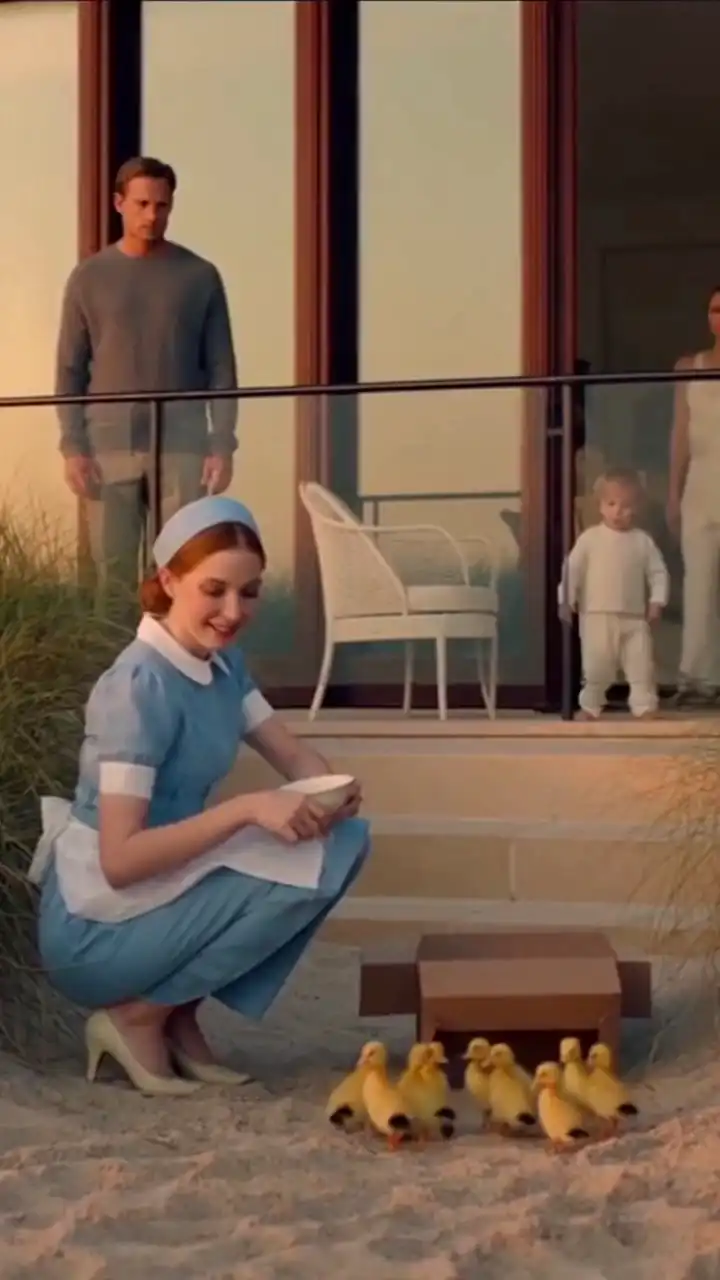
THE NANNY WHO BROUGHT DUCKS TO THE OCEAN HOUSE AND MADE A CHILD WALK TOWARD LIFE