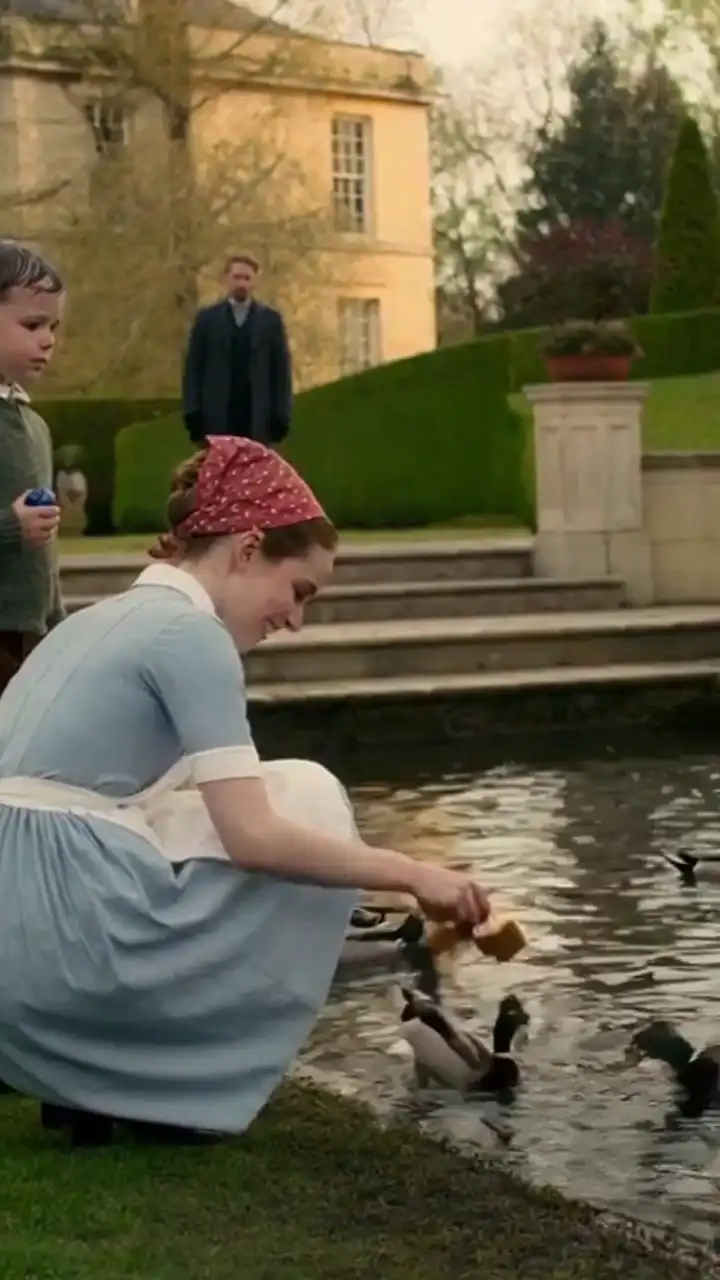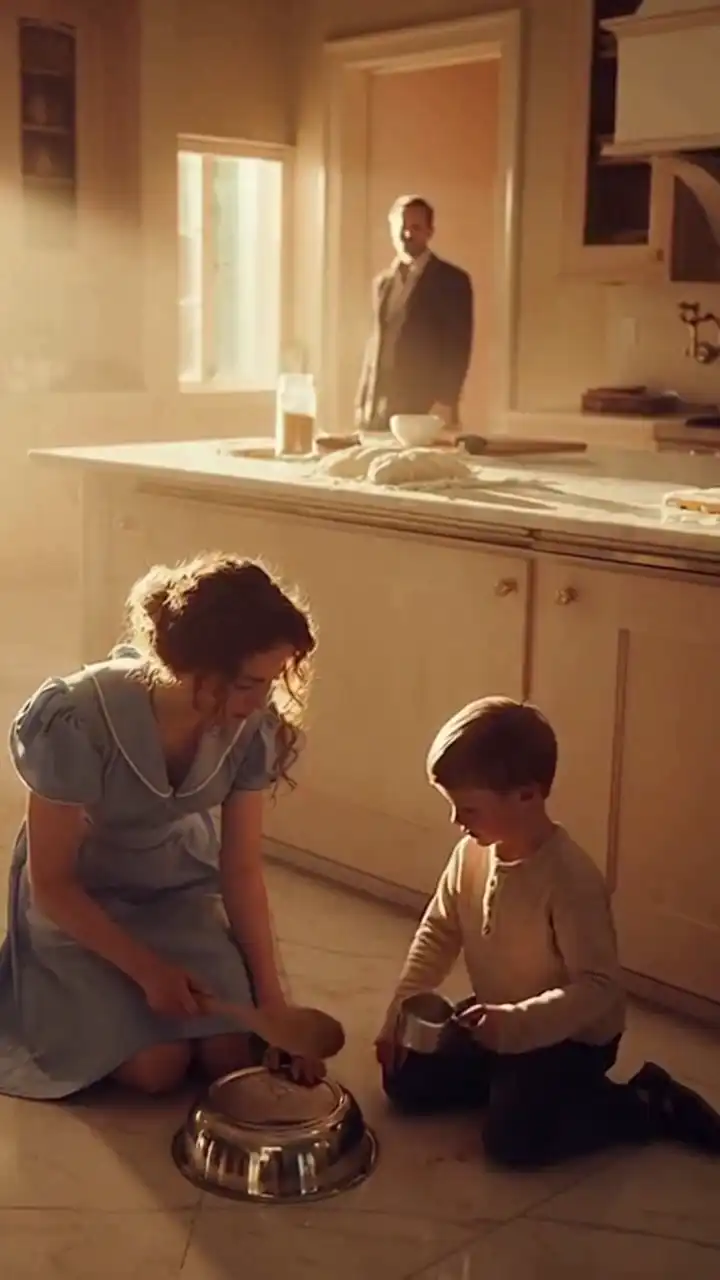
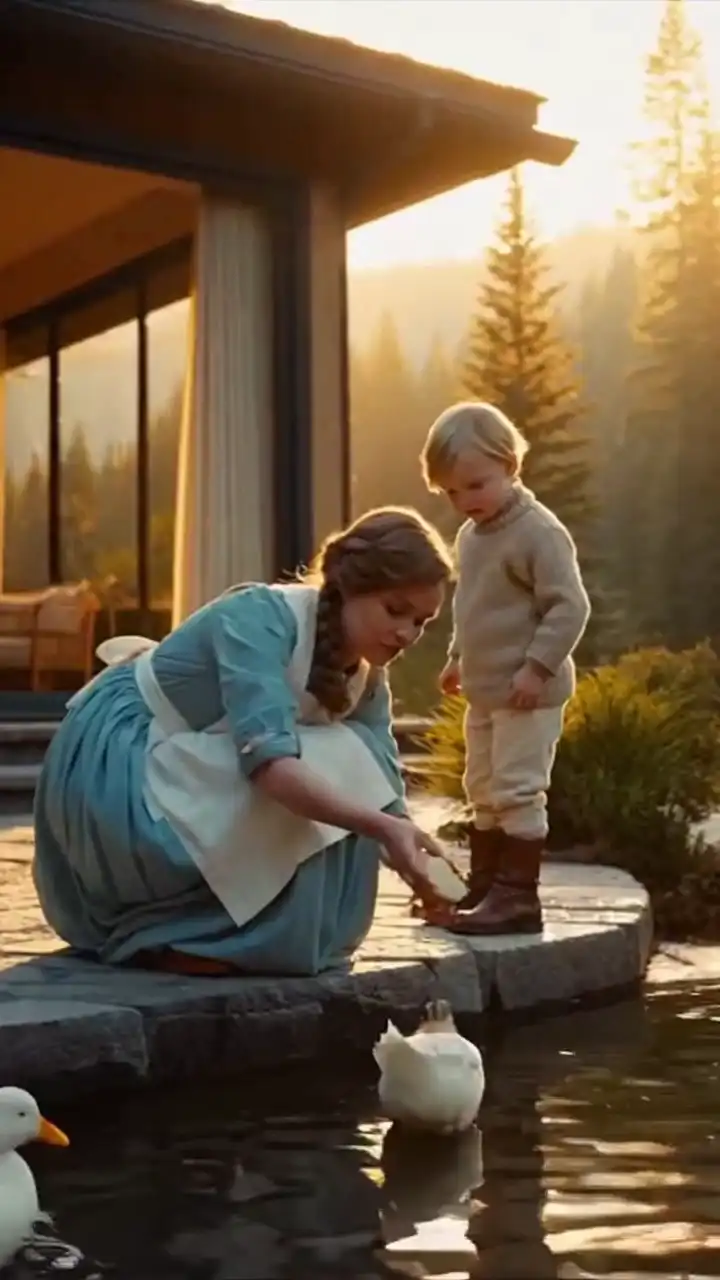
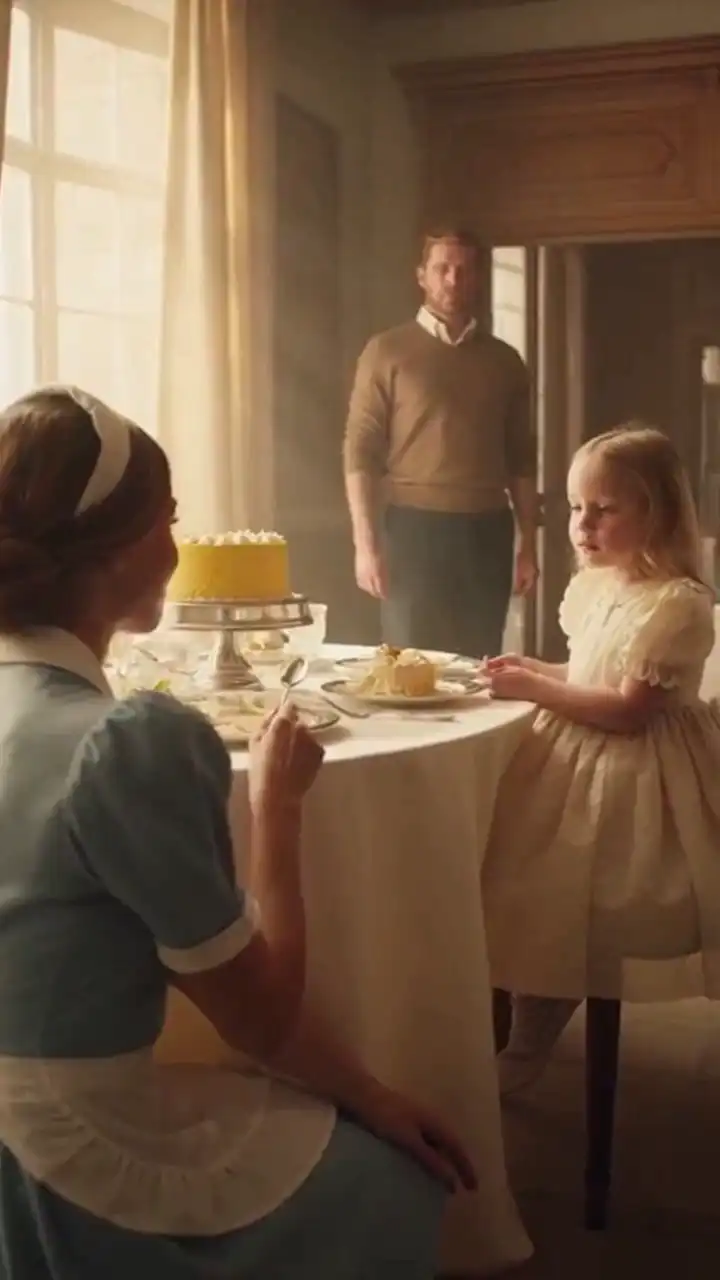

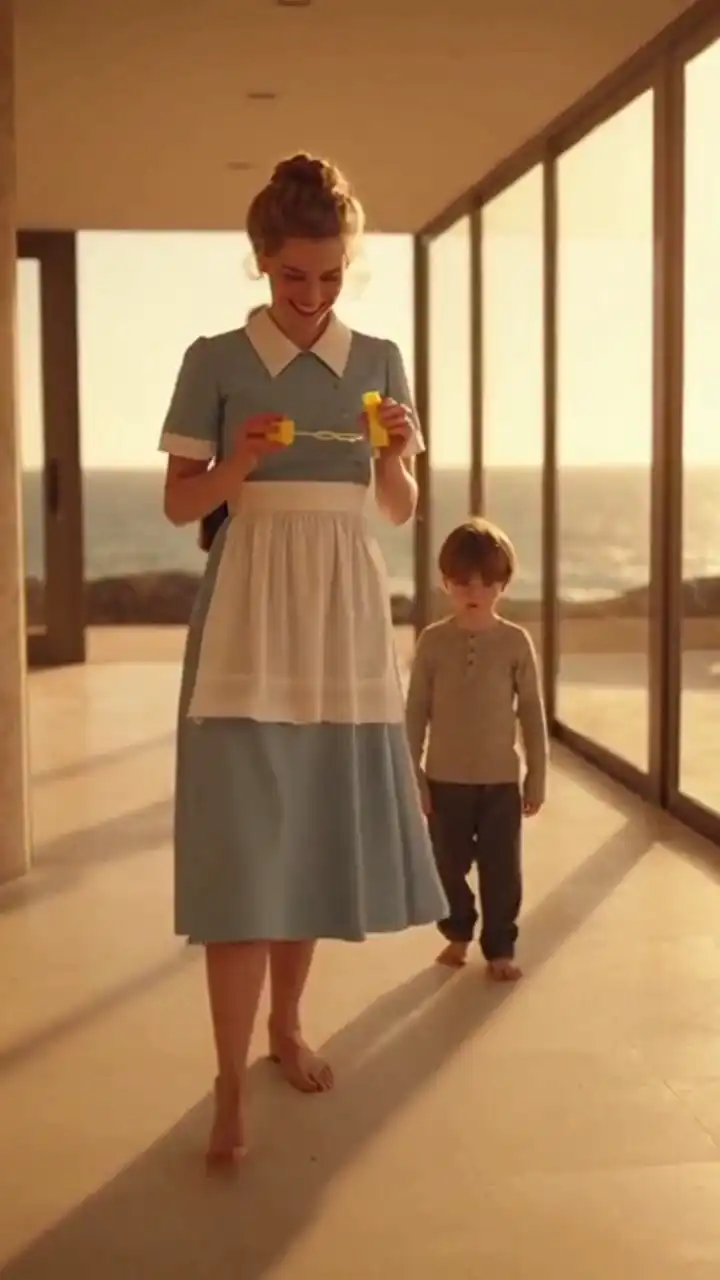
HE BLEW A FORTUNE TRYING TO REACH HIS SON, THEN THE NEW NANNY BROKE THE RULES WITH BUBBLES AND THE BOY RAN TO HER
For a few seconds after the boy placed the wand in Lily’s hand, nobody moved.
Caleb stood at the terrace doors with one hand still on his briefcase. The house manager looked horrified, as if this tiny act had been committed against good furniture.
Lily didn’t celebrate. That was the first thing Caleb noticed.
Every other specialist had treated any tiny reaction like a press conference. “Great job.” “Use your words.” “Look at me.” “Can you do it again?” They turned moments into demands, and his son always shut down.
Lily only whispered, “Thanks,” as if the boy had done something ordinary and good.
Then she blew one more bubble, not at him, just upward.
He watched it rise.
Caleb missed his meeting.
He told himself he stayed because the nanny needed supervision. Because she had ignored direct instruction in the first ten minutes. Because his son could spiral without warning.
But when Lily sat on the terrace floor and the boy sat three feet away instead of running back to the east window, Caleb stayed because he was scared to break whatever had just happened.
The ocean wind pushed at the linen curtains. The bubbles thinned and popped in the salt air. The boy leaned forward.
Lily held out the bottle. “Want to carry this?”
No pressure. No command in her voice. Just space.
The boy didn’t take it.
Caleb almost spoke, almost told her not to ask too much.
Then the child reached, not for the bottle, but for the cap. He pressed it between his fingers, studying the grooves. Lily let him. A minute later, he gave it back.
That was all.
And somehow it was more than Caleb had seen in months.
By noon, the house had a new tension running through it.
Not hope exactly. Hope was too dangerous in that place.
Attention.
Everyone noticed the boy had not returned to the east window for over an hour. He had followed Lily from the terrace to the kitchen doorway, not entering, just standing there while she rinsed fruit and hummed under her breath. At lunch he still refused the formal dining room, but he ate three strawberries from a small white plate on the floor near the breakfast nook while she sat nearby blowing one bubble at a time into the sunlight.
Caleb watched from across the island and felt something ugly twist in him.
Relief.
And resentment.
Because he had built his whole way of caring around control. Predictable routines. expert plans. schedules printed by assistants. If this girl from an agency could get one real response by being loose, playful, and completely unimpressed by the Mercer system, then what exactly had he been doing all this time?
That afternoon he called Dr. Brenner, the child psychologist who had worked with them for four months.
“She used bubbles,” Caleb said flatly.
There was a pause on the line. “And he engaged?”
“He stood. Followed her. Handed her something.”
Another pause. “That suggests shared attention. Initiated connection. That’s significant.”
“With bubbles.”
“Caleb,” the doctor said carefully, “a child like your son may not need more management. He may need safety that doesn’t feel like management.”
The words irritated him more than they should have.
By the second day, Caleb’s irritation found a target.
Lily opened the kitchen windows wide despite the staff’s dislike of sea air near polished surfaces. She let the boy sit by the pantry with measuring cups instead of the approved sensory kit. She tapped rhythms with wooden spoons on the counter edge and waited while he tapped the floor back with his toy ring. She blew bubbles down the long hallway and stopped before he got overwhelmed. She learned the exact second his shoulders tightened and the exact second to back away.
She never dragged him toward the world.
She made the world gentler, then let him enter it.
On the third morning, Caleb walked in to find his son lying on his stomach under the breakfast table while Lily rolled oranges back and forth across the tile.
“No,” Caleb said immediately.
Lily looked up. “He started it.”
“This is not therapy.”
“I know.”
“This house has structure for a reason.”
She sat back on her heels. “With respect, the structure isn’t helping him feel alive.”
The line hit harder than she knew.
Caleb’s face changed. “You are here to follow instructions.”
“And he is a child, not a security problem.”
The room went dead silent.
The chef turned away. A maid pretended to wipe a clean surface twice.
Lily had gone too far, and they all knew it.
Caleb dismissed the staff with a look, then waited until they were alone except for the boy under the table.
“You don’t know anything about this family,” he said.
Lily’s voice stayed calm. “I know he startles before anyone touches him. I know he listens more when nobody stares at him. I know every adult who comes near him wants proof that they’re helping. He feels that. It makes him pull back.”
Caleb folded his arms. “And you know this in three days?”
“In three days, yes.”
He should have fired her right there.
Instead he said, “His mother died in front of him.”
Lily went quiet.
It was the first time Caleb had said the sentence aloud to someone who wasn’t paid by the hour to hear it.
“He was in the back seat,” Caleb said. “They were coming home from dinner. The driver survived. I was in New York. By the time I got there…” He stopped, jaw locking. “After that, every loud thing hurt him. Every sudden thing. Every stranger.”
Lily did not offer pity. That, too, made her different.
She only glanced toward the boy. “Then it makes sense that he needs invitation, not extraction.”
Caleb hated that the sentence made sense.
The breakthrough came the next evening in the west corridor overlooking the water.
It had rained hard in the morning, rare and sharp for that stretch of coast, and the sky had turned bright after. Lily found a packet from an online delivery in the mudroom—cheap neon sidewalk chalk Caleb’s assistant had ordered by mistake for a charity event and forgotten to return.
She took the box, the bubble bottle, and the boy to the covered garden path where puddles still glimmered between stone planters.
Caleb followed the moment he realized she was taking him outside without clearing it first.
“Lily.”
She turned. “The path is dry under the overhang.”
“He doesn’t do well with changed surfaces.”
“Then we’ll stop if he tells us to stop.”
“He won’t tell you.”
She looked at him straight. “He already has. You just expect words.”
That stung enough that he stepped back.
Lily crouched and drew one blue circle on the stone with the chalk. Then another farther away. Then another.
She blew bubbles so they drifted over each circle.
The boy stood at the threshold, body rigid.
Lily stepped onto the first blue circle and popped a bubble with her fingertip.
Then she stepped to the next.
The boy watched the bubbles. Watched her shoe. Watched the color on the stone.
No one spoke.
A bubble floated low and burst near the first circle.
The boy moved.
One foot onto blue.
Pause.
Second foot beside it.
Caleb’s throat tightened.
Lily went to the next circle, backward, giving him room. Another bubble. Another bright target. Another pause.
He followed.
Not because he had been ordered.
Because the path made sense to him. Because the game linked movement to pleasure instead of pressure. Because the space between him and another person was finally safe enough to cross.
At the fourth circle, a breeze carried the bubbles sideways toward the wet edge of the path. One landed in a shallow puddle and flashed rainbow before breaking.
The boy stared.
Lily said nothing.
She simply stepped beside the puddle and blew three more bubbles over it.
The boy made a sound. Small. Almost hidden.
Caleb had not heard his voice outside a cry in so long that he looked around, as if it had come from somewhere else.
The boy took one careful step off the dry stone.
His shoe touched the wet edge.
Then he stamped.
Water jumped.
He blinked at the splash.
Stamped again.
Lily laughed, bright and surprised, not at him but with the moment.
And then the impossible happened.
The boy looked at her.
Not through her. Not past her.
At her.
And made the sound again, clearer this time. “Mo.”
More.
Lily’s face changed first. Then Caleb’s.
No therapist in a soft office. No specialist with laminated plans. No carefully managed exercise had gotten that from him.
One muddy puddle, some colored circles, and a girl who knew not to rush in.
Caleb took a step forward on instinct.
The boy’s shoulders jumped.
Lily lifted one hand sharply without turning around. Stop.
The fact that Caleb Mercer, who ran companies and directed rooms with a glance, actually stopped because a nanny told him to stop would have shocked anyone who knew him.
She blew another bubble over the puddle.
The boy splashed again.
“Mo,” he said, louder.
Lily nodded. “More.”
She gave him the word, simple and clean, then waited.
He splashed. She blew.
Splash. Bubble.
Splash. Bubble.
A rhythm.
A bargain with the world.
By dinner, Caleb had mud on the cuff of his slacks from kneeling too close to the edge of the path while watching his son ask for more bubbles with his eyes, then with his hand, then once with that broken little word that sounded like a door opening.
He did not mention the mud.
The next morning he canceled a flight to Chicago.
He told his office it was for a family matter. For the first time, that sentence meant what it should have meant years ago.
Still, control did not leave him gracefully.
He began shadowing Lily. Asking too many questions. Timing naps. Wanting to understand the system so he could own it.
“Why three bubbles there?”
“Why not say his name?”
“Why floor meals instead of the table?”
“Why the humming?”
Lily answered when it helped and ignored him when it didn’t.
On the sixth day, Caleb made the mistake that showed him exactly who he had been.
His son was in the library, standing near Lily while she built a line of couch cushions across the carpet like stepping stones. Bubble wand in one pocket. Soft music from a phone on the shelf. Light low. Safe.
The boy had already crossed the cushions twice behind her.
Caleb walked in smiling too fast. “Come here, buddy. Show me.”
The child froze.
Lily’s whole body stilled.
Caleb crouched, holding out his hands. “Come on. You can do it.”
The boy’s breathing changed. Fast. Thin. He dropped to the floor, palms over ears.
Lily moved at once, kneeling sideways several feet away, making herself smaller, not touching him. “It’s okay. Too much. We stop.”
Caleb’s face drained.
The boy began hitting his own forehead with the heel of his hand.
Caleb lunged forward.
“Don’t,” Lily snapped.
He stopped again, horrified at being told not to comfort his own child and more horrified that she might be right.
Lily took the bubble wand out silently and blew one bubble low across the carpet.
The boy’s hand paused.
Another bubble.
Another.
She did not ask him to look. She let the familiar pattern pull him back from the cliff edge.
His breathing slowed.
Five minutes later he was curled under the reading chair, shaken but calm.
Caleb stood by the bookshelf looking like a man who had just watched his own reflection crack.
“I pushed him,” he said.
“Yes,” Lily said, not cruelly.
“I only wanted—”
“I know.”
He sat down heavily on the carpet in a ten-thousand-dollar suit and put both hands over his mouth.
When he finally spoke, his voice was rough. “Every person who came here promised progress if I stayed consistent. If I reinforced behavior. If I used the right prompts. I thought if I controlled enough variables, he’d come back.”
Lily looked at the child under the chair, then at Caleb. “He doesn’t need to come back to the version of him adults can manage. He needs to feel safe enough to come forward as he is.”
No consultant had ever said it that plainly.
That night Caleb walked through the house and saw what he had made.
A nursery turned into a therapeutic environment.
A kitchen too quiet for a child.
A schedule that treated spontaneous joy like a risk factor.
He stood in the east window room where his son had spent so many frozen hours and noticed the one thing money had missed: there was nowhere in the whole room that looked lived in.
The next day he changed things in ways the staff found unsettling.
He told the house manager to stop correcting every misplaced object.
He moved breakfast out of the formal dining room permanently.
He had a low shelf installed in the sunroom with cheap chalk, bubbles, tape, cups, textured balls, paper, and old baking trays.
Cheap things. Reachable things. Things no one had to ask permission to use.
He asked Lily before adding anything.
That mattered to her more than he realized.
Because Lily did know special-needs children. Her younger brother Mateo had lived half his childhood in a locked world after a traumatic hospitalization and years of adults trying to “normalize” him. She had learned young that some children enter connection sideways. Through rhythm. Through repetition. Through play no one is trying to grade.
She told Caleb this one afternoon while washing strawberries at the sink.
“He used to talk only when we stopped asking direct questions,” she said. “If someone made him perform, he disappeared. If we sat beside him and rolled pennies back and forth, he’d give us whole pieces of himself.”
Caleb leaned against the counter, listening harder than he had listened to any expert. “So you saw my son and recognized that?”
“I saw a kid surrounded by pressure in beautiful packaging.”
He let out a breath that sounded almost like a laugh, though there was nothing funny in it.
Weeks passed, and the progress came in scenes, not miracles.
The boy began waiting near the kitchen in the mornings when he heard Lily’s shoes.
He touched the bubble bottle without fear.
He started bringing objects to her: the silver ring, a spoon, one sock, a torn magazine page with a yellow boat on it.
Offerings. Signals. Bridges.
He tolerated Caleb sitting nearby if Caleb kept his voice low and his hands to himself.
One afternoon Lily spread shaving cream on a sheet pan on the terrace table and traced circles through it. The boy copied her with one finger, then two. Caleb watched from the doorway and did not interrupt when his son smeared foam onto the cuff of his shirt.
Another day they sat on the floor while Lily blew bubbles and the boy began popping them with Caleb’s open palm instead of his own. The contact lasted less than a second each time. Still, Caleb nearly broke apart over it.
The first time the child leaned against Lily’s knee while watching the ocean, no one commented. But Caleb had to turn away.
Then came the test that would have ended it all in the old version of the Mercer house.
Caleb’s sister, Andrea, arrived for a weekend visit with polished concern and expensive opinions. She loved her nephew in the way some people love damaged things from behind glass.
At lunch she found the boy on the kitchen floor beside Lily, sorting measuring spoons while bubbles drifted through a shaft of light from the pantry door.
Andrea stopped cold. “Caleb, what is this?”
“It’s lunch.”
“This is chaos.”
The boy’s shoulders tightened.
Lily quietly lowered the wand.
Andrea kept going. “He needs proper treatment, not some daycare circus. And why is staff sitting on the floor with him? This is exactly how boundaries disappear.”
Caleb looked at his son’s hands start to flap faster.
The old Caleb would have hushed the room, apologized for the mess, and restored order.
Instead he said, “Enough.”
Andrea stared at him.
He stood from the counter and spoke with the calm voice he used in boardrooms, the one that ended arguments without raising volume. “For a year, this house followed every proper rule you could imagine. My son vanished anyway. She is the first person who has helped him feel safe. So if you can’t tell the difference between dignity and stiffness, don’t lecture me about treatment in my own home.”
Andrea flushed. “You’re choosing a nanny over family?”
“No,” Caleb said. “I’m choosing what my son is actually responding to over what looks acceptable to other people.”
Lily looked down, pretending not to hear. But the authority in the room shifted right there and did not shift back.
After Andrea left early the next morning, the house felt strangely lighter.
The biggest change came not in speech, but in pursuit.
One windy afternoon near the end of Lily’s first month, she was on the lower garden path blowing bubbles out toward the bluff. The boy stood by the hydrangeas, watching, calmer than he had been in over a year.
Caleb was on a call nearby when a gust snatched the bottle from Lily’s hand and sent it skidding toward the stone steps.
The spill was small. The danger was smaller. But Lily moved fast, and for one second she slipped out of the boy’s sight behind a hedge.
He panicked.
Not the old shutdown. Not the frozen retreat to the window.
He ran.
Straight after her.
Around the hedge, down two steps, calling in that rough new voice, “Li! Li!”
Caleb dropped the phone.
Lily turned at once. “I’m here.”
The boy collided with her legs and clung.
Actually clung.
Hands gripping fabric. Face pressed to her hip. Breathing wild but anchored.
Caleb had imagined for months that if his son ever reached for someone, it would be him. Seeing it happen with Lily hurt and healed him at the same time.
Lily crouched carefully. “I’m here,” she repeated.
The boy lifted one hand and pointed frantically toward the bubbles rolling in the grass. “Mo,” he said, but now it meant more than bubbles. More presence. More don’t disappear.
Caleb walked toward them slowly.
This time he did not say, Show me.
He did not ask his son to prove anything.
He only knelt a few feet away and said, “She’s here. I’m here too.”
The boy looked at him, still holding Lily.
Then, after a long shaky breath, he reached one muddy hand toward his father.
Caleb took it like it was the most fragile thing in the world.
That evening, after the boy finally fell asleep in Lily’s lap during a storm without startling awake, Caleb stood in the hallway outside the guest suite the agency had assigned her.
“I need to ask you something,” he said.
Lily looked immediately guarded. She had worked in enough wealthy homes to know that gratitude and dismissal often arrived in the same polite tone.
Caleb noticed. “I’m not letting you go.”
She relaxed by an inch.
“I want you to stay,” he said. “Not for another week. Not until he plateaus. Stay as long as you’re willing. With your own contract. Your own terms. Training budget if you want it. School, if you want that too. And full authority over his day with me learning from you, not overriding you.”
Lily stared at him. “You’d really do that?”
He looked toward the room where his son slept. “I spent a year paying people to explain my child to me. You walked in and actually met him.”
Her eyes watered, though she smiled. “He met me too.”
“Yes,” Caleb said quietly. “He did.”
She agreed to stay, but only after adding one condition that made him almost laugh with relief.
“No turning the house into a lab again.”
He nodded. “Deal.”
Summer moved in.
The east window was no longer a shrine to absence.
Now some mornings the boy sat there with Lily and a tray of soap bubbles, watching light slide over the sea. Some afternoons he and Caleb rolled oranges on the kitchen floor. Sometimes the boy still shut down. Sometimes he still could not bear noise or touch or sudden plans. Healing did not turn him into a different child.
It let him be present in his own life again.
The staff adjusted. The polished quiet of the house loosened. There was more laughter from the kitchen, more open doors, more chalk on stone, more towels by the terrace for muddy shoes. Life returned in small, improper ways.
Months later, during a charity dinner Caleb hosted at the estate, several guests wandered to the garden after dessert. They saw the billionaire widower in shirtsleeves kneeling beside his son on the path, holding a bottle of bubble solution while the young nanny marked bright blue circles on the stone.
The boy stepped from one circle to the next, then turned, grinning, and held out the wand.
Not to Lily.
To his father.
Caleb took it, looked at Lily, and blew a crooked stream of bubbles so badly that the child laughed out loud.
A real laugh. Open, startled, alive.
Several guests stared. One of them wiped away tears without hiding it.
Caleb didn’t care.
Because for once the most important thing in that enormous house was not what looked proper.
It was that his son had asked for more from the world, and the world had finally answered.
And Lily stayed.
Not as a temporary fix. Not as a silent servant passing through rich people’s grief.
She stayed as the person who had cracked open a locked door with patience, cheap bubbles, and the courage to disobey a man who thought control was love.
The estate by the ocean was still big. Still expensive. Still impressive from the road.
But inside it, at last, there was movement.
There was sound.
There were muddy footprints near the terrace, chalk dust on the path, and a child who no longer stood all day at a distant window waiting for nothing.
There was a father learning to follow instead of force.
And there was a young nanny who came in through an agency side door and ended up becoming the one person no one in that house could imagine losing again.
Disclaimer: Mention of any brand or trademark is for identification only and does not imply partnership or endorsement
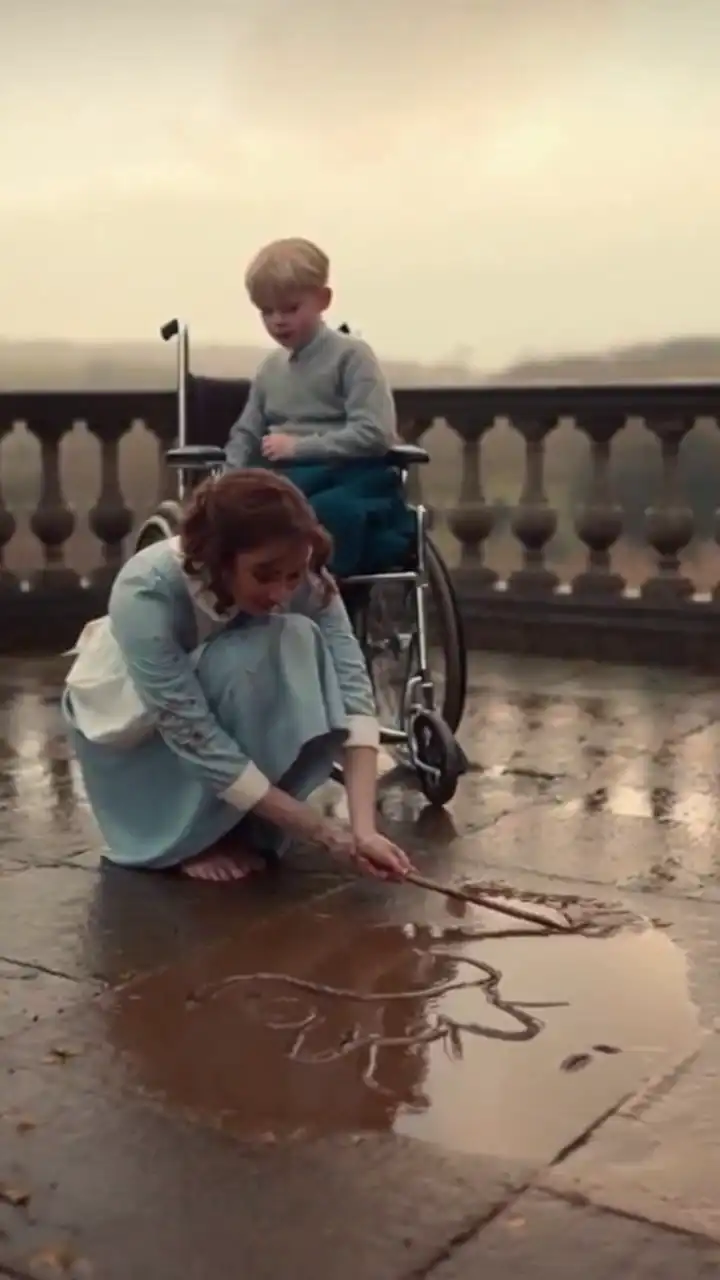
WHEN THE BILLIONAIRE’S SON DRAGGED HIS USELESS LEGS INTO THE MUD FOR THE FIRST TIME, HIS FATHER’S GIRLFRIEND SCREAMED FOR THE NANNY TO STOP

WHEN THE RICHEST MAN ON THE HILL HIRED THE WRONG NANNY, HIS SILENT SON CRAWLED ACROSS THE FLOOR FOR HER
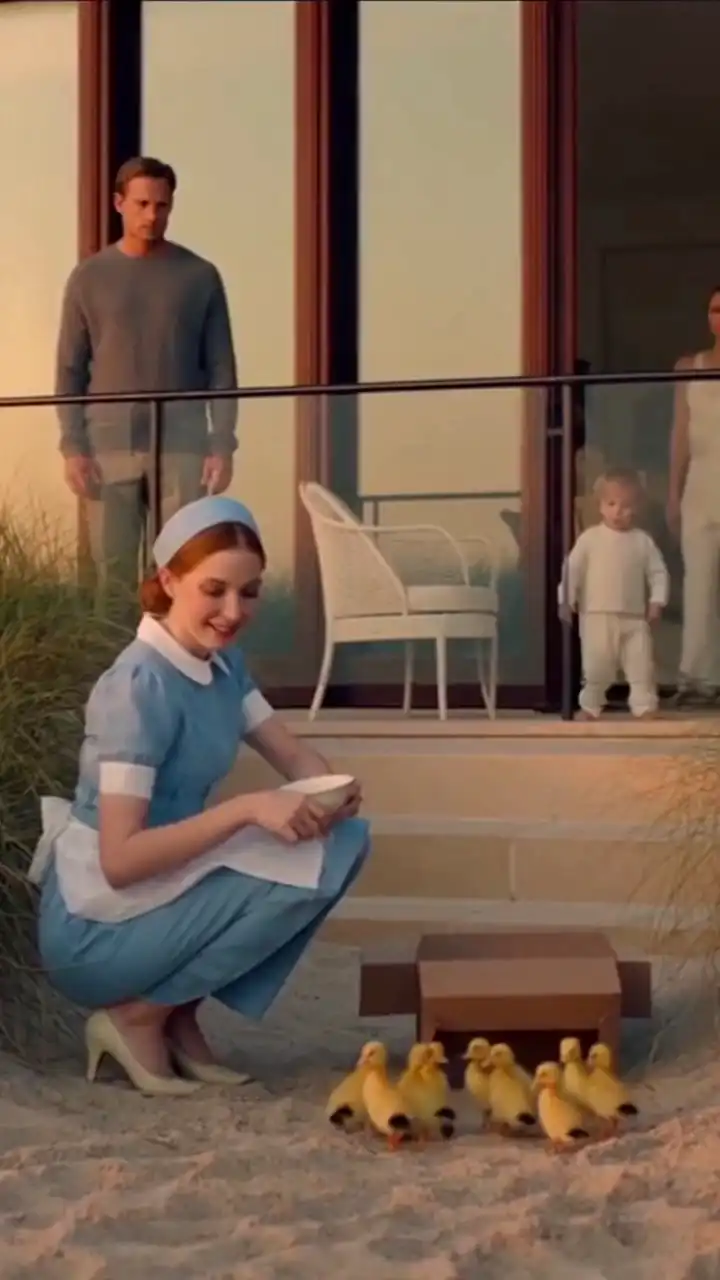
THE NANNY WHO BROUGHT DUCKS TO THE OCEAN HOUSE AND MADE A CHILD WALK TOWARD LIFE