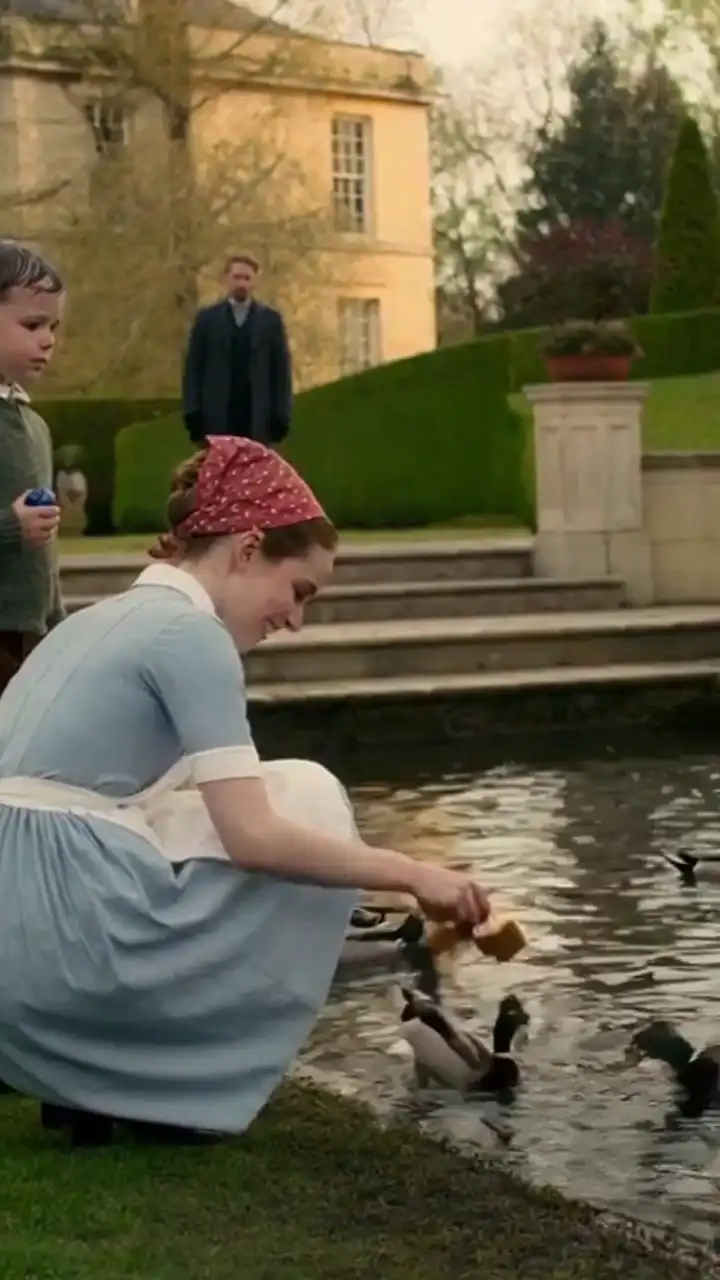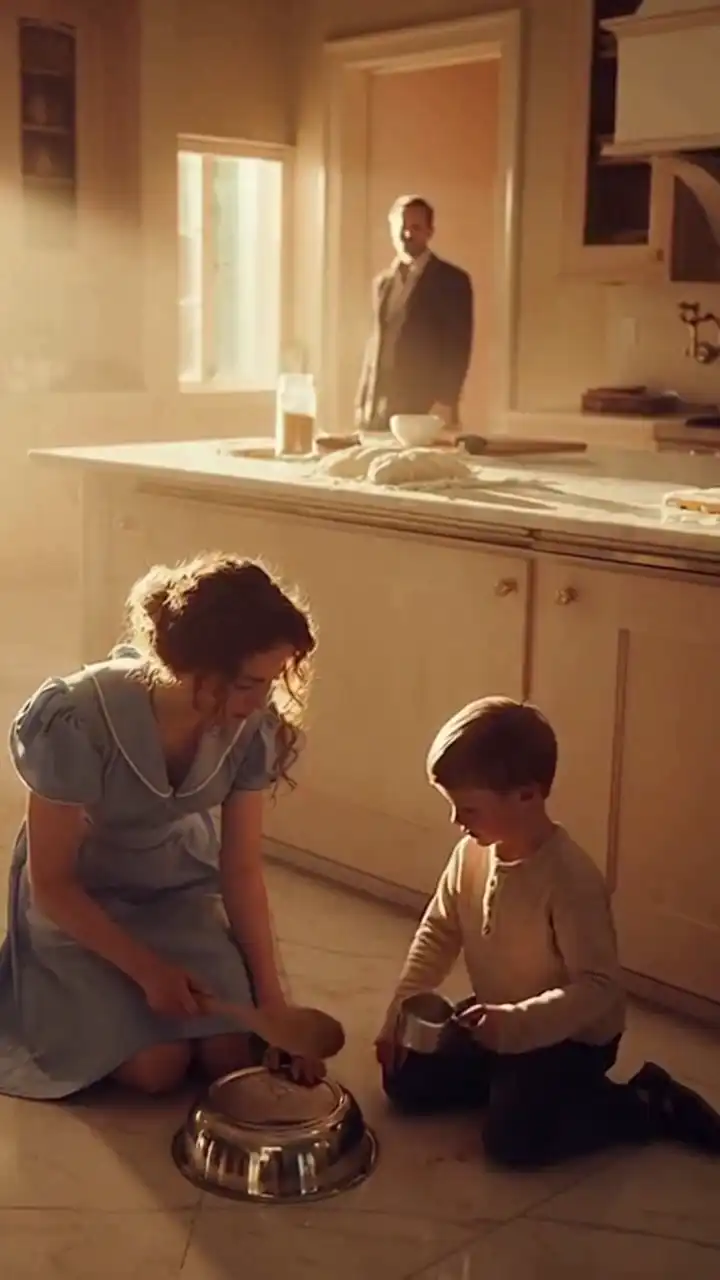

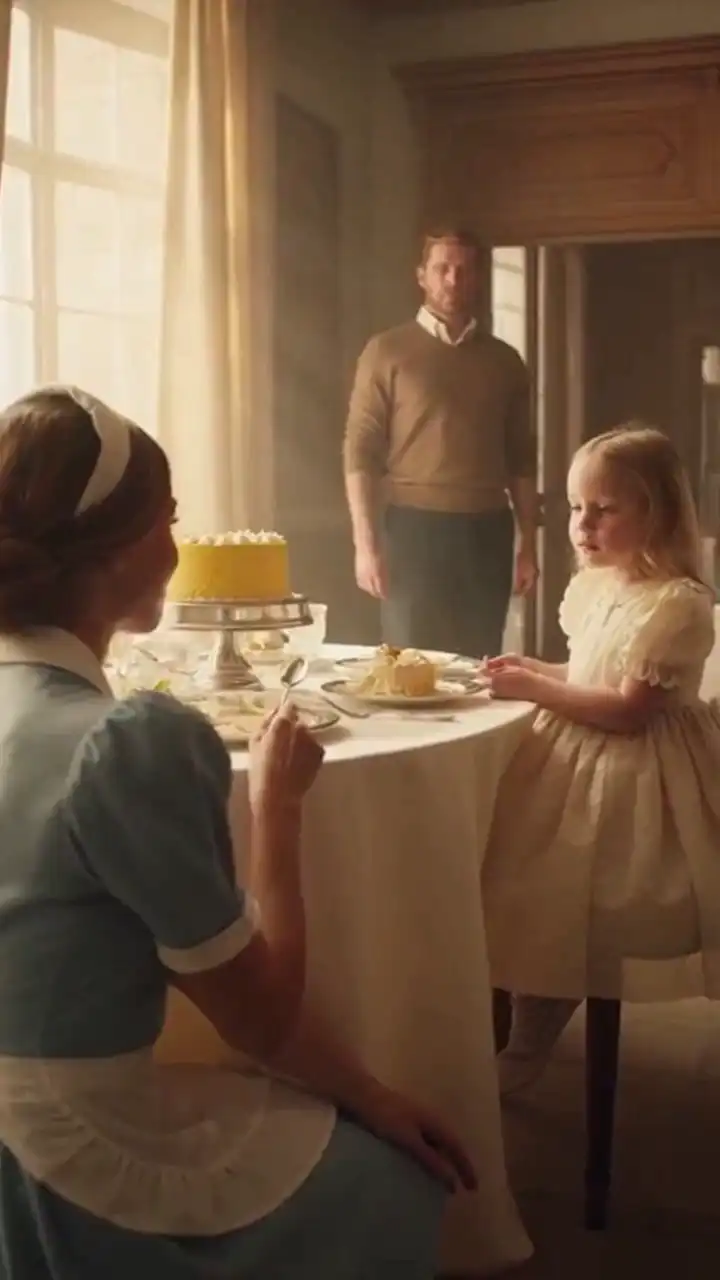

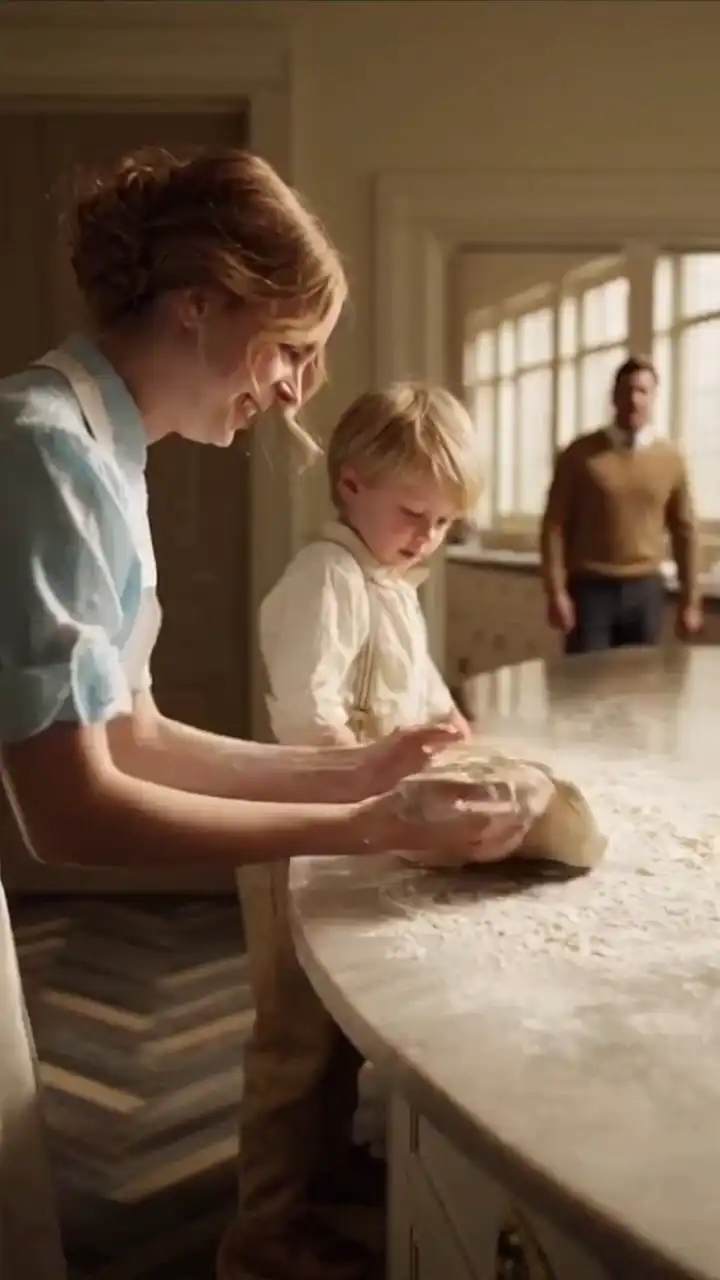
THE SILENT BOY SPOKE ONLY AFTER THE NANNY COVERED A MILLION-DOLLAR KITCHEN IN FLOUR
Grant heard the word as if somebody had struck glass right beside his ear.
Not because it was loud. It was barely a sound.
But Oliver had not spoken since the week of his mother’s funeral.
Victoria reacted first. “He’s distressed. This is exactly why routine matters.”
Lena still didn’t move. Oliver’s fist was twisted in her apron so tightly his knuckles had gone pale. Flour streaked his sleeve. Dough stuck to two of his fingers. His breathing came fast and shallow, but he was looking at Lena, not through her.
That alone was new enough to make Grant’s chest go tight.
“Oliver,” he said carefully, stepping forward.
The boy’s shoulders jumped. His eyes dropped at once.
Grant stopped.
He hated that. Hated that his own voice now made his son shut down harder. Every specialist had told him not to show desperation, not to crowd, not to force interaction. He had turned himself into a careful visitor in his own child’s life and called it respect.
Lena lowered herself to Oliver’s level without touching him. “Nobody’s taking me anywhere right now.”
Victoria gave a dry, disbelieving laugh. “You cannot reward this kind of episode.”
Lena looked up at her for the first time. “He didn’t have an episode. He made a choice.”
No one talked to Victoria that way in that house.
Grant should have stepped in. Normally he would have. It was easier to smooth things over than to start a war at home. Easier to let staff rotate, doctors revise plans, and his wife manage the details while he signed checks and came back from meetings with toys he hoped might count as effort.
But Oliver was still gripping Lena’s apron.
Still there.
“Leave it,” Grant said quietly.
Victoria turned to him. “Grant, the kitchen is covered in flour.”
Grant looked at the floor, the counter, the child, the bowl, the ridiculous smashed dough pig. Then he said the strangest sentence that had ever been spoken in that room.
“I don’t care.”
Victoria went silent.
That afternoon, Lena was not fired only because Oliver refused to leave the kitchen unless she walked with him. He did not speak again, but he followed her to the mudroom, to the side hall, and finally to the small breakfast nook where she sat on the floor and rolled tiny ropes of dough on a baking tray while he watched.
He did not smile. He did not chat. He did not suddenly return to normal.
But he stayed.
For a child who had spent eleven months withdrawing from every hand extended toward him, staying was not small.
Lena did not treat the moment like a miracle. That was another thing Grant noticed. She did not cry, didn’t ask for praise, didn’t start making plans out loud. She acted like Oliver had opened a cracked door and loud adults could still slam it shut if they rushed.
So she kept things simple.
The next morning she asked the cook for plain flour, salt, water, and old baking sheets.
Victoria objected before the words were fully out of her mouth.
“This is not a daycare.”
Lena answered, “Good. He already failed all the things that looked expensive.”
Grant almost laughed, then stopped himself when he saw Victoria’s expression.
“What exactly is your method?” Victoria asked coldly.
Lena shrugged. “Warm hands. Repetition. No pressure. Something he can change with his own fingers.”
That afternoon she sat on the back terrace with Oliver and made dough again, this time stiffer. She rolled balls. Flattened them. Stacked them. Tore them apart. She tapped the tray with a spoon, making a soft rhythm. Not music exactly. More like a heartbeat the room could hear.
Oliver stood in the doorway for a long time before coming closer.
He touched one dough circle, then another. He pressed one to the tray and peeled it off. He began arranging them in a line.
Lena copied him.
He moved them into two lines.
She copied him again.
No praise. No “good job.” No flood of adult feeling pouring onto him.
Just: I see what you’re doing. I’m here. Keep going.
Grant watched from the French doors with his phone in his hand and work emails open on the screen. He did not answer one of them.
Later, he asked her why dough of all things.
Lena washed her hands at the sink before answering. “Because it pushes back.”
He frowned.
“He’s been living in rooms where everything is finished before he gets there,” she said. “Tables polished. food plated. toys arranged. adults choosing the right words in careful voices. Dough is soft, but it resists. He presses, it changes. He pulls, it stretches. He can leave a mark and see it. For a shut-down kid, that matters.”
Grant looked toward the terrace, where Oliver sat with both hands resting on the tray as if it were warm.
Lena added, “And kitchens are alive. They smell like something. They make noise. Kids know the difference between a place where people live and a place where people maintain appearances.”
He had no defense against that, because it was true.
The estate had become a museum after Claire died.
Claire had loved the back kitchen. Before the illness got bad, she used to bake on Sunday mornings with music too loud and windows open, and flour would end up on her cheek because she never remembered not to touch her face. Oliver used to sit on the counter and steal bits of raw dough while she pretended not to see.
Grant had forgotten that until the smell brought it back so hard he had to grab the sink edge.
He had not protected his son with order.
He had erased the last language the boy had shared with his mother.
The change came in pieces after that.
Oliver began appearing wherever Lena was kneading or rolling or cutting dough with dull cookie cutters she bought herself in town because the house only owned formal pastry tools no child was ever allowed to touch.
He started waiting at the kitchen doorway ten minutes before she came downstairs.
He carried one small lump of dough from room to room like a secret stone.
He still said nothing.
But he looked.
At Lena’s hands. At her face. Sometimes, briefly, at Grant.
Victoria noticed every inch of it and liked none of it.
She began finding reasons to interfere. The kitchen was too unsanitary for play. The flour should be locked. Lena was encouraging dependence. Oliver needed “professional structure,” not attachment to household staff. The estate would look absurd if guests arrived to see the heir of Ashford Properties with dough under his nails.
Grant knew what sat under all that polished language.
Victoria had married into a house with grief still in it, and she had tried to beat that grief into neatness. She had never been cruel to Oliver in an obvious way. She bought him expensive clothes he wouldn’t wear and organized his books by color and spoke in low controlled tones about “stability.” But she treated sorrow like a stain that would spread if anyone touched it barehanded.
Lena touched everything barehanded.
One Sunday, Victoria hosted a luncheon for donors from the private arts foundation she chaired. White tablecloths on the lawn. Caterers. Floral arrangements. People who said things like “children are resilient” while drinking cold champagne.
Oliver was not supposed to be seen. That was not spoken plainly, but everybody understood it. He was usually kept upstairs during these events with a tutor or a screen and quiet instructions.
Lena found him in the service corridor just before noon, already tense, breathing through his mouth, toy horse pressed so hard into his chest it left marks on his arm.
The voices outside were rising. Laughter. Clinking glass. Too much.
“Come on,” Lena whispered. “Back kitchen.”
She set him at the long wooden prep table and dumped a bowl of dough in front of him. Then she took another bowl for herself and started fast, rhythmic kneading. Push, fold, turn. Push, fold, turn.
Oliver watched.
Then copied.
His movements were jerky at first. Too hard, then too soft. But the rhythm caught him. Lena exaggerated the sound, letting the dough smack the wood.
Push, fold, turn.
Outside, polished adults discussed grants and preservation projects.
Inside, a silent boy slammed his palms into dough.
Grant came in through the side door halfway through a call, saw them both covered in flour dust, and stopped talking mid-sentence.
Oliver looked up at him with panic for one sharp second.
Lena didn’t say a word. She just handed Grant a third lump of dough.
He stared at it.
This was a man who negotiated acquisitions worth more than some towns. A man who had not made anything with his hands in years.
“Do it,” Lena said.
He should have felt insulted. Instead, he rolled his sleeves.
His first push was awkward. Too careful.
Lena smacked her dough harder. “It won’t break.”
Something in that line reached him farther than she knew.
Grant shoved harder.
The dough flattened under his palm. A rough, ugly shape. Not elegant. Not controlled.
Oliver looked from the dough to his father’s hand.
Then, slowly, he pushed his own harder too.
The three of them stood there in a heat-filled kitchen while ovens clicked and dough thudded and for the first time since Claire’s death, Grant was doing something beside his son instead of arranging help around him.
That was the exact moment Victoria walked in with two donors behind her.
She froze at the sight: Grant with flour on his cuffs, Lena at the table like she belonged there, and Oliver in the center of it all.
One donor smiled uncertainly. “Oh. How sweet.”
Victoria did not smile. “Oliver, upstairs.”
The boy went rigid.
Grant saw it happen. Every muscle tightened. Every small gain threatened.
Lena stayed still, but her eyes cut to him. This one was his.
For months he had let other people define what was proper around his child. Doctors. Staff. His wife. His own guilt.
This time he put both palms on the table and said, “No.”
Victoria turned. “Excuse me?”
“He’s staying.”
“Grant, we have guests.”
“He’s staying.”
The donors looked away, embarrassed in the expensive way of people who never intend to remember what they saw.
Victoria lowered her voice. “This is exactly the problem. Boundaries have collapsed. He is attached to a nanny who plays in dough all day, and now you’re indulging it in the middle of a formal event.”
Grant’s face changed at that. Not angry first. Clear.
“Attached?” he said. “He finally feels safe enough to come downstairs.”
Victoria folded her arms. “You are letting a servant run your son’s emotional life.”
The kitchen went dead quiet.
Lena stepped back at once, not from shame but from instinct. She knew class lines when they turned sharp. She had probably lived under them her whole life.
Grant looked at Oliver.
The boy was staring at the dough, shoulders curled inward, the old retreat coming back.
Then the child did something small and devastating.
He reached out without looking and put his floury hand on Lena’s wrist.
Not clinging this time.
Choosing.
Grant turned back to Victoria. “If that’s how you see her, then you don’t understand what’s happening in this house.”
Victoria’s control slipped. “What’s happening is that this place has become ridiculous.”
“No,” he said. “What happened was my son stopped speaking and everyone accepted silence as long as the table settings stayed straight.”
She stared at him as if he had struck her.
Maybe in a way he had. Because he had finally said aloud what she had built her position on—that order mattered more than emotional truth.
The donors quietly removed themselves.
Victoria left a minute later with all the dignity she could gather, but something had shifted for good. The authority she had held through polish and certainty no longer worked in the one room that mattered.
After that, she tried one more strategy.
She pushed for Lena to be replaced by a “clinical therapeutic companion” from Boston. Someone credentialed. Someone neutral. Someone who would not blur lines.
Grant almost said yes on reflex. That had been his whole pattern: outsource, refine, delegate, fund.
But before he answered, he found Oliver in the garden at dusk.
Lena had made simple salt dough stars with him earlier and left them on trays to dry. One had cracked. Oliver stood by the herb beds holding the broken star in one hand and his toy horse in the other.
Grant went closer slowly.
“Do you want another one?” he asked.
Oliver looked toward the kitchen windows where Lena was visible inside, laughing with the cook while rinsing bowls.
Then he looked back at the broken star.
His lips parted. The effort showed in his whole face.
“Lena.”
Just that.
But clear.
Grant had to turn away for a second because his throat closed so hard he could not breathe right.
When he faced his son again, Oliver lifted the broken star slightly, as if showing evidence.
Grant understood with a force that felt like shame.
The boy was not asking for a new star.
He was asking for Lena.
Asking that she not disappear like everything else had.
That night Grant canceled the Boston hire.
Victoria called it irrational.
He called it done.
Their marriage, already built on avoidance and polished surfaces, did not survive the weeks that followed. There was no screaming scandal. Just the collapse of a structure that had looked stable because no one touched it. Victoria moved into the guest wing first, then into an apartment in the city. She told friends the estate had become impossible. In her version, boundaries had been lost.
In Grant’s, his son had been found.
Winter settled over the property. The kitchen changed with it.
Lena stayed.
Not as some romantic fantasy everyone instantly blessed. At first she stayed because Oliver needed continuity and because Grant, for the first time in years, stopped pretending parenting could be contracted out in neat blocks of time.
He changed his schedule. Not perfectly. Not overnight. But really.
He took breakfast at home.
He learned Oliver’s silent signs: the way his left shoulder tensed before noise overwhelmed him, the way he hovered by a doorway when he wanted company but could not ask, the way he touched objects instead of faces when he needed grounding.
Lena showed him without lecturing.
“Don’t fill every silence,” she’d say.
Or, “Sit beside him. Not in front.”
Or, “Let him finish with his hands before you ask him for words.”
And slowly, painfully, Grant learned.
There were setbacks. Days when Oliver spoke nothing. Days he threw dough to the floor and ran. Nights he woke up trembling and mute again. Healing did not move in a straight line just because one word had broken through.
But now the house did not respond by tightening.
It responded by living.
The back kitchen became the center of everything. Soup simmering. Bread proofing. Music low. Boots by the mudroom door. Trays of misshapen biscuits cooling on racks. Ordinary life, which had once seemed beneath the estate, became the thing that held it together.
In spring, Lena and Oliver carried dough outside and used it like pretend bakery goods in the garden. They set up a crooked table under the old elm and arranged flour-dusted rolls beside dandelions and pebbles. Oliver began handing people things.
First Lena.
Then the cook.
Then, one afternoon, Grant.
“Hot,” Oliver whispered, placing a misshapen roll in his father’s hand.
Grant laughed and then covered his eyes because he was crying at the same time.
Lena looked away on purpose and gave Oliver another tray to carry.
By summer, the staff no longer asked whether Lena would remain. They asked where she wanted shelves installed for the bins of cutters, bowls, and mixing tools she had accumulated. Grant had a teaching kitchen built off the old one, not gleaming and untouchable, but warm and usable, with lower counters and wide windows facing the gardens.
He offered it awkwardly, like a man who had learned too late that money only means something when it finally serves the right thing.
“It could be for Oliver,” he said.
Lena looked at the room, then at him. “It should be for other kids too.”
That was how her staying changed her class position without anyone needing to dress it up in sentimental words.
Grant funded a small weekly baking and sensory play program on the estate for local children who struggled with speech, grief, or shut-down behavior. Not branded with the family name in giant letters. Just real. Accessible. Quietly open.
Lena ran it.
Not as the girl who got lucky in a rich house.
As the woman who had walked into a dead kitchen, ignored what looked proper, and brought a child back by giving him something soft enough to hold and strong enough to answer his hands.
On the first day of the program, Oliver stood beside her at the long table in a tiny apron dusted white at the front.
The room filled with children.
Some loud. Some nervous. Some hiding behind parents’ legs.
Oliver did not hide.
He took a ball of dough, pressed both thumbs into it, and looked at a little girl who wouldn’t come closer.
Then he said, careful and quiet, but steady enough for everyone to hear, “It’s okay. Messy.”
Lena’s eyes filled at once.
Grant, standing in the doorway with flour already on one sleeve because Oliver had dragged him into setup early, had to grip the frame.
Because that was it.
Not a perfect cure. Not a movie ending. Not a child transformed into chatter and sunshine.
Something better.
A boy who had come back into the world enough to invite someone else in.
And when the session ended, when the last family had gone and the evening light turned the garden gold, Oliver did what he did now whenever he was tired and content. He took Lena’s hand in one of his, Grant’s in the other, and pulled them both toward the house.
Not the front entrance with the polished stone and formal halls.
The back door.
The kitchen.
The place where everything had started to live again.
Lena stayed. Not because the family pitied her, and not because she remained in the position she arrived in.
She stayed because Oliver asked, because Grant finally knew what mattered, and because one young woman who was told she was too messy for that house turned out to be the only person brave enough to fill it with life.
Disclaimer: Mention of any brand or trademark is for identification only and does not imply partnership or endorsement
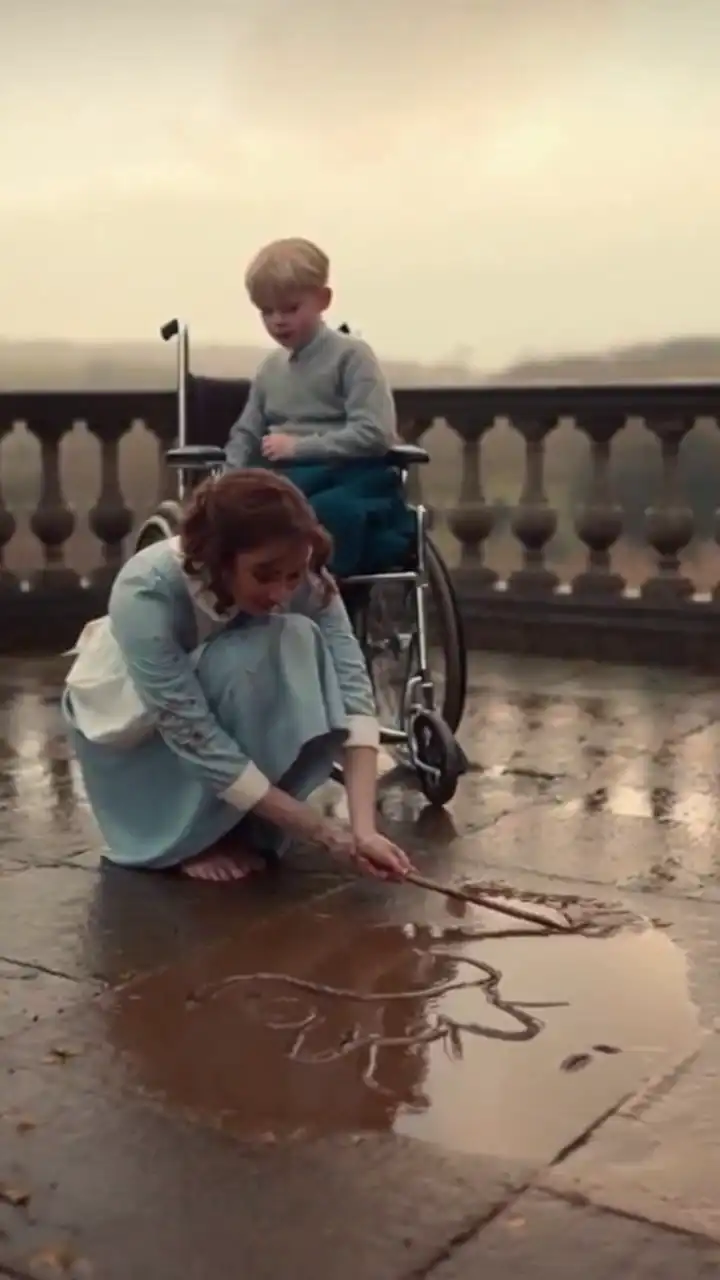
WHEN THE BILLIONAIRE’S SON DRAGGED HIS USELESS LEGS INTO THE MUD FOR THE FIRST TIME, HIS FATHER’S GIRLFRIEND SCREAMED FOR THE NANNY TO STOP

WHEN THE RICHEST MAN ON THE HILL HIRED THE WRONG NANNY, HIS SILENT SON CRAWLED ACROSS THE FLOOR FOR HER

THE NANNY WHO BROUGHT DUCKS TO THE OCEAN HOUSE AND MADE A CHILD WALK TOWARD LIFE