

THE BABYSITTER BUILT A SPACESHIP FROM A CARDBOARD BOX IN A BILLIONAIRE’S PENTHOUSE—AND THE BOY WHO HADN’T LAUGHED SINCE HIS MOTHER DIED SUDDENLY DID
Ethan had sat through board meetings worth hundreds of millions without blinking.
But his son’s laugh hit him harder than any market crash ever had.
He stayed by the kitchen entrance, one hand still locked around the chair, watching Noah grip Lena’s sleeve with two fingers.
Noah never reached first.
Doctors had written pages about sensory withdrawal, trauma response, possible autistic presentation sharpened by grief. They had suggested low-pressure language, regulated transitions, reduced stimulation, visual schedules, patient repetition.
All of that was probably true.
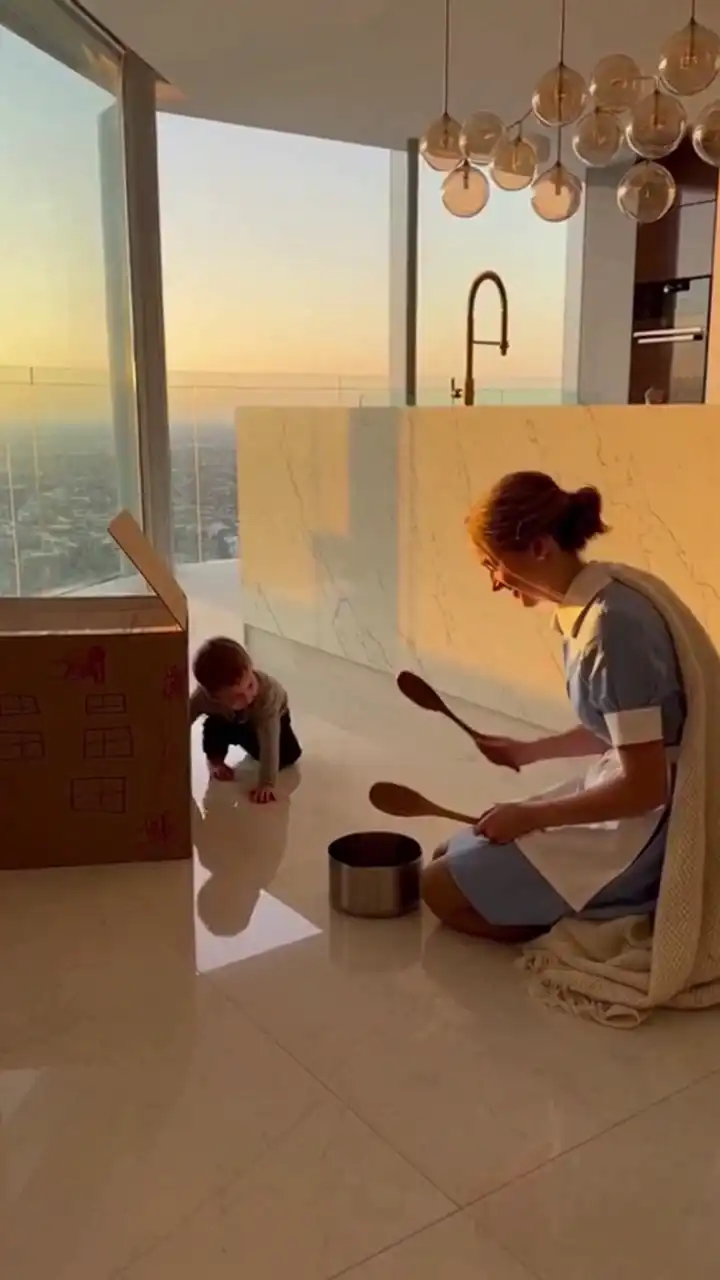
But no report had prepared Ethan for the sight of his son inside a crooked cardboard box in a penthouse kitchen, laughing because a young babysitter had put a blanket on her head and pretended to crash a spaceship.
Lena didn’t push the moment.
That was the first thing Ethan noticed after the shock.
She did not say, “Use your words.” She did not call for him. She did not celebrate and scare the boy back into silence.
She just sat there on the marble floor and let Noah have the laugh.
Then she tapped the pot again.
Tap-tap.
Noah answered with the spoon against the box.
Tap.
Pause.
Tap-tap.
A conversation, but sideways. Safe. No eye contact required. No demand hidden inside it.
Ethan took one step forward.
Lena lifted her hand without looking at him, a small stop sign.
He almost snapped at her on instinct. This was his house. His son. His kitchen. His life held together by structure and schedules because structure was the only thing that had not died with his wife.
But Noah was still playing.
So Ethan stayed where he was.
For the next twenty minutes, the penthouse stopped sounding like a private museum and started sounding like a child was inside it.
Wood on metal. Spoon on cardboard. Blanket dragging over polished floor. One burst of laughter, then another.
When Noah crawled fully into the box and peeked out through the crooked window Lena had cut, Ethan felt something ugly move through his chest.
Relief. Grief. Guilt. Maybe all three.
Because he realized, with humiliating clarity, that he had spent months trying to get Noah back by making everything smoother, quieter, safer, more controlled.
And Noah had disappeared deeper into it.
Lena finally looked at Ethan. “He likes predictable rhythm. And he likes not being cornered.”
Ethan heard the words, but the sting was in what came next.
“He’s been living in other people’s instructions.”
That night Ethan should have told the agency he wanted someone older, more clinical, more polished.
Instead he said, “Come back tomorrow.”
Lena nodded. “Then tomorrow nobody should clean this up before I get here.”
His eyes went to the spoons, the box, the tape stuck to imported stone, the dented stockpot on the floor.
“Why?”
“Because if he comes back and the whole thing vanished, it tells him his joy was a mistake.”
Ethan had no answer for that.
So for the first time since Claire died, he left a mess in the kitchen overnight.
The next morning Noah woke early and went straight to the box.
The housekeeper, Mrs. Dalrymple, stood frozen beside the espresso machine with a look that said she had never in twenty years of service been asked to protect garbage in a luxury penthouse.
But there was Noah, sitting beside it, touching the taped seam like he was checking whether something good could still exist when he came back.
When Lena arrived, she did not bring expensive supplies. She brought a grocery bag.
Inside were clothespins, string, old measuring cups, two plastic containers with rice and dried beans, and a roll of aluminum foil.
Ethan stared at the bag. “This is your plan?”
“This is noise, texture, repetition, and choice,” she said. “And none of it tells him he’s being tested.”
She was right, and Ethan hated that she was right.
Because he had turned Noah’s healing into a project with benchmarks. Even his hope had become managerial.
Lena didn’t “work on” Noah.
She entered his patterns.
If Noah lined up the measuring cups, she lined up lids beside them without touching his row.
If he spun one cup in circles, she spun another beside him until he noticed.
If he hid under the table, she sat outside it and rolled a clothespin back and forth into his field of vision like a silent invitation.
Some days he took it.
Some days he didn’t.
Lena never punished the silence by filling it.
That, more than anything, disturbed Ethan. He was a man built on intervention. If something broke, he fixed it. If data dropped, he optimized. If a doctor suggested a protocol, he funded ten more.
Watching Lena do less felt irresponsible.
Until he saw what her “less” was doing.
On the fourth day, Noah followed her from the kitchen to the living room.
On the sixth, he let her drape the old blanket over both of them and the box and sat inside with her for fifteen minutes, calm, not braced, not trying to escape.
On the eighth, he carried one wooden spoon to her without being asked.
That tiny offering wrecked Ethan more than the laugh.
Because it was intentional.
Because Noah had chosen.
One evening Ethan came home early from his office downtown and found Lena sitting cross-legged on the floor with Noah while the sunset turned the windows orange. They had built a tunnel system out of shipping boxes from Ethan’s latest smart-home installation.
The expensive modular play gym in Noah’s room sat untouched.
Lena was wrapping foil around a paper tube. “Laser scanner.”
Noah watched closely.
Ethan stepped in and said the wrong thing. “That foil can tear. The edges might cut him.”
Lena didn’t look up. “Then sit down and hold the tube while I fold the edge.”
“I’m serious.”
“So am I.”
Noah had already gone still.
Lena finally met Ethan’s eyes. “You do this every time.”
Every time.
Ethan opened his mouth, then closed it.
She continued, quiet but firm. “The second something becomes alive in here, you rush in to make it perfect. He feels that. He braces before anything can happen.”
It landed because it was true.
Claire had been the warm parent. Claire baked cookies at midnight and let Noah stir pancake batter with both hands and left finger paint on his elbows because she liked seeing proof that he had enjoyed himself.
Ethan had been the planner. The efficient one. The safe one.
After the accident, safe had become holy.
Claire died when a delivery truck ran a red light on a rainy Tuesday. Ethan had not been in the car. He had been on a call, sending a text that he would make dinner next week instead.
There had been no next week.
So he built systems.
A cleaner schedule. Better staff. More supervision. More precautions. More experts. More insulation between Noah and anything that could bruise, sting, fall, spill, break, upset, surprise, trigger, unsettle.
And inside all that protection, the child had gone dim.
Lena’s voice softened. “He doesn’t need a project manager. He needs somebody willing to stay in the room when life gets messy.”
Noah was watching them both now, his body taut.
Ethan did the hardest thing he had done in months.
He sat on the floor.
Awkwardly. In work clothes. In a penthouse living room where he usually took investor calls with skyline views behind him.
He held the cardboard tube while Lena folded the foil edge safely inward.
Noah looked from one adult to the other.
Then he took the tube from Ethan’s hand.
That was the beginning of the real shift.
Not just in Noah.
In the home.
Lena started using the kitchen as her base because, she said, kitchens made people participate. She was right again.
The first day she put dry beans into old yogurt containers and made shakers, Noah covered his ears for a second, then lowered his hands when she softened the rhythm.
The next day she lined up pots, lids, wooden spoons, and measuring cups on the floor and created what looked like a junkyard band.
Ethan walked in, saw his chef-grade cookware scattered across the marble, and nearly shut it down.
Then Noah tapped one lid with a spoon.
Lena waited.
Noah tapped again.
She answered with a gentler beat on a pot.
He listened.
Then he copied.
Ethan stood there in his tailored shirt, watching his son build a pattern out of noise.
Not random noise. Shared noise.
He did not understand all of it, but he began to see the logic. Lena was making the house legible to Noah through rhythm, repetition, and control he could actually touch. Cheap objects did not perform at him. They did not flash or sing or instruct. They stayed where he put them. They answered when he answered. They invited instead of demanding.
And because they were ordinary, they pulled other people in.
Mrs. Dalrymple passed through and got handed a shaker. The doorman, dropping off a package, smiled when he heard drumming from inside the penthouse instead of silence. Even Ethan’s sister, who had started visiting only in whispers after Claire’s death, sat at the island one Sunday and cried quietly while Noah pushed a measuring cup toward her.
It was the first thing he had ever offered her.
Not every day was progress.
One afternoon Noah had a hard spiral when a blender turned on unexpectedly in the kitchen next door. He dropped to the floor, covered his ears, and began hitting the side of his head with his palm.
Ethan lunged forward in panic.
Lena moved faster but calmer.
She slid the old blanket over the dining chairs and turned the space beneath into a small cave. Then she sat just outside it and tapped a slow, steady beat on the floor with her fingers.
Not talking. Not grabbing.
A pattern. A path back.
Noah crawled under the blanket cave, still shaking. Lena rolled one wooden spoon toward him. He didn’t take it at first. Then he did. Tap. Tap.
Her fingers answered.
By the time Ethan crouched beside them, breathing too hard, Noah was no longer hitting himself.
Afterward Ethan went to his office, shut the glass door, and finally broke.
Not loudly.
Just the kind of breakdown rich men think they can postpone forever.
He sat behind a desk made of dark imported wood and put his face in his hands because the truth had become too clear to dodge: every time Noah lost control, Ethan flooded the room with his own.
He was trying to save his son from pain he could not save his wife from.
And he was crushing him with it.
Lena found him there later, not intruding, just standing at the half-open door.
“He’s asleep,” she said.
Ethan wiped his face once. “How do you do it?”
She leaned against the frame. “Her death wasn’t only a loss for him. It was a shock to his whole system. Some kids talk more when they’re drowning. Some shut every window they have. He’s not rejecting people because he’s cold. He’s protecting himself from too much.”
Ethan looked out at the city lights below. “And the boxes? The spoons? This circus?”
“It’s honest,” she said. “A cardboard box can become a ship because someone says it can. That’s easier than asking a hurt kid to perform healing on command. Play lets him come out without being examined.”
That stayed with Ethan.
Without being examined.
He had been looking at Noah like a problem statement. Every silence meant regression. Every motion meant symptom. Every day was data.
Lena treated him like a child.
Weeks passed.
The penthouse changed in visible ways.
A basket appeared by the kitchen filled with bottle caps, ribbon, fabric scraps, tape, spoons, jars, cardboard tubes, and old takeout containers washed clean. Noah went to it on his own.
The piano lid opened one afternoon because Lena used its wooden side as a place to bounce rhythm with her fingers. She never forced music lessons. She just let sound exist again.
A corner of the living room became “the fort station,” which would have horrified Ethan a month earlier.
The apartment stopped feeling staged for people who never touched anything.
Then came the moment that shifted everything for all three of them.
It was raining hard, the kind of gray afternoon that usually made Noah more withdrawn. Ethan had canceled a dinner and come home early. Lena and Noah were in the kitchen building what Lena called a “storm control center” out of boxes, colanders, and foil strips that flashed when the light hit them.
Noah was tapping a pattern on two upside-down mixing bowls.
Lena answered.
Then she looked at Ethan. “Your turn.”
He almost refused.
Noah went still.
The old fear hit him: do it wrong and lose the child again.
Lena saw it. “He doesn’t need perfect. He needs you to join.”
So Ethan picked up a wooden spoon.
He copied Noah’s exact rhythm on the counter edge.
Tap. Tap-tap. Pause.
Noah stared at him.
Ethan repeated it, softer.
Noah lifted his spoon and answered.
For three full seconds they were in the same exchange, father and son, no translator, no therapist, no crisis in between.
Then Noah did something nobody in that penthouse had heard since before Claire died.
He said, very quietly, “Again.”
Ethan looked up so fast he nearly dropped the spoon.
Lena didn’t react. Bless her, she didn’t turn it into an event.
She only nodded at Ethan once.
Again.
Ethan tapped the pattern once more, and this time his hand shook.
Noah answered. “Again.”
The word was rough and small and imperfect.
It was also a door opening.
Ethan sat down right there on the kitchen floor.
Noah did not run.
He came closer.
Not all the way into his father’s lap. Not movie-style, not instantly healed, not easy.
But close enough for his knee to rest against Ethan’s leg while they kept tapping bowls during the rain.
That night Ethan stood in Noah’s doorway long after bedtime, listening to the quiet hum of the city below and the softer sound of his son sleeping without the usual tension in his face.
The next morning he called the agency.
Not to replace Lena.
To rewrite her contract.
He doubled her pay, gave her full benefits, and told them she would no longer be treated as temporary household help. He also arranged and paid for the early childhood therapy training courses she wanted but had never been able to afford.
When he told Lena, she went still for once.
“You don’t owe me that,” she said.
“It’s not charity,” Ethan replied. “It’s respect. And it’s late.”
She accepted, but only after making one condition of her own.
“Noah doesn’t need me turned into another system. I stay if this house stays human.”
Ethan gave a tired, real smile. “That might be the first nonnegotiable I’ve agreed to.”
So the rules changed.
Not the safety rules that mattered. The dead ones.
Meals stopped being plated in silence and started being assembled at the island where Noah could watch, stir, stack, and sometimes refuse without a scene.
The kitchen was allowed to look used.
The staff stopped apologizing for normal sounds.
Ethan moved one standing weekly investor call out of the apartment entirely because Lena told him, flat out, that Noah spent the whole day tightening up before those calls.
And Ethan listened.
On the first anniversary of Claire’s death, Ethan expected Noah to shut down completely.
Instead Lena brought out the biggest cardboard box yet and a bag of markers.
She said, “Today can be sad and still have hands.”
Noah sat with them on the floor.
Ethan almost couldn’t.
But Lena gave him a marker anyway.
They drew windows, stars, and crooked buttons on the box. Noah pressed silver foil stars onto one side. Ethan wrote “Mom’s seat” above the front corner before he could overthink it.
Noah touched the words with one finger.
Then he climbed inside and patted the space beside him.
For Ethan.
Ethan folded himself awkwardly into the box spaceship while Lena threw the old blanket over the top.
Inside it was dim, warm, ridiculous, and small.
Outside was a skyline worth millions.
Inside was the first place that had felt survivable in a year.
Noah leaned against his father’s arm.
Not by accident.
On purpose.
Ethan shut his eyes.
When the blanket lifted a minute later, Lena was still there, kneeling on the floor, one hand holding the flap like a stage curtain.
She did not belong to their family by blood.
But she was part of what had saved it.
By winter, the penthouse sounded different from the hallway outside. Delivery staff heard drumming. Laughter. Cabinet doors. Someone singing badly while making soup. A child’s feet running from one room to another.
Not every day was easy. Noah still had hard moments. He still retreated sometimes. He still needed rhythm, warning, space, and patience.
But he was back in the world.
And Ethan was too.
One Sunday morning, months after the cardboard box first scraped across marble, Ethan found Noah and Lena on the kitchen floor making a city out of cereal boxes and masking tape.
Noah looked up at his father and held out a spoon.
Not because he needed help.
Because he wanted him in.
Ethan sat down immediately.
The penthouse windows still faced the same expensive skyline. The marble still shone. The furniture still cost too much.
But now there were tape marks near the baseboards, a basket of ridiculous treasures by the kitchen, a blanket fort half folded in the corner, and three people on the floor building something together out of things most rich people would have thrown away.
And for the first time since Claire died, the home was warm enough for all of them to stay inside it.
Disclaimer: Mention of any brand or trademark is for identification only and does not imply partnership or endorsement
WHEN THE BILLIONAIRE’S SON DRAGGED HIS USELESS LEGS INTO THE MUD FOR THE FIRST TIME, HIS FATHER’S GIRLFRIEND SCREAMED FOR THE NANNY TO STOP
THE NANNY WHO BROUGHT DUCKS TO THE OCEAN HOUSE AND MADE A CHILD WALK TOWARD LIFE
WHEN THE RICHEST MAN ON THE HILL HIRED THE WRONG NANNY, HIS SILENT SON CRAWLED ACROSS THE FLOOR FOR HER