

THE RICH MAN’S SILENT SON SPOKE FOR THE FIRST TIME WHEN THE NEW NANNY LET HIM STEAL COOKIE DOUGH IN A PERFECT WHITE KITCHEN
The sound of breaking glass should have sent Evan back into himself.
That was what usually happened. One hard sound, one sudden movement, and he would lock up all over again, jaw tight, hands clenched, gone behind that blank stare.
Lily reacted before anyone else.
She didn’t rush to him. She didn’t grab him. She dropped to a crouch, put both palms over her own ears, and made an exaggerated face at the shattered mess on the floor.
“Rude,” she said to the glass.
Evan flinched.
Then he looked at her hands over her ears.
Lily slowly took one hand away and tapped the counter twice. A steady little beat. Then again. Two taps. Pause. Two taps. Like a game.
Evan’s fingers twitched against the dough.
The room held its breath.
He tapped once on the marble.
Then again.
Not words. Not much.
But not nothing.
Grant sank down to one knee without even noticing he had done it. His expensive slacks hit flour on the floor. He didn’t care.
Vanessa did.
“This is exactly the kind of overstimulation Dr. Bell warned about,” she snapped. “Sharp sounds, raw food, no boundaries—”
“Dr. Bell hasn’t gotten him to say a word,” Grant said, eyes still on his son.
It was the first time Lily heard any edge in his voice toward his wife.
Vanessa heard it too.
She turned cold after that.
Not loud. Cold.
That afternoon she emailed the household staff a new kitchen policy. No non-staff entry without approval. No food handling by minors. No disruption of meal schedule. She copied Grant, Lily, the chef, and the estate manager.
Lily read it and said nothing.
At dinner, Evan refused to come downstairs.
At breakfast, he sat mute again, staring at the ocean.
Vanessa looked almost relieved.
Grant looked wrecked. Like hope had hit him too fast and then been ripped back out.
Lily did not try to repeat the miracle in the same way. She understood that much. Kids like Evan often couldn’t be dragged through a breakthrough twice just because adults were desperate.
So she changed the path and kept the rhythm.
The next morning, instead of calling him to breakfast, she opened the refrigerator while he sat in the doorway of the family room and said casually to the air, “This house has the saddest fruit I’ve ever seen.”
No response.
She took out blueberries, peaches, and a bowl of cherries. She washed them under running water, loudly, on purpose. Water hit metal. Fruit rolled in the sink. She hummed badly.
Evan’s eyes shifted.
She didn’t look at him. “If nobody helps, all these cherries are going to think they’re important.”
A small thing moved in the doorway.
One socked foot.
Then the other.
He came as far as the kitchen threshold and stopped.
The threshold mattered. Lily understood thresholds.
The child did not need a speech. He needed places to enter.
She put a colander on the floor instead of the counter. Then she sat on the floor beside it, not in one of the perfect barstools. She popped a cherry stem loose and dropped the fruit in with a dramatic plunk.
Evan stood there, breathing shallowly.
Lily rolled a peach gently across the tile toward him.
Not at his feet. Near enough to choose.
He stared at it for a long time.
Then bent, picked it up, and carried it to the sink.
From the hallway, Grant watched like a man watching a door unlock one click at a time.
That became their beginning.
Not therapy flashcards. Not reward charts. Not the expensive talking games people had brought in boxed and shrink-wrapped.
Kitchen life.
Wash the fruit.
Tear the lettuce.
Push the button on the blender, then clap both hands over the noise.
Press biscuit dough with little cutters.
Line up the “bad pieces” and eat them before anyone saw.
Carry warm rolls in a dish towel from counter to table.
Touch. Smell. Stir. Wait. Try.
Lily never forced eye contact. Never demanded “use your words.” Never praised him so hard it felt like pressure. She treated him like a child joining life, not a patient passing a test.
Weeks earlier, the private specialists had circled the same conclusion in cleaner language: trauma-linked selective mutism with sensory shutdown. But in practice, too many of them had approached Evan like a locked machine. Prompt, reward, observe, report.
Lily approached him like a person whose world had become dangerous.
Because she knew what that looked like.
Grant learned that by accident one rainy afternoon when he came home early and found Lily at the back kitchen table mending the strap on Evan’s canvas apron.
Evan sat beside her, kneading dough with both fists, fully focused.
Grant kept his voice low. “How did you know not to push him after the first word?”
Lily didn’t answer right away. She pinched the thread through the fabric, tied it off, and only then looked up.
“My younger brother stopped talking for almost a year after our dad left and my mom got sick,” she said. “Everybody kept trying to pull him back with questions. He got worse every time. The only thing that worked was doing normal stuff beside him until he felt safe enough to come in on his own.”
Grant had hired her because of one parking-lot moment and a feeling. He had never actually asked her enough.
“Is he okay now?” he asked.
She smiled a little. “He talks too much.”
For the first time in months, Grant laughed in his own house.
Evan looked up at the sound.
Not frightened.
Curious.
That mattered too.
But every gain in that kitchen made Vanessa more rigid.
It wasn’t just jealousy. It was threat.
The house had run on her version of order. White sofa, low voices, careful schedules, grief folded into tasteful silence. She had stepped into a widow’s absence by becoming useful, polished, impossible to criticize. She handled dinners, charity boards, staff, calendars. She knew which wine went with which course and which school headmaster to charm.
What she did not know how to do was live beside pain that got messy.
And Lily was making everything messy.
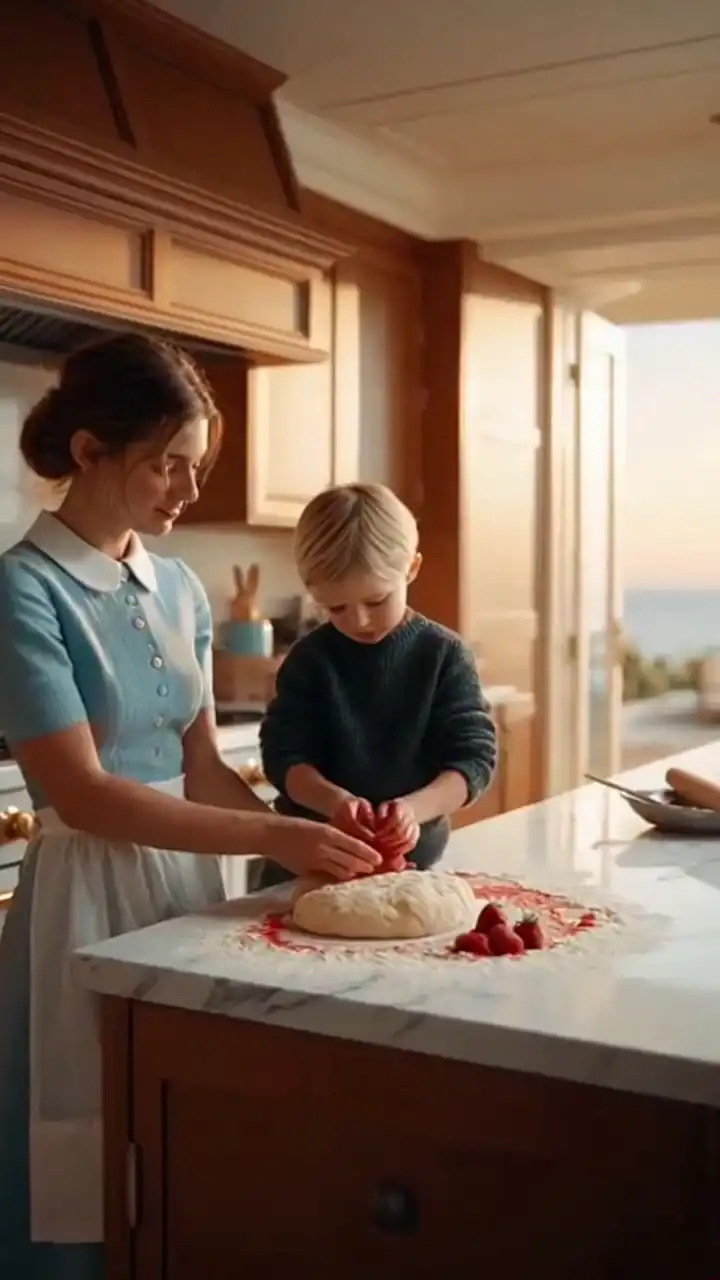
There were tiny fingerprints on the lower refrigerator door now. Flour in grout lines. Child-sized aprons hanging from a brass hook. A bowl of bruised strawberries on the counter because Evan liked sorting them by color before they were cut.
Worst of all, Grant had started coming home earlier.
He took calls from the study less often. He ate in the family kitchen instead of the formal dining room. Twice, Vanessa came downstairs in the evening and found father and son on the floor by the oven light, waiting for shortbread to cool while Lily taught Evan how to test the edge without burning himself.
Vanessa was being displaced by noise she could not control.
So she struck where people like Lily were easiest to wound.
One Saturday, she hosted a luncheon for the board of the children’s hospital. The event had been planned for weeks. Caterers, flowers, polished silver, ocean terrace set for sixteen.
Lily had already intended to keep Evan far away from it.
Public adults, strange voices, too much perfume, too many eyes—he would shut down instantly.
But that morning Evan saw the pastry chef rolling dough and followed him into the kitchen. He stood there in his apron, hands already reaching.
Lily glanced toward the terrace doors. “We can do our own batch in the back kitchen.”
Evan’s hand tightened on the counter.
He didn’t look at her. He just stayed planted.
He wanted this kitchen.
This one.
The forbidden one.
So Lily made a choice.
She washed his hands, tied his apron, and set a small board at the far end of the island, away from the luncheon platters. She gave him scrap dough, a tiny rolling pin, and the moon cutter.
He began to work in silence, shoulders loose, breathing steady.
For twenty precious minutes, it held.
Then Vanessa walked in with three women from the terrace.
She stopped dead.
The women looked from the child to the dough to Lily’s flour-dusted sleeves.
One gave the polite rich-lady smile people use when they’re watching someone else’s household problem.
Vanessa’s face hardened in a way Lily had never seen fully uncovered.
“What is this?”
Lily stood. “He was regulated. I kept him to one end.”
“This is a formal event.”
Evan froze.
Lily saw it at once. Fingers stopping. Breath gone. Neck tight.
She moved carefully. “Vanessa, please lower your voice.”
That only made it worse.
Vanessa stepped forward. “No. This has gone far enough. He is not a kitchen prop, and you are not family. You were hired to follow instructions, not turn my house into a daycare center.”
One of the board women murmured, “Perhaps this isn’t the best time—”
Vanessa ignored her. “Take him upstairs. Now.”
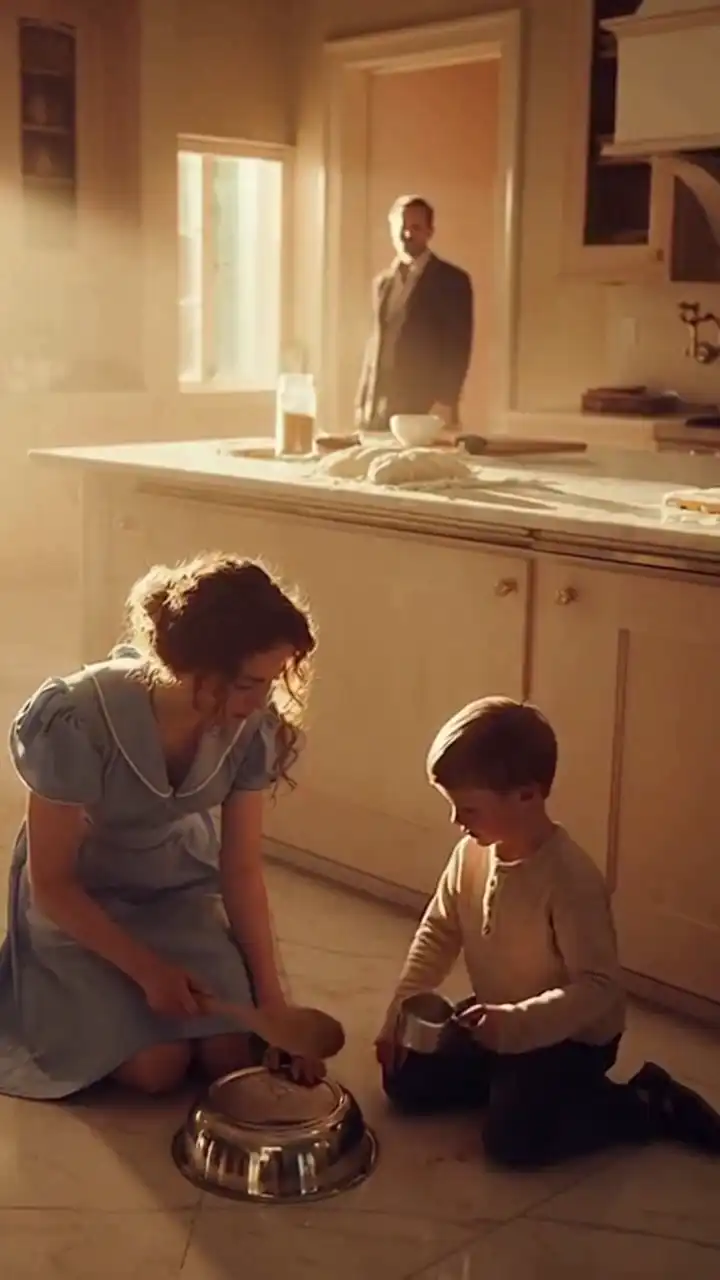
Evan’s rolling pin dropped.
The small wooden knock against marble made him jerk backward hard enough to hit the cabinet behind him.
Lily felt a flash of anger so hot she nearly lost her own control.
Not because Vanessa was insulting her.
Because Evan’s face had gone empty in one second.
Lily knelt beside him. “No rush. Just breathe.”
Vanessa said, “Don’t crouch on the floor in front of my guests.”
Grant’s voice came from the doorway.
“Then stop speaking to my son like he’s a stain.”
Nobody moved.
He had come in from the garage still in his suit, rain on his shoulders, and must have heard enough from the hallway.
Vanessa turned. “I’m trying to preserve some dignity.”
Grant looked at the frozen child, the untouched luncheon desserts, the women pretending not to stare, and then at Lily on the floor beside Evan.
“Dignity for who?” he asked.
Vanessa’s lips parted, but nothing came out.
The board women did what wealthy women always do when real truth enters a room—they became very interested in leaving gracefully.
Within five minutes, the terrace had thinned.
Within ten, the luncheon was over.
Within twenty, Vanessa was in Grant’s study behind closed doors.
Their voices carried anyway.
Lily stayed with Evan in the back kitchen, not prying, just helping him press the same piece of dough flat and fold it again. Flat and fold. Flat and fold.
At one point the study door slammed.
Grant came out hours later looking older than he had that morning.
He stood in the back kitchen doorway and watched Evan cut one crooked moon from the flattened dough.
Then he said quietly, “Vanessa is going to stay with her sister for a while.”
Lily did not answer.
This was not victory. It was fallout.
Grant rubbed a hand over his face. “I should’ve stopped this earlier.”
That was the first honest sentence he had given her.
She looked at him then. Not at the billionaire. Not at the employer. Just at the father who had let order stand where love should have been.
“He needed a person in the room,” she said. “Not just management.”
Grant took that hit without defending himself.
He nodded once.
Then he did something stranger than all the expensive interventions that had come before.
He asked, “Can you show me?”
So she did.
She showed him how to stand near Evan without blocking his path.
How not to flood him with praise after every tiny step.
How to narrate practical things instead of emotional demands. The pan is hot. The berries need rinsing. The dough is sticking. Try more flour.
How to invite him into action instead of into performance.
Grant was terrible at first.
Too stiff. Too careful. Too eager in the wrong places.
The first time Evan handed him a biscuit cutter, Grant said, “Good job, buddy,” in the overbright voice adults use when they are begging children not to disappear.
Evan’s shoulders rose.
Lily murmured, “Less.”
Grant exhaled. Tried again. “Star or circle?”
Evan pointed.
That was better.
They built from there.
A week later, Grant canceled a deal lunch in Manhattan because Evan had agreed, for the first time, to help make dinner rolls from start to finish.
His assistant sounded stunned on speakerphone.
Grant said, “Move it.”
Then he turned his phone face down and dusted flour across a black cashmere sweater that probably cost more than Lily’s monthly rent.
Evan noticed.
His mouth twitched.
Lily saw it.
“Looks expensive,” she said.
Grant deadpanned, “Was.”
A breath of sound left Evan. Not a word. Not even a full laugh.
But close.
The real break came on a stormy evening when the power flickered across the house and the backup system took a few seconds too long to kick in.
The kitchen dropped into dim gray light. Wind hit the windows. Somewhere upstairs, a door banged.
Evan went rigid.
Grant started toward him too fast.
Lily caught Grant’s sleeve. “Wait.”
She lit the gas stove with a long match. Blue flame bloomed. Warm light hit the room low and soft. She set a pot on top and poured in apple slices, butter, cinnamon, and brown sugar.
The scent rose almost immediately.
Not fear. Not questions. Not “use your breathing.” Just something ordinary and warm happening in the dark.
She handed Evan a wooden spoon.
He did not take it.
She began stirring herself. Slow circle after slow circle. “Storm apples,” she said lightly. “Best excuse for dessert.”
Grant, to his credit, copied her silence.
The wind hit again.
Evan’s hands flew to his ears.
Lily kept stirring. “Too loud.”
Grant crouched a few feet away, keeping his body turned sideways instead of straight at the child like Lily had taught him.
Another bang upstairs.
And then Grant said, very calm, very plain, “I know.”
No one in the room moved.
That sentence was not polished. It was not clinical. It was not trying to fix anything.
It was simple recognition.
Evan looked at him.
Really looked.
Grant’s eyes were wet. He didn’t hide it this time.
“When the water took her,” he said, voice shaking, “I kept trying to make everything quiet after. I thought quiet would help. I think I made it worse.”
Lily lowered the flame.
The cinnamon smell thickened.
Evan stared at his father’s face like he was seeing a language he used to know.
Grant held still. “You didn’t have to protect me by disappearing.”
The spoon slipped from Lily’s fingers and tapped the pot rim.
Evan inhaled sharply.
His lips parted.
Nothing came.
Grant did not push.
The boy looked at the bubbling apples, then at Lily, then back at his father.
And in a raw, rusty little voice from a place that had been shut for too long, he said, “Mama burned them.”
Grant folded in half.
Not physically at first. Emotionally.
He made one broken sound and covered his mouth with his hand like he could catch it too late.
Because that was not just a sentence.
It was memory.
It was before.
It was proof the boy had not lost his mother inside the silence. He had been holding her there alone.
Lily turned off the stove and stepped back. This was not her moment to occupy.
Grant moved carefully, every inch asking permission.
Evan did not retreat.
Grant gathered him in, awkward and shaking, and the child let himself be held.
The next day, the house changed in ways that could actually be counted.
The therapy team was reduced. Not eliminated, but restructured around what Evan could tolerate.
Meals moved permanently to the family kitchen unless there were guests.
The formal breakfast room was abandoned.
An apron hook was installed lower on the wall because Evan wanted to hang his own.
And Grant had the chef begin teaching one simple baking lesson every Thursday for staff children and neighborhood kids from the public elementary school across the bridge.
Vanessa called twice in the first week and once in the second. Grant kept the conversations short. By the third week, the lawyers were talking.
She had not lost because Lily stole a husband.
She lost because she kept choosing image over the child who lived in that house.
As for Lily, she assumed, at first, that once Evan stabilized, she would be thanked generously and phased out with professional kindness.
That was how rich families often worked. Deep need, sudden closeness, then distance once the crisis looked less ugly.
But Grant had begun noticing things he used to step over.
The beat-up car Lily drove.
The online community college tab open on her phone when she thought no one was looking.
The way she calculated every grocery extra she bought for sensory cooking projects, then tried to hide the receipts in case it seemed presumptuous.
One evening, after Evan had fallen asleep in the den with flour still on one elbow, Grant asked Lily to sit at the kitchen table.
Not in the office. Not standing in the hall. At the same table where she had taught his son to rejoin the world one ordinary act at a time.
He set a folder in front of her.
Lily frowned. “What is this?”
“A proposal,” he said.
Her face changed at once. Guarded. Ready to refuse something insulting.
He understood why.
So he said it plainly.
“It’s funding for school. Full tuition. Child development, speech and language support, occupational training if you want it, or a degree if that’s what you’d rather pursue. Plus salary if you stay with Evan while you study. If you choose not to stay, the funding still stands.”
Lily stared at him.
“I’m not offering charity,” he said. “I’m correcting my own stupidity. I spent a fortune on people with credentials and ignored the one person who actually knew how to reach him. You should have every credential you want, if you want it.”
She didn’t touch the folder.
“Why?” she asked, very quietly.
Grant looked toward the den, where his son was asleep under a blanket with a wooden spoon still clutched in one hand because he had insisted on “helping” until the last second.
“Because someone should have invested in you before life made you prove your worth in someone else’s kitchen,” he said.
That nearly broke her.
Lily looked down fast, blinking hard.
She had entered that house through a side door with practical shoes and a borrowed blazer, another paid helper in a long line of women expected to manage damage without ever belonging near the center of it.
Now she was being seen in full.
Not as miracle help.
Not as sentimental rescue.
As someone with real skill, real value, and a future bigger than service.
She finally opened the folder.
Scholarship trust.
Tuition schedule.
Flexible study plan.
A letter already drafted to a respected pediatric communication program in Boston.
Her hands shook.
“I don’t even know what to say.”
From the den came a sleepy rustle.
Then a small, rough voice, still learning its way back into the world, called out:
“Lily.”
She stood so fast her chair scraped.
Grant smiled through wet eyes. “I think he does.”
Lily went to the den.
Evan was sitting up, hair crushed on one side, blanket tangled around his legs. He held out one hand toward her and the other toward the kitchen.
“Apple,” he said.
One word for her.
One word for what they had made.
Simple. Ordinary. Huge.
Lily laughed and cried at the same time.
Behind her, Grant leaned against the doorway, no longer a man hiding inside polished control, no longer mistaking silence for healing.
The sea still hit the windows outside. The house was still enormous. The grief was still real.
But now there was fruit in the sink, dough under nails, voices in the kitchen, and a child coming back one word at a time.
By spring, Evan was speaking in short bursts. Not all day. Not on command. But enough to ask for strawberries, to tell the chef “no nuts,” to whisper “again” when dough hit the counter, to say “Dad home?” at five-thirty when the sky turned gold over the water.
Lily started classes that summer with everything paid.
She stayed on in the afternoons, not as a disposable employee, not as some poor girl lucky to be tolerated in a rich home, but as the person who had changed its direction.
At the end of her first semester, Evan stood in the kitchen with flour on his chin and pressed a crooked sugar cookie into her hand.
It was burnt on one side.
He looked proud anyway.
“For school,” he said.
Lily took it like it was made of gold.
Maybe in that house, it was.
Disclaimer: Mention of any brand or trademark is for identification only and does not imply partnership or endorsement

WHEN THE BILLIONAIRE’S SON DRAGGED HIS USELESS LEGS INTO THE MUD FOR THE FIRST TIME, HIS FATHER’S GIRLFRIEND SCREAMED FOR THE NANNY TO STOP

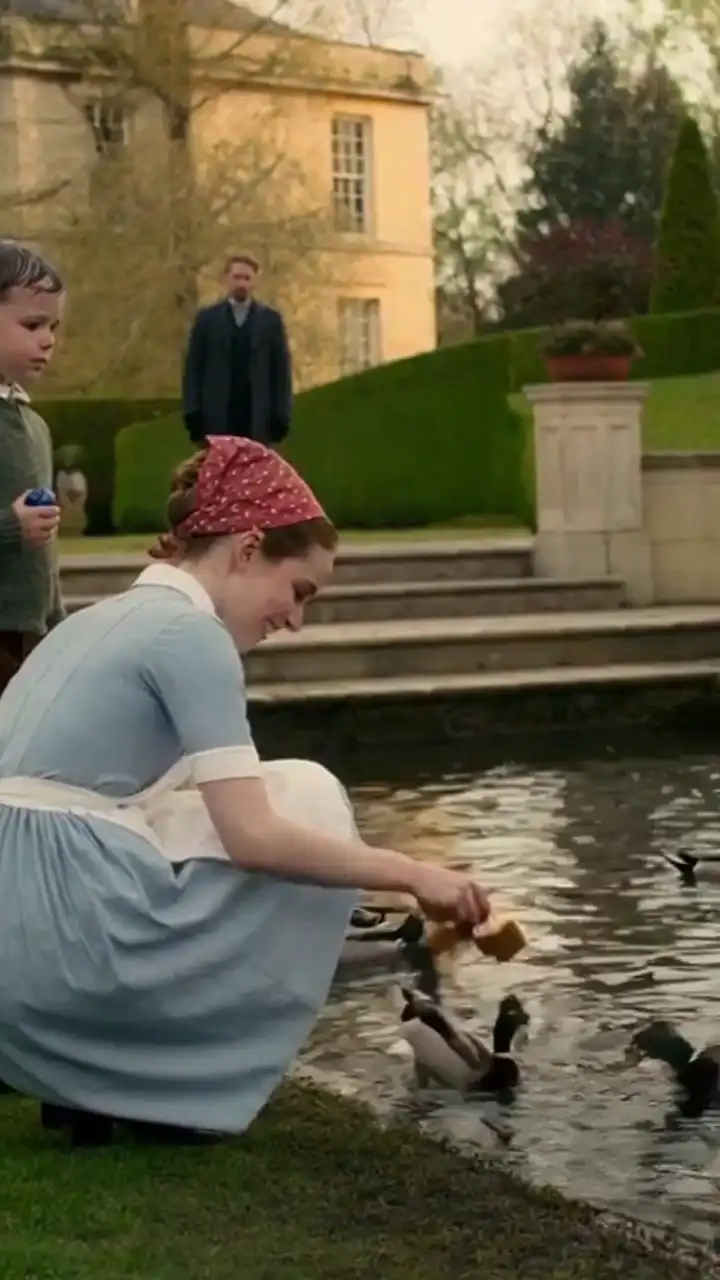
THE NANNY WHO BROUGHT DUCKS TO THE OCEAN HOUSE AND MADE A CHILD WALK TOWARD LIFE

WHEN THE RICHEST MAN ON THE HILL HIRED THE WRONG NANNY, HIS SILENT SON CRAWLED ACROSS THE FLOOR FOR HER