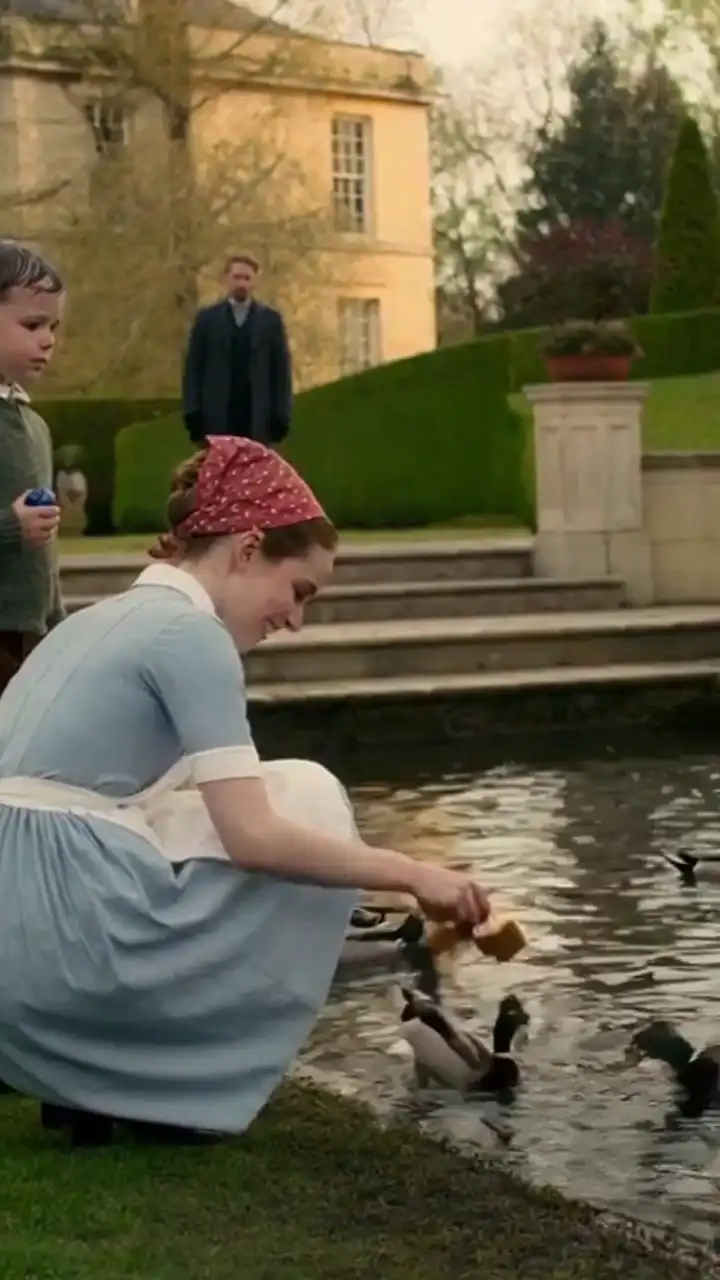
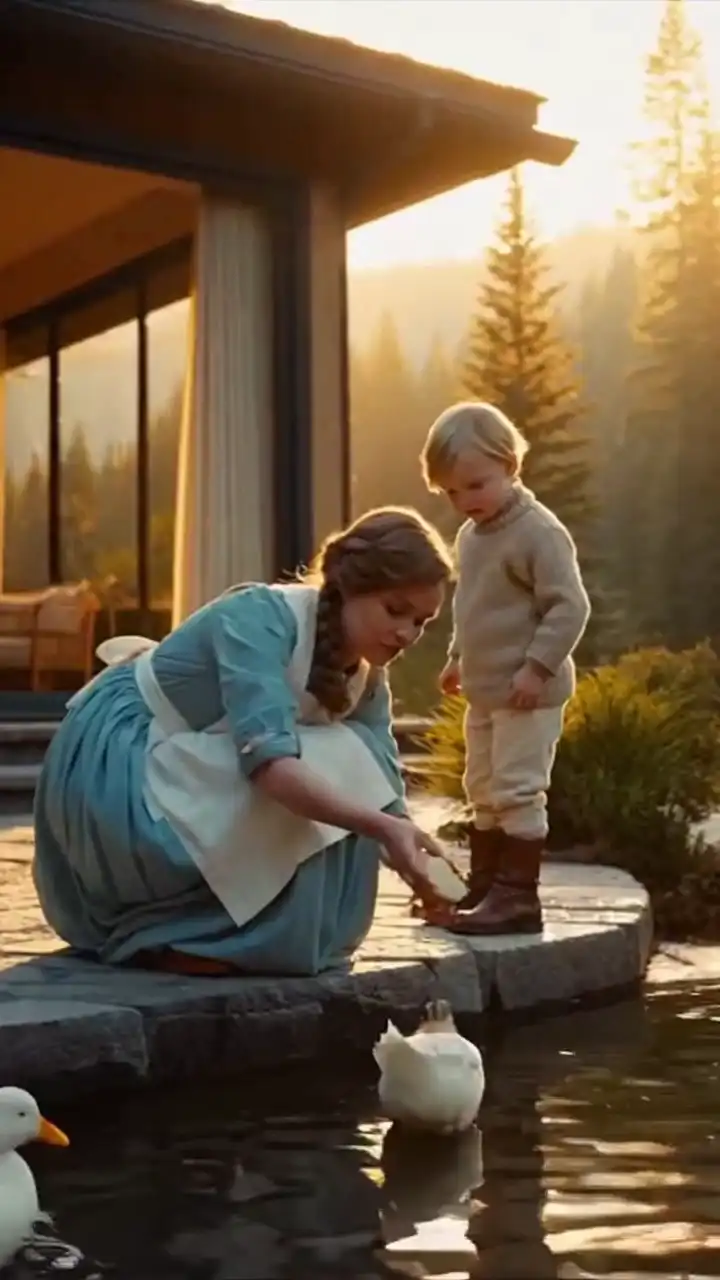

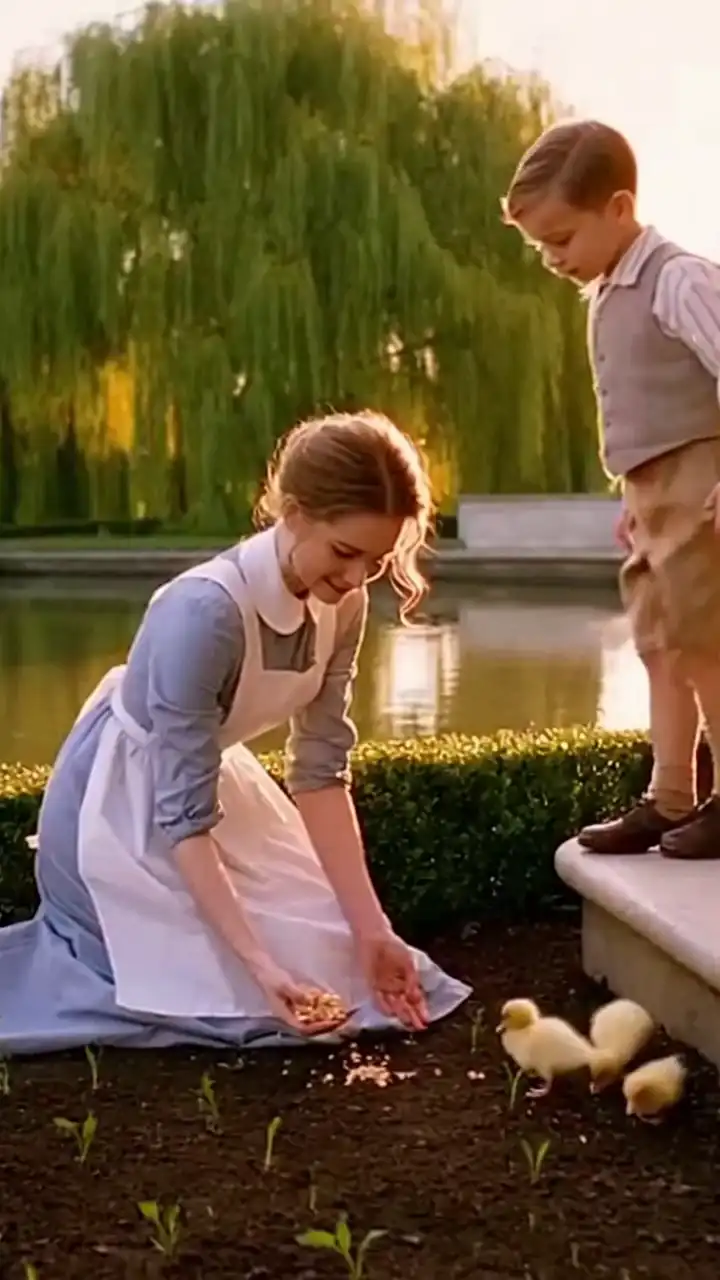
THE DAY THE HEIR'S SILENT SON FOLLOWED A NANNY INTO THE GARDEN AND FOUGHT TO KEEP HER
Andrew's sister, Victoria, recovered first.
"No," she said, already moving down from the terrace in her heels. "This stops now. We are not turning my brother's home into a petting zoo because one girl got lucky."
Oliver's hand froze in midair.
Lily saw it happen. She didn't touch him. Didn't rush to fill the silence.
She simply tipped her palm lower, letting a few cracker crumbs fall into the grass beside her shoe instead of asking him to come closer.
The pressure dropped.
Oliver looked from the crumbs to the nearest duckling. The duckling darted forward, pecking fast, making a silly wet clicking sound against the stone edge of the pond.
And Oliver moved again.
Not because an adult instructed him.
Because the duckling did.
Andrew watched his son lower himself awkwardly to the grass, knees stiff, balance uncertain, every movement delayed by that strange gap that had ruled his body for two years. But he lowered himself. He stayed. He looked.
Victoria stopped short. "Andrew, say something."
He did not.
He stood with his hands in his pockets, jaw tight, eyes fixed on his son as if any sudden word might scare him away.
Lily reached into her canvas tote and took out the rest of what looked like a very unimpressive supply kit: a bag of oats, two plastic cups, a string, and a red toy pinwheel with one cracked blade.
Victoria gave a short laugh. "This is absurd."
Lily answered calmly. "He's not playing with me. He's tracking movement and rhythm without being trapped by it."
That made Victoria roll her eyes, but Andrew heard something under the plain words. Not a trick. Not performance. Observation.
Lily put a little water in one cup, oats in the other, then tied the pinwheel to the low branch of a shrub near the pond where the breeze could catch it.
The ducklings wandered under it. The blades spun with a faint ticking sound.
Oliver stared. His fingers flexed against his knees.
Lily sat beside the setup like she had all day. "If he wants to feed them, he can. If not, they still eat."
No demand. No test. No celebration before the act.
That, more than anything, was different.
Andrew had spent two years in rooms where everyone wanted Oliver to produce something. A response. A sound. A task. Progress that could be charted, billed, and discussed.
Lily behaved as if Oliver was not a problem to solve in an hour.
She behaved as if he had already arrived and everyone else needed to slow down enough to meet him.
The first time Oliver reached for oats, he didn't take them from Lily. He pinched them from the cup sitting on the ground.
The second time, his fingers brushed the side of her hand.
The third time, he didn't pull away.
Victoria muttered, "This proves nothing."
But she sounded less certain now.
That evening, the memorial dinner was canceled.
Not by announcement. By simple neglect.
The florist's arrangement sat untouched. The chef's plated courses were sent downstairs for staff. Andrew stayed in the garden until dusk while Lily showed Oliver how to pour a little water into a shallow dish for the ducklings.
Oliver followed every small movement of her hand.
When the ducklings were put back into the box to return to the farm stand before night, something changed in the air.
Oliver's breath started coming faster.
His eyes, which had been focused and steady for almost an hour, went wide and scattered.
He stood abruptly, then made that low sound Andrew knew too well—the sound that usually came right before a full shutdown or a storm of self-hitting they could barely interrupt.
Lily looked at the box. Then at Oliver.
"It's too abrupt," she said quietly.
Victoria, who had stayed only to prove this would fail, crossed her arms. "Exactly. He's dysregulated. This is why structure matters."
But Lily crouched so she wasn't looming over him.
"They leave now," she told Oliver gently. "Tomorrow, maybe pond fish. Maybe birds. Different, not gone."
He didn't understand every word. Andrew knew that. But he reacted to rhythm, tone, sequence.
Still, when the groundskeeper picked up the box, Oliver lunged one step after it.
It was clumsy and desperate at once.
Then he stopped, stunned by his own movement, and slapped both hands over his ears.
Lily took the cracked pinwheel off the branch and placed it in the grass in front of him.
It spun once in the breeze.
Again.
Again.
"Look," she said softly. "Something stays."
Oliver's breathing slowed by a fraction.
Not enough.
So Lily did something that made Victoria gasp again.
She sat directly on the grass, crossed her legs, and began lining up oats, leaves, tiny stones, and cracker crumbs into a crooked path leading from Oliver's shoes to the pinwheel.
No lesson. Just a visible pattern.
Oliver stared through tears he never quite let fall.
One by one, he crouched and moved the pieces back after the breeze disturbed them.
He was still upset. But now his hands had somewhere to go.
By the time he rebuilt the little line three times, the panic had dropped from a cliff edge to something survivable.
Andrew exhaled for what felt like the first time in months.
That was the start.
Not magic. Not cure. A start.
Lily was hired that night, though Victoria made it sound temporary. "A trial period. Strict boundaries. Limited scope. No improvising with livestock."
Lily almost smiled. "They're ducklings, not livestock."
Andrew signed the papers himself.
Over the next weeks, the house changed in small, offensive ways.
There were paper cups on terrace steps.
A cheap bag of birdseed in the mudroom.
Banana slices on a kitchen counter where everything used to come trimmed and plated by staff.
Lily asked the cook for stale bread ends for pond fish. She saved herb stems for the rabbits that sometimes slipped through the side hedge from the neighboring property. She hung little bells near the garden door because Oliver liked the exact soft sound when the wind hit them.
At first she didn't ask Oliver for much.
Only attention in shared bursts.
A handful of oats.
Three steps to the koi pond.
Standing still while sparrows stole crumbs from a planter.
Following the shadow of a pigeon across the terrace.
She entered his pace instead of dragging him into hers.
That was what nobody else had done.
Therapists came with goals. Tutors came with tasks. Previous nannies came with polished voices and bright toys and charts for eye contact. Lily came with time, ordinary things, and no fear of looking foolish.
Andrew began seeing the pattern.
Oliver did not wake up for instruction.
He woke up for life that moved without demanding him.
A fish surfacing.
A duck splashing.
A squirrel on the wall.
A pinwheel turning.
The world was easier for him when it arrived sideways.
One afternoon Andrew came home early from the family office and found his son in the old service courtyard near the kitchen, a place no one in the main house used unless something was broken.
Lily had made a "bird station" out of an overturned wooden crate, bottle caps filled with water, and stale cereal.
There was a blanket draped between two chairs like a tiny fort.
Oliver sat inside it, half-hidden, watching finches hop in and out of reach.
A secret base.
Cheap. Crooked. Alive.
Andrew stood in the doorway, silent.
Lily looked up and started to apologize for using the courtyard without permission, but he shook his head once.
Inside the blanket fort, Oliver glanced at his father, then back to the birds. Usually that glance would have ended there.
This time he looked again.
Twice.
A small invitation, but an invitation.
Andrew crouched outside the blanket opening, careful not to enter.
"What do they eat?" he asked, not to test him. To join the scene.
Oliver's fingers tightened on the cereal box.
Lily answered lightly, "Mostly this terrible bargain-brand stuff they don't deserve."
Andrew almost laughed.
Oliver looked at the birds, then at the cereal, and made a soft sound.
Not quite a word. More shaped than before.
Lily didn't force the moment bigger.
"Want him to pour?" she asked Oliver.
The boy hesitated.
Then he held the box out—not to Lily.
To Andrew.
It wasn't affection. It wasn't healed. But it was participation, and Andrew took it like something holy.
From then on, he started coming home before dark more often.
Not with grand speeches. Not with dramatic vows.
He stood by the pond in rolled-up dress shirts while Oliver tossed fish pellets one at a time.
He learned not to fill every silence.
He learned not to praise too fast.
He learned that his son hated being watched for achievement, but liked being watched for company.
Victoria hated all of it.
She complained that the estate looked sloppy. That guests had heard animal sounds from the back garden. That Oliver's routine was "being set by an underqualified girl with no clinical training." She sent Andrew names of elite residential programs and developmental centers that promised intensive results in controlled environments.
One brochure arrived printed on heavy cream paper with gold edging. "Comprehensive separation-based reset," it promised.
Andrew left it unopened on his desk for two days.
Victoria opened it for him on the third.
"This is what has to happen," she said. "He's attached to a transitional crutch. You can see it already. If she leaves for one weekend, he falls apart. That is not healing."
Andrew looked out his office window toward the back lawns where Lily and Oliver were near the hedge, tossing cracked corn for a pair of ducks who had somehow started visiting regularly.
"Or maybe he's attached because for the first time something reaches him," Andrew said.
Victoria softened her voice, the dangerous version of soft. "You are grieving with your wallet again, just in reverse. Before, you bought experts. Now you're buying a fantasy about a sweet girl from nowhere fixing what medicine couldn't."
Andrew didn't answer.
Because part of him was afraid she might be right.
That fear got its chance soon enough.
A specialist from the center came to observe.
He watched Oliver for forty minutes from the morning room while Lily tried to continue the usual routine. But the man kept interrupting.
"Prompt him."
"Redirect."
"Discourage dependency on one caregiver."
"Do not reinforce fixation with repetitive animal play."
Oliver shrank with each correction. His shoulders climbed up around his ears. His hands began their old tight flutter near his mouth.
Lily's jaw set.
"He needs less language right now," she said.
The specialist gave her a thin smile. "And you need less intuition and more training."
By the time he suggested a six-week residential assessment with restricted family contact, Andrew's stomach had turned cold.
Victoria heard "program." Andrew heard "remove him from the only pattern that has opened him."
Still, he hesitated.
Because rich men are often most dangerous when they are uncertain. They call uncertainty prudence and let institutions decide for them.
The next morning, he made the mistake that nearly destroyed everything.
He told Lily the center would be doing a three-day intake evaluation the following week. "Just for assessment," he said. "No final decision."
Lily went still. "And where will Oliver think I'm going when strangers take over his routine?"
Andrew rubbed a hand over his face. "This can't all depend on you."
"It doesn't," she said. "It depends on not ripping away the bridge before he knows the shore."
He heard the challenge in it and retreated into authority. "I'm his father."
She nodded once. "Then be with him like one."
She left the room before she said something she couldn't take back.
For two days the house felt wrong again.
Oliver sensed it before anyone explained anything.
He started checking doorways.
He followed Lily from room to room but never touched her.
He refused lunch.
He wouldn't go to the pond unless she came too.
Victoria took this as proof. "You see? Unhealthy dependence."
Lily called it what it was. "He knows he's about to lose something without understanding why."
On the morning of the intake, a black car from the center came through the front gates.
A woman with a leather folder stepped out. A male aide followed with a calm smile too practiced to mean calm at all.
Oliver was in the garden with Lily near the bird station in the service courtyard, rebuilding seed piles after sparrows wrecked them.
Andrew walked out with the evaluator behind him.
He had planned to explain slowly.
He never got the chance.
Oliver saw the strangers, saw Lily stand, saw the evaluator glance at him like a case, and something primal flashed across his face.
Not blankness.
Recognition.
Separation.
The aide stepped forward with a soft voice. "Hi, Oliver."
Oliver backed into Lily so fast he almost fell.
Andrew's heart slammed.
The evaluator was already making notes. "Observe protective reliance."
Lily didn't move her hands to claim him. She kept them visible at her sides.
"It's okay," she said, but her own voice had gone tight.
The aide reached for Oliver's forearm.
That was the wrong move.
Oliver made a sound so raw it cut through the whole courtyard. Not a meltdown noise Andrew had heard before. This one had shape in it, direction in it.
He shoved the man's hand away with both of his own and grabbed a fistful of Lily's sweater.
Then he said it.
Not clearly. Not perfectly.
But unmistakably.
"No."
Everyone froze.
The sparrows burst up from the crate.
The evaluator stared.
Andrew stared harder.
Oliver had not used a functional word in almost two years.
His chest was heaving. His face was blotched red. He clung to Lily's sweater with one hand and pointed with the other toward the gate, trembling with effort.
"No," he said again, rougher this time. Then, after a terrible visible struggle, one more word dragged itself out of him.
"Stay."
Lily covered her mouth.
Victoria, who had come to witness the intake from the far archway, went completely still.
The evaluator tried to recover. "This is an acute distress response. It doesn't necessarily indicate—"
Andrew turned on her with a voice that had finally found its edge. "Get out."
"Mr. Bell—"
"Get out of my house."
The aide stepped back first. The evaluator shut her folder.
Victoria descended into the courtyard in outrage. "Andrew, don't be irrational. One reactive episode does not justify abandoning treatment."
Andrew looked at her, then at his son still gripping Lily's sweater like letting go might erase the world again.
"Did you hear him?" he asked.
Victoria opened her mouth, but for once there was no elegant answer waiting.
Because she had heard him.
And worse for her, Oliver had not reached for family money, family name, family order, or the professionals she trusted.
He had guarded a person she considered replaceable.
That was what she could not forgive.
The center was canceled that hour.
Victoria called it a disgrace. She said Andrew was allowing sentiment to sabotage intervention. She said the staff would talk. She said people would think the Bell family had lost all standards.
Andrew finally said the thing he should have said months earlier.
"Then let them."
She moved out of daily control of the house after that. Not dramatically. Just effectively. The household no longer took direction from her social schedule or her ideas about what looked proper. She still came for holidays. She was still his sister. But she no longer decided who belonged.
That part belonged to Oliver now more than anyone wanted to admit.
After the intake disaster, Lily considered leaving anyway.
Not from anger. From fear.
She stood by the pond that evening while the visiting ducks cut little V-shapes through the water. Andrew joined her after Oliver fell asleep for the first time in months without pacing his room.
"You were right," he said.
She shook her head. "I didn't need to be right. I needed you not to let strangers tear him away to prove you're responsible."
He took that without defending himself.
The dusk made the old estate look softer than it ever did by day.
"I built my whole life making things containable," he said. "My father died, I took over the business too young, I kept everything running, everything polished, everything controlled. After Mara died, I think I did the same thing to grief. And to him."
Lily looked out at the ducks. "Oliver doesn't move toward control. He moves toward safety. And safety, for him, looks ordinary."
It did.
Bread crusts. Birdseed. Water dishes. Wind. Repetition. A person who stayed.
Andrew let the silence sit. Then he said, "If you ever want training, school, credentials, whatever path you want next, I'll pay for it. Not to keep you here. Because what you do matters, and no one should get to call it nothing."
Lily turned toward him then, surprised enough to show it.
She had grown up with younger brothers, a mother on night shifts, and neighbors' kids attached to her hip while adults worked. She had no language for what came naturally except that children could feel when they were being managed and when they were being met.
She nodded once. "I'd like that."
So the arrangement changed.
Not overnight, not like a fairytale.
Lily stayed on as Oliver's caregiver, but Andrew funded her coursework in developmental support and child communication at a nearby college. Her name went from "the girl helping with Oliver" to being listed on household planning and medical meetings. Staff stopped treating her like temporary weather.
More importantly, Andrew changed his schedule around his son instead of around appearances.
There were now fixed morning walks to the pond before calls.
A basket of seed by the kitchen door.
A ridiculous rabbit dish by the hedge.
The service courtyard became Oliver's place: blanket fort in spring, bird table in summer, little weatherproof boxes of pinecones and shells in fall. The old-money estate slowly developed the signs of actual life, and not one of them matched the magazines Victoria liked to leave around.
Oliver's progress came in the only way that meant anything: uneven, specific, real.
He began to follow Lily and Andrew together.
He brought cups for fish feed before anyone asked.
He used "more" for oats, then "duck," then "go."
He laughed easier.
He slept better.
He started putting objects into Andrew's hand the way he once only lined them up alone.
And when Lily left for class in the afternoons, he no longer panicked if she told him the order first: class, car, back. She had taught him that leaving was survivable when staying had been made reliable.
Months later, at the first small family gathering Andrew allowed after everything changed, a cousin's child ran through the courtyard and knocked over one of Oliver's bird trays.
Seeds scattered everywhere. Finches exploded into the air.
The old Oliver would have shut down on the spot.
Instead, he looked toward the gate where Lily had just arrived back from class, saw her, then turned before she reached him.
He crouched and began gathering the bottle caps himself.
When the younger child tried to help and made it messier, Oliver made an unhappy sound—but he didn't fold into himself.
Lily paused a few feet away.
Andrew paused too.
Oliver picked up one of the caps, put it back on the crate, then looked straight at the little cousin and pushed a cup of seed toward him.
A shared repair.
Andrew sat down right there on the stone step because his knees almost gave out.
Later that same evening, Lily went to leave through the side courtyard as usual.
Her tote bag was over her shoulder. The sunset was low over the hedge. Andrew was in the kitchen speaking to the cook.
Oliver saw Lily at the door and did something that sealed the whole story better than any speech.
He ran.
Not elegantly. Not far. But fully.
Across the worn brick of the service courtyard, through the place that used to be only for deliveries and broken things, Oliver ran after her on his own two uncertain legs.
He reached her before she opened the gate and caught her sleeve.
"Stay," he said.
Clear this time.
Not a panic word. A choice.
Lily knelt in front of him. "Class tomorrow. Then back."
Oliver looked at her face, then at the gate, then back at her. He thought about it. Really thought.
Finally he let go of her sleeve, walked to the cracked red pinwheel still tucked into the herb pot by the door, pulled it free, and put it into her hand.
A trade.
Come back.
She nodded like she'd been handed something official. "Back."
He accepted that. Then took her free hand and put it on the gate latch himself before stepping away.
Andrew had seen boardrooms, funerals, acquisitions, judges, surgeons. Nothing had ever humbled him like watching his son defend a bond, negotiate its pause, and choose trust over terror.
That was the end of the old house, even though the walls stayed the same.
Not because a rich man was saved by love in some dramatic way.
Because a silent child, given ducks and crumbs and time, learned to reach for life again.
And because when the world tried to interrupt the first person who truly met him where he was, he didn't disappear.
He said no.
Then he made sure she came back.
Disclaimer: Mention of any brand or trademark is for identification only and does not imply partnership or endorsement
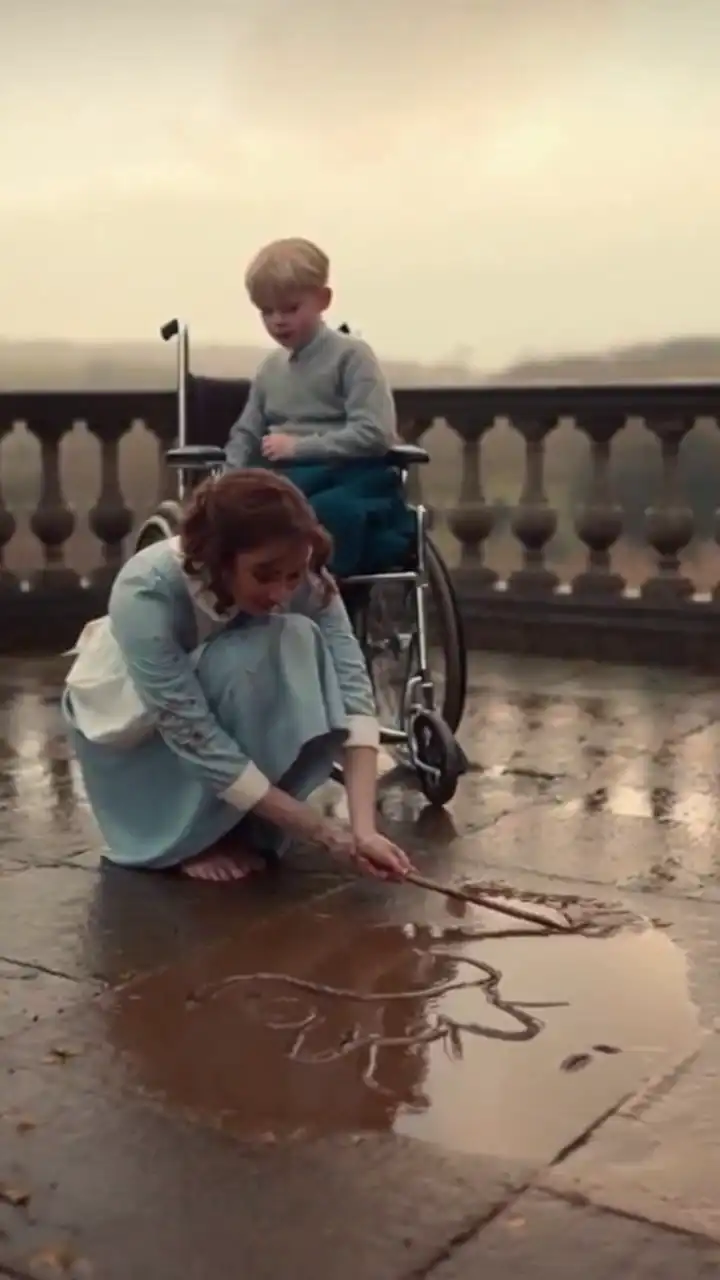
WHEN THE BILLIONAIRE’S SON DRAGGED HIS USELESS LEGS INTO THE MUD FOR THE FIRST TIME, HIS FATHER’S GIRLFRIEND SCREAMED FOR THE NANNY TO STOP
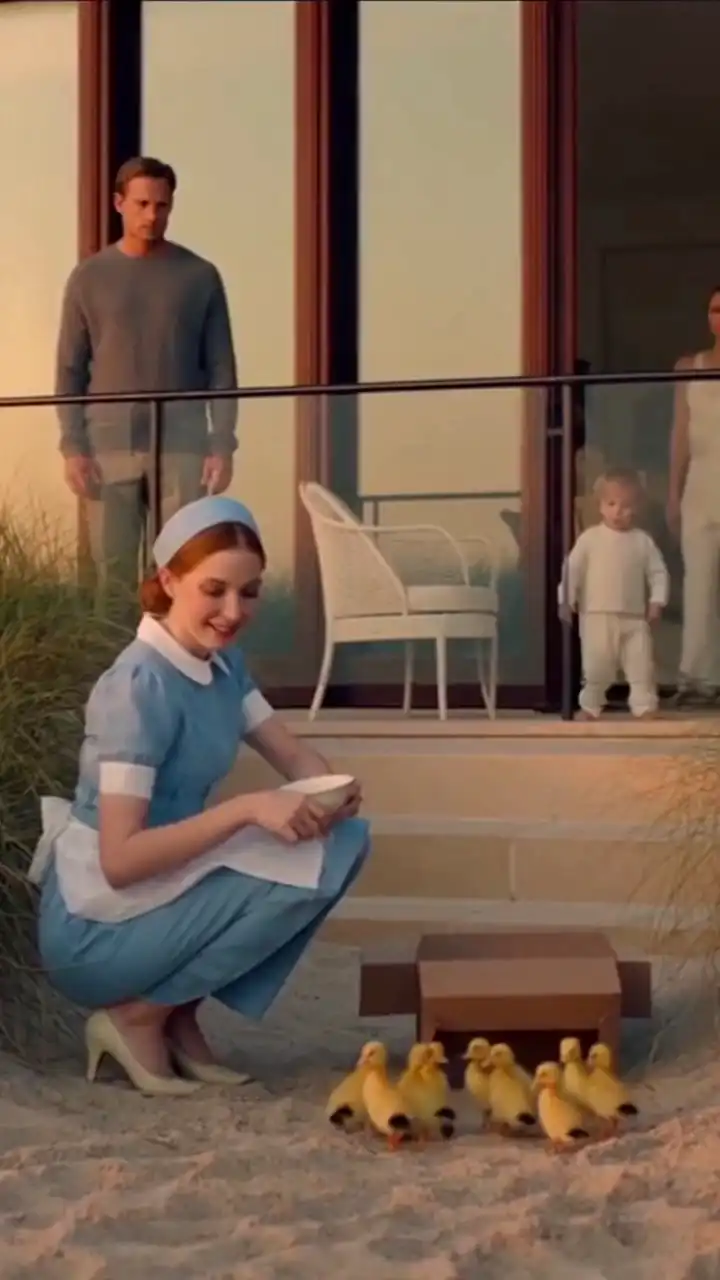
THE NANNY WHO BROUGHT DUCKS TO THE OCEAN HOUSE AND MADE A CHILD WALK TOWARD LIFE
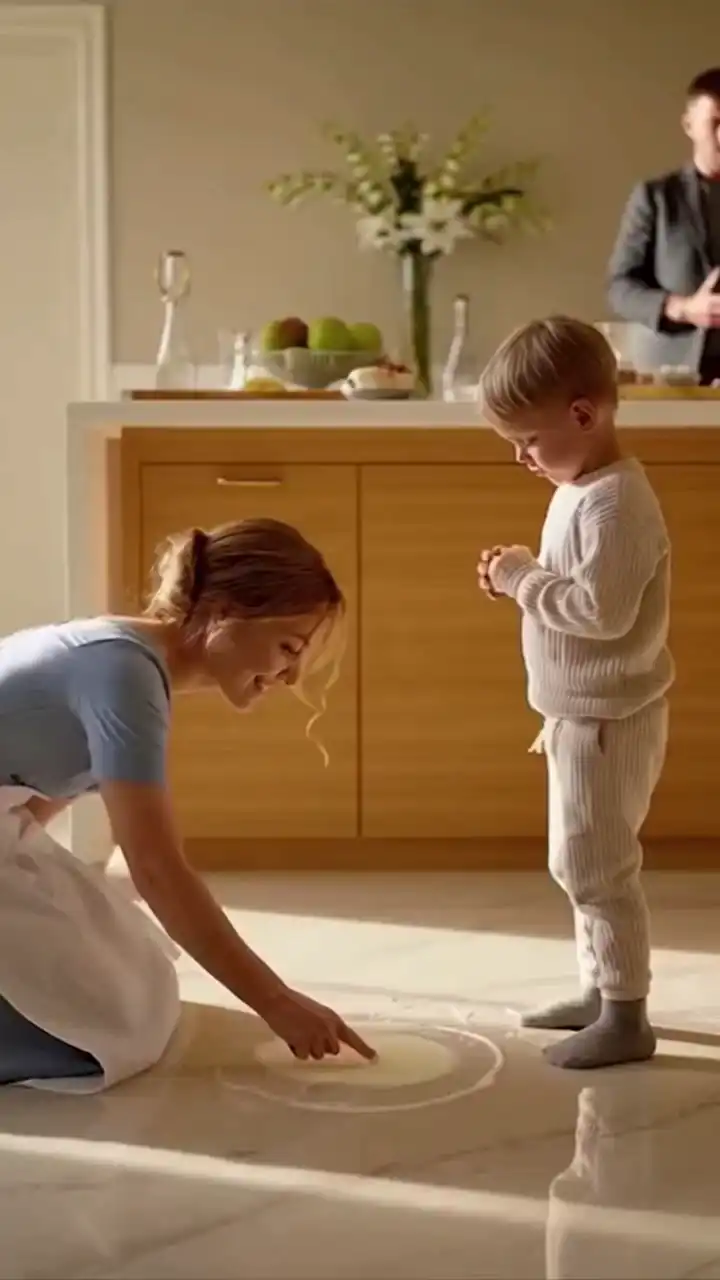
WHEN THE RICHEST MAN ON THE HILL HIRED THE WRONG NANNY, HIS SILENT SON CRAWLED ACROSS THE FLOOR FOR HER