
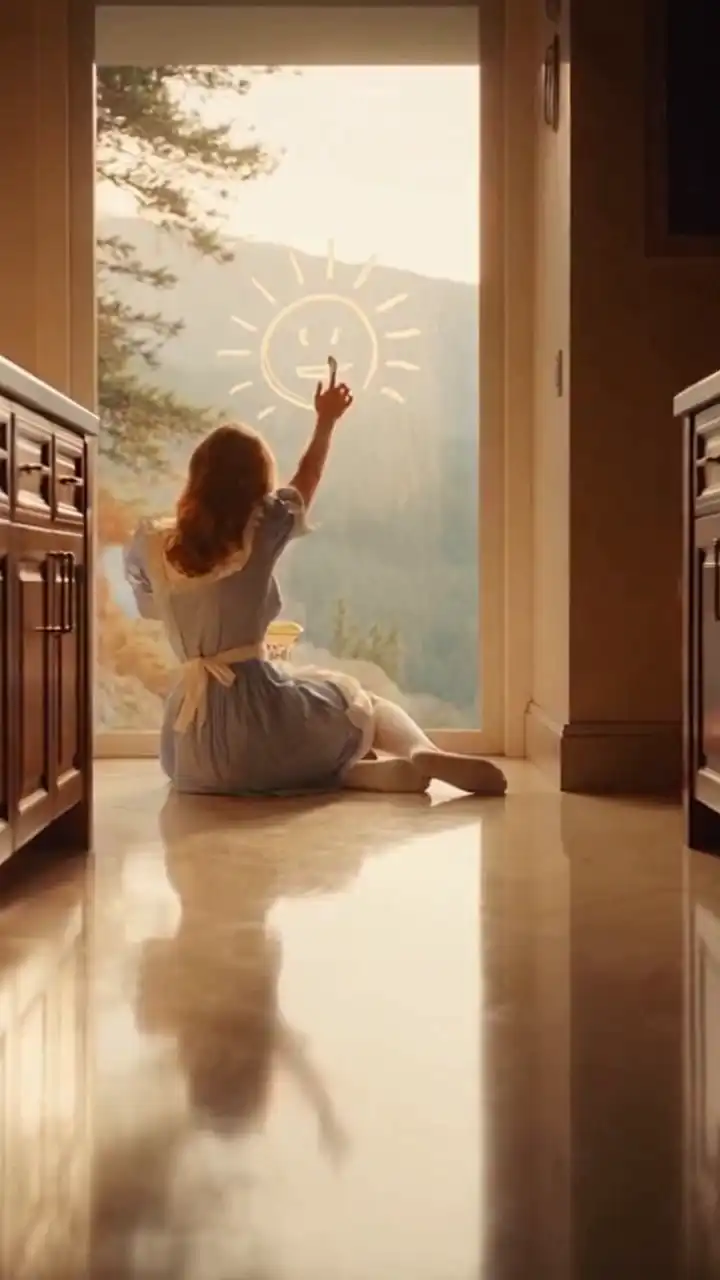
THE NANNY SMEARED ICE CREAM ON HER FACE IN A MOUNTAIN MANSION, AND THE SILENT BOY CRAWLED TO HER FOR THE FIRST TIME SINCE HIS MOTHER DIED
The spoon shook in Oliver’s hand.
Not much. Just enough for Ethan to see that this was costing the boy everything.
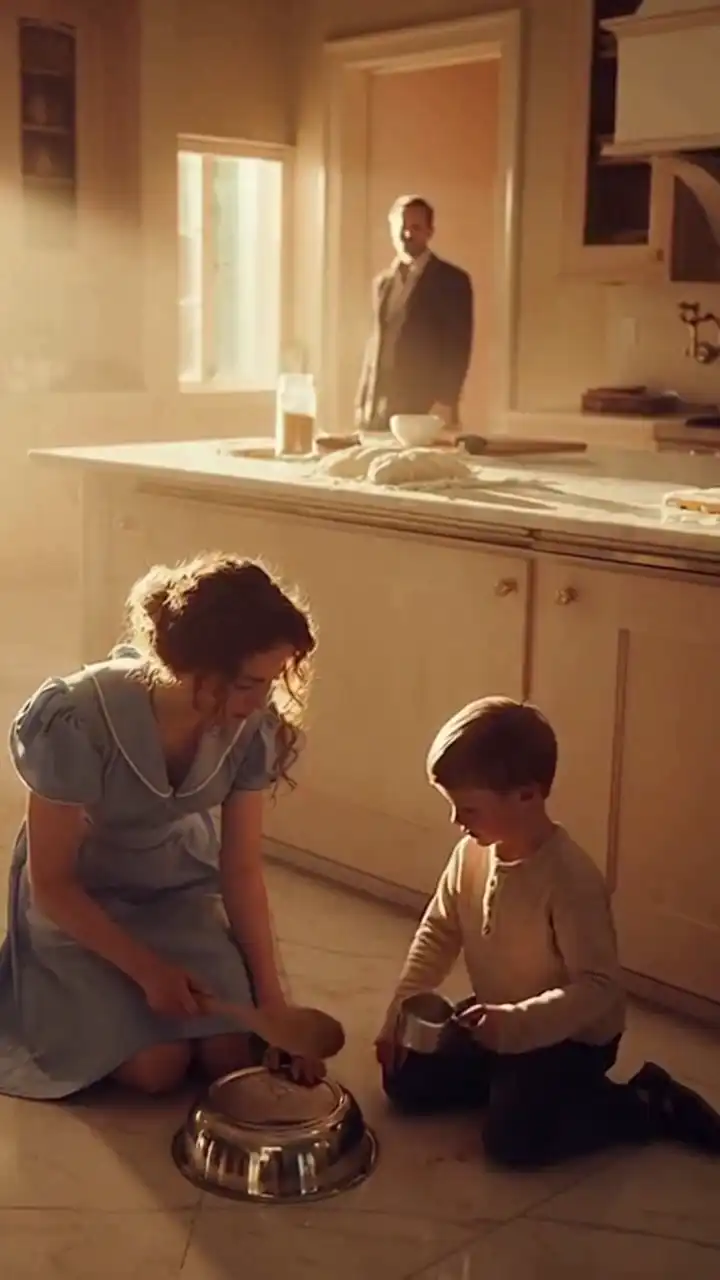
Lena stayed exactly where she was on the tile. No sudden smile. No big reaction. No “good job.” She only looked down at the extra spoon in his fist and said in the same easy tone, “That one’s yours. Mine’s doing all the hard work.”
Oliver’s eyes lifted to her chin, where the ice cream was still melting.
For one suspended second, Ethan thought his son might retreat from the closeness, from the sound, from the change. That was the pattern now. One tiny opening, then days of shutdown worse than before. Every therapist had warned him not to read too much into flickers.
But Oliver didn’t back away.
He touched the sleeve of Lena’s sweatshirt again. Then he dipped his spoon into the tub, very carefully, and held it out toward the smear on her chin as if trying to fix what he saw.
Lena let him.
The spoon bumped her skin. A crooked white streak landed near her mouth.
“Much worse,” she said gravely. “Now it’s a disaster.”
A sound burst out of Oliver.
Small. Choked. Rusty from disuse.
But it was a laugh.
Ethan gripped the kitchen counter so hard his knuckles blanched. He had spent nearly a year paying people to help his son regulate, process, reconnect, tolerate, verbalize. He had flown in specialists from Boston and Denver. He had approved play therapy rooms, grief work, sensory assessments, child trauma consults.
And his son was laughing because a girl in cheap sneakers had turned herself into a mess on the kitchen floor.
Oliver laughed once more, then clapped a hand over his own mouth as if he’d broken some rule.
That was when Ethan understood something awful about his own house.
The child still believed joy was dangerous here.
Lena must have understood it too. She didn’t move closer. She only breathed on the patio door again and drew a lopsided cat beside the suns.
Then she put one finger to the tile and crawled two silly inches backward.
Oliver froze.
Then followed.
Not far. Barely a body length. But it was pursuit. Choice. Movement toward someone.
Ethan had not realized he was crying until Lena glanced up and saw him.
Her look said one clear thing: Don’t ruin this.
So Ethan did the hardest thing a man like him could do.
Nothing.
He stayed where he was and let his meeting time out, let his phone buzz itself silent, let the kitchen become a place he did not control.
That afternoon should have felt like a miracle.
Instead, by evening, the cost of it hit.
Oliver refused dinner. He would not come out for bath time. He shoved a lamp off the small table in his room when the housekeeper tried to straighten his blankets. When Ethan stepped in, Oliver pressed himself against the wall and started making a low sound in his throat, trapped and panicked, like an animal cornered after stepping into daylight.
Regression, one specialist had called it. A retreat after activation. The child gets close to feeling, then runs.
Ethan knew the term. Knowing the term did not make the sight easier.
Lena stood in the hallway and watched Ethan try reason first.
“Buddy, it’s okay.”
No response.
Then calm commands.
“Oliver, stop. Look at me.”
Nothing.
Then the brittle edge Ethan used when everything else failed.
“Enough.”
Oliver flinched so hard his shoulder hit the wall.
Lena stepped in front of Ethan before he even realized he was moving.
“Back up,” she said quietly.
He stared at her.
“That is my son.”
“And right now he’s not refusing you. He’s drowning.”
No one talked to Ethan Cross like that. Not in his company. Not in his house. Not after he had just paid them.
But there was a broken lamp on the rug, a boy shaking in the corner, and the terrible truth that Ethan’s authority was making the room smaller.
Lena looked around once, spotted a basket of clean laundry outside the door, grabbed a pillowcase from the top, and sat on the floor several feet away from Oliver.
Then she put the pillowcase over her own head.
Ethan almost said, What on earth are you doing?
Before he could, Lena’s muffled voice came through the fabric.
“Oh no. I have become a ghost who is very bad at haunting. I can’t even find the door.”
She bumped gently into the dresser.
Then into the bed.
Then sat down hard on purpose.
“Embarrassing,” she announced to the floor.
Oliver’s low sound did not stop.
But it changed.
Less trapped. More listening.
Lena took the pillowcase off halfway, crossed one eye dramatically, and whispered, “Don’t tell anybody a ghost lost a fight with a sock basket.”
A beat passed.
Then another.
Oliver’s breathing hitched. His hand moved from his throat to the carpet.
Lena didn’t go for him. She just dragged the laundry basket closer and began tossing rolled-up socks into it from a terrible distance.
Miss. Miss. Miss.
“Retirement-level throwing,” she muttered.
A sock landed near Oliver’s knee.
He stared at it.
Then, with visible effort, picked it up.
He didn’t throw it. He just held it.
That was enough.
Lena missed two more on purpose. Then she leaned back and said, “This team is struggling.”
Oliver’s fingers twitched.
He tossed the sock. It fell nowhere near the basket.
Lena slapped her palm to the carpet. “Best one so far.”
A breath. Another twitch.
Then Oliver looked at the basket.
It was the first direct, purposeful look Ethan had seen from his son all day.
Later that night, after the shattered lamp was cleaned up and the house had gone still again, Ethan found Lena in the staff kitchen stirring boxed mac and cheese in a saucepan because, as she said when he stared, “Sometimes a house this fancy needs to eat like a divorced uncle.”
He should have corrected her tone. He should have reminded her she was temporary, that this was still his home, his child, his call.
Instead he leaned against the counter and asked the question he should have asked before hiring ten professionals and creating a museum out of grief.
“Why did that work?”
Lena looked at the pot, not at him.
“Because nobody in this house lets anything be ugly.”
He said nothing.
She continued, “He lost his mom in a violent, sudden way. Everybody around him got scared of making it worse. So the whole house started walking like a church. Quiet voices. careful hands. perfect rooms. No surprises. No mess. No noise. But little kids don’t come back through perfection. They come back through ordinary life.”
Ethan thought of the untouched playroom. The formal breakfasts. The carefully curated calm. The way he had corrected staff for leaving clutter in the wrong place because chaos made him feel one inch closer to the night he could not control.
Lena stirred the noodles and went on.
“When he leaned in today, that wasn’t because of ice cream. It was because nothing was being asked from him. No eye contact request. No language prompt. No ‘show me your feelings.’ Just a dumb girl being messy on the floor and surviving it.”
Her words hit hard because they were true.
Ethan had turned survival into management.
The next week did not unfold like a movie miracle.
It was messier than that.
Some mornings Oliver came into the kitchen and stood in the doorway while Lena sang terribly and burned toast on purpose because “some breakfasts deserve to lose.” Other mornings he vanished back into his room and would not tolerate anyone near him. He began following sounds more than people: the mixer whirring, pasta water boiling, Lena knocking wooden spoons together like drumsticks, the rasp of crayons on cardboard she saved from delivery boxes.
Life entered the house sideways.
Not expensive life.
Real life.
Lena set up “window art” with washable markers on the lower sunroom glass. She let Oliver breathe fog onto cold mirrors and draw circles through it with one finger. She spread old sheets on the floor and rolled toy cars through paint. She crouched under tables and called them caves. She slid across hardwood in socks. She opened the back mudroom and lined up rain boots by the door even though the weather app said clear, because “mountains lie.”
Ethan watched his staff react to all of this like they were witnessing a minor social collapse.
The housekeeper winced at handprints on glass.
The cook complained that Oliver was eating crackers in the kitchen instead of at the breakfast table.
The estate manager quietly asked Ethan whether the new nanny understood household standards.
Ethan opened his mouth to agree.
Then he looked through the doorway and saw Oliver on the floor in a patch of winter sunlight, pushing a wooden spoon toward Lena’s ankle and waiting—waiting—for her to kick it back.
A game.
His son was initiating a game.
“Standards are changing,” Ethan said.
The manager blinked.
They changed slowly. Then all at once.
One afternoon fog rolled low through the pines, wrapping the estate in gray. Oliver had a bad hour. Then a bad two hours. No touch, no food, no doorway hovering, no floor games. He sat under the long entry bench, arms around his legs, forehead pressed to the wall.
Ethan felt the old panic climbing up his throat.
This was what happened every time hope appeared. It punished him.
He started giving instructions just to feel useful. Call Dr. Mercer. Cancel the afternoon tutor. Clear the hall. Bring water.
Lena came in from the mudroom carrying grocery bags and looked at him like she was seeing a man relighting the same fire.
“Don’t turn him into an emergency because he’s scared,” she said.
“He’s shutting down again.”
“Yes,” she said. “Because coming back hurts.”
That line stopped him.
Because coming back hurts.
Not because the child was failing. Not because Lena’s methods had gone too far. Because feeling life after numbness was painful.
Lena unpacked the grocery bags right there in the hallway.
Not medicine.
Not therapy tools.
Clementines. Paper cups. Cheap animal crackers. A can of whipped cream. Two packs of sidewalk chalk that had no business existing in winter.
Then she sat on the floor a few feet from the bench and made herself a ridiculous snack tower on an upside-down shoebox. Crackers. Orange slices. A spray of whipped cream so excessive it looked criminal.
She narrated to nobody.
“This is a mountain restaurant for raccoons with terrible judgment.”
Oliver did not move.
She placed one animal cracker on top of the whipped cream mountain and let it slide off.
“Oh no,” she gasped. “Casualty.”
Still nothing.
Then she peeled a clementine slowly enough for the scent to travel. Bright and sweet against the cold hall air. She lined the slices in a crooked spiral on the floorboards. Then, because subtlety clearly wasn’t her gift, she put two slices over her own eyes.
“Citrus blindness,” she whispered. “A disaster.”
From under the bench came movement.
Tiny. But there.
A shoe scraping wood.
Lena lowered one orange slice and pretended not to notice. “If only there were a specialist nearby.”
Ethan stood at the far end of the hall, every muscle locked.
Oliver turned his head.
Not fully. Just enough to see her.
Then he looked at the whipped cream tower.
Then, with painful slowness, he slid one hand out from under the bench.
It hovered over the nearest clementine slice and stopped.
Lena waited.
Ethan waited.
The whole house seemed to wait.
Oliver took the slice and held it. He didn’t eat it. He just rubbed the wet citrus against his thumb, like he needed proof the world could still feel sharp and alive.
Then his eyes filled.
It happened so suddenly Ethan nearly missed it. No sob first. No warning. Just water gathering in a child who had become dry as paper.
Oliver made a broken sound.
Then another.
And reached.
Not for the food.
For Lena.
She moved close only then, slow enough to leave him room to refuse. But he didn’t. He folded forward against her chest and shook with the first real crying Ethan had seen since the funeral.
The sound ripped through the hallway.
Ethan had imagined this moment for months. He thought if the tears ever came, he would feel relief first.
He felt guilt.
Because his son had not needed more control. He had needed someone brave enough to sit beside pain without trying to seal it shut.
Lena held Oliver and said almost nothing.
Just one line, over and over, soft and steady.
“It can be ugly. I’m still here.”
Ethan went into his study and closed the door because he could not stand upright under what that sentence exposed.
It can be ugly. I’m still here.
He had been in the house all along.
But he had not stayed in the ugliness. He had organized around it.
That night, for the first time in nearly a year, Oliver would not sleep alone.
He did not ask in words.
He simply stood outside Lena’s small room at the end of the staff hall, clutching the frayed edge of the blanket he dragged everywhere now, and looked at her door without knocking.
Lena opened it and crouched.
“You want company?”
He didn’t answer.
He leaned.
That was answer enough.
Ethan saw it from halfway down the hall. He should have felt threatened. Replaced. Ashamed that his child wanted the nanny at bedtime instead of him.
He did feel ashamed.
But not because of her.
Because Oliver had learned safer dependence on a girl hired in desperation before he could trust his own father’s presence.
Lena looked up at Ethan, asking silently what the rule would be.
For months Ethan had made rules to stop damage. Most of them had only polished it.
He walked down the hall, knelt in front of his son, and kept his voice level.
“Can I sit too?”
Oliver’s body stiffened.
Ethan almost pulled back.
Then Oliver gave the smallest nod.
So the three of them sat on the rug inside Lena’s room, which was plain and cramped and warmer than most of the mansion. A thrift-store lamp glowed on the dresser. Her sneakers were kicked under the chair. A paperback lay open face-down on the bed. Nothing matched. Nothing was curated. It looked human.
Lena told a terrible made-up story about a bear who stole grilled cheese from hikers and developed “elite taste.” Oliver’s face stayed buried in the blanket, but every few lines his shoulders loosened a little more.
At one point, his hand emerged and found the cuff of Ethan’s sleeve.
Just the cuff.
Just for a second.
It was enough to crack something open in Ethan that no boardroom humiliation, no market loss, no sleepless night had touched.
He did not grab the moment. He did not say, “There you are.” He did not turn it into proof.
He let his hand rest on the rug, palm up.
A few minutes later, Oliver’s fingers brushed it.
Then stayed.
The weeks after that were uneven, but the pattern had changed.
Oliver still retreated sometimes. Storms and sudden noises could send him under furniture or behind curtains. If a stranger entered too fast, he shut down. Certain roads visible from the estate windows could freeze him in place. Grief did not leave because a child laughed on a kitchen floor.
But now there were returns.
He came back faster.
He began to hover near Lena while she kneaded bread dough, pressing one cautious finger into the soft rise and watching it spring back. He sat on the bathroom rug while she fogged the mirror after his bath and drew lopsided fish. He started bringing objects to people: a spoon to Lena, a block to Ethan, a sock to the dog from the neighboring caretaker’s cabin when it visited the property.
Offerings. Threads.
One Saturday it snowed lightly over the pines, and Ethan canceled a city meeting he once would have flown to in any weather. He found Oliver and Lena in the mudroom, both on the floor in winter coats, arranging boots by size and then knocking them over like dominos.
It was pointless.
It was noisy.
It was glorious.
Lena looked up, half expecting correction.
Instead Ethan took off his watch, set it on the bench, and sat down on the slate floor.
Oliver watched him.
Ethan picked up one boot and placed it crooked on purpose.
“Engineering failure,” he said.
Lena snorted.
Oliver looked between them, then shoved the next boot over with his hand.
The line fell.
He smiled.
Not the startled, borrowed laugh from the ice cream day.
His own smile.
Quick, fragile, real.
No one spoke for a few seconds after that.
Not because they were afraid to break it.
Because for once, nobody needed to improve it.
Spring had not come yet, but the mountain light changed. The house changed with it. Staff stopped hovering every time Lena let things get noisy. The formal breakfast room stayed empty more often while toast, eggs, and fruit were eaten around the kitchen island or, sometimes, on the back steps wrapped in sweaters. The giant playroom remained mostly untouched, while the mudroom, kitchen floor, hallway bench, and small sunroom became the places where life actually happened.
Ethan changed too, though slower than he wanted.
He learned to stop asking professionals for permission before sitting on the floor with his own son.
He learned that repair was not one breakthrough but a hundred returns.
He learned that grief in a child did not always look like tears. Sometimes it looked like stillness so complete adults mistook it for peace.
One evening, after Oliver finally fell asleep curled sideways across Lena’s bedspread with his blanket under his chin, Ethan stood in the doorway and kept his voice low.
“You were right.”
Lena smiled tiredly. “About what?”
“About life near him. About not demanding anything.” He paused. “About me.”
She leaned against the dresser. “He loves you.”
Ethan looked at his sleeping son. “He barely knows how to be with me.”
“He’s learning,” she said. “So are you.”
It should have sounded forgiving.
Instead it sounded like work.
Good work. Honest work. The kind money could support but not complete.
Ethan glanced around the little room again. The worn paperback. The cup with three pens and a toothbrush in it because she had clearly used the wrong cup and never cared enough to fix it. The folded laundry she hadn’t put away. The human scale of it.
He had hired her to care for damage.
She had brought back ordinary living.
He asked the practical question because men like him hid inside practical questions when the real ones scared them.
“Are you staying?”
Lena looked at Oliver before answering.
“If he keeps needing me.”
Ethan nodded. It was not a promise, not a confession, not a neat ending. Just the truth standing where a neat ending would normally go.
Outside, the mountain wind moved through the trees.
Inside, Oliver slept with one small hand fisted in the edge of Lena’s sleeve, and when he stirred, his other hand searched once across the blanket until it found Ethan’s wrist where he sat beside the bed.
He did not wake.
He just held on.
And this time, neither adult tried to turn that fragile grip into certainty.
It was enough that he reached.
Enough that he no longer disappeared alone.
Enough that in a house built to shut out weather, noise, risk, and disorder, a child had started finding his way back through sticky fingers, fogged glass, crooked drawings, bad jokes, and the stubborn presence of people willing to stay when healing looked messy.
The mountain estate was still too big. The grief was still there. Tomorrow could be harder again.
But the silence was broken now.
And hope, once it entered a house like that, did not look grand.
It looked like a kitchen floor.
Disclaimer: Mention of any brand or trademark is for identification only and does not imply partnership or endorsement
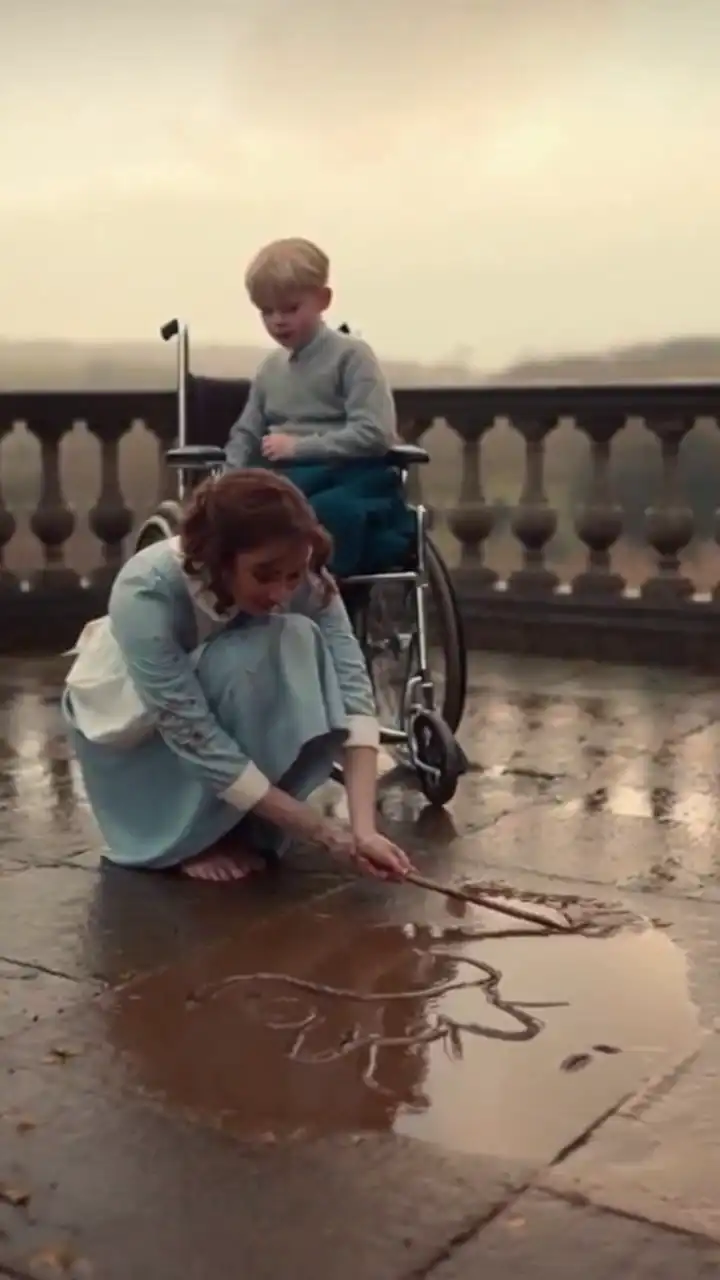
WHEN THE BILLIONAIRE’S SON DRAGGED HIS USELESS LEGS INTO THE MUD FOR THE FIRST TIME, HIS FATHER’S GIRLFRIEND SCREAMED FOR THE NANNY TO STOP
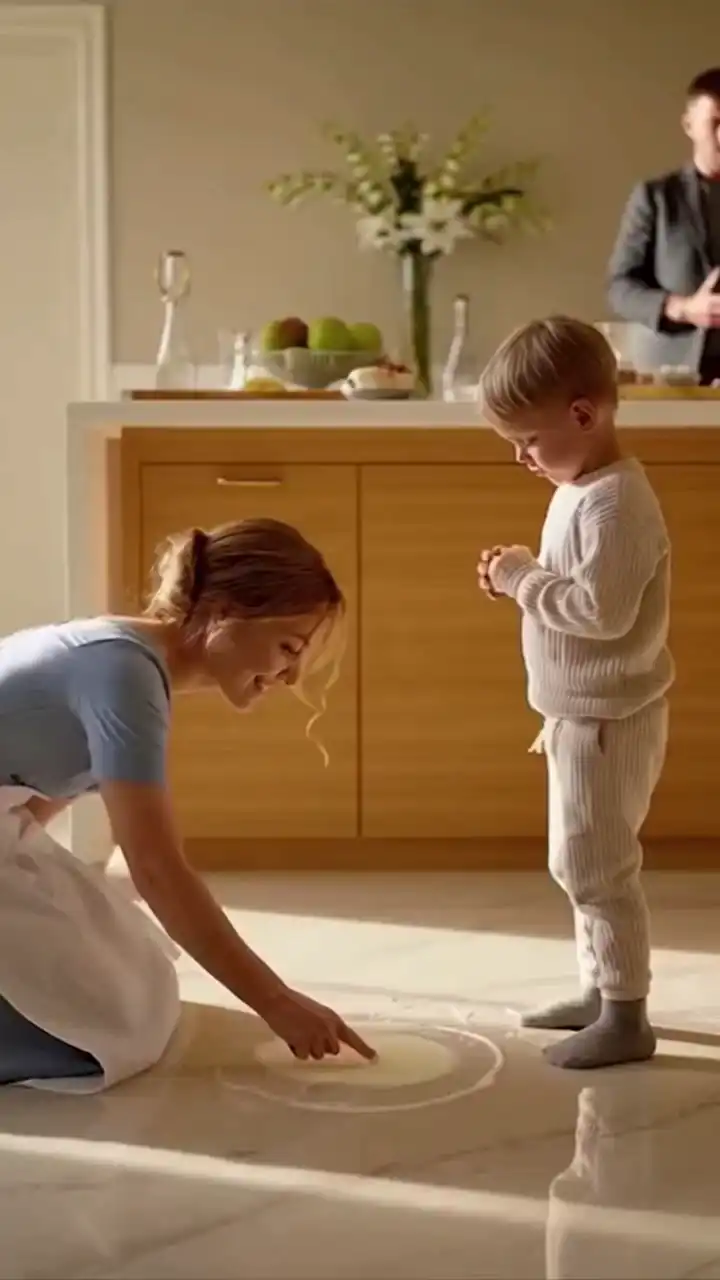
WHEN THE RICHEST MAN ON THE HILL HIRED THE WRONG NANNY, HIS SILENT SON CRAWLED ACROSS THE FLOOR FOR HER
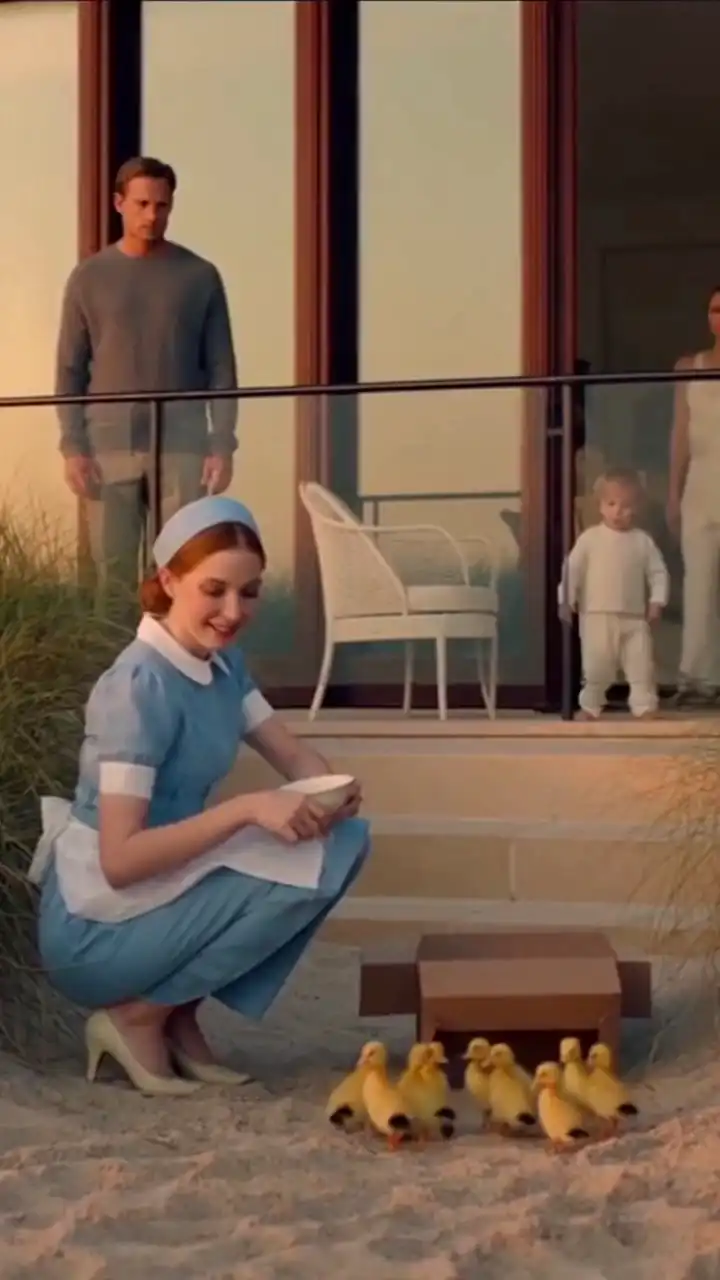
THE NANNY WHO BROUGHT DUCKS TO THE OCEAN HOUSE AND MADE A CHILD WALK TOWARD LIFE