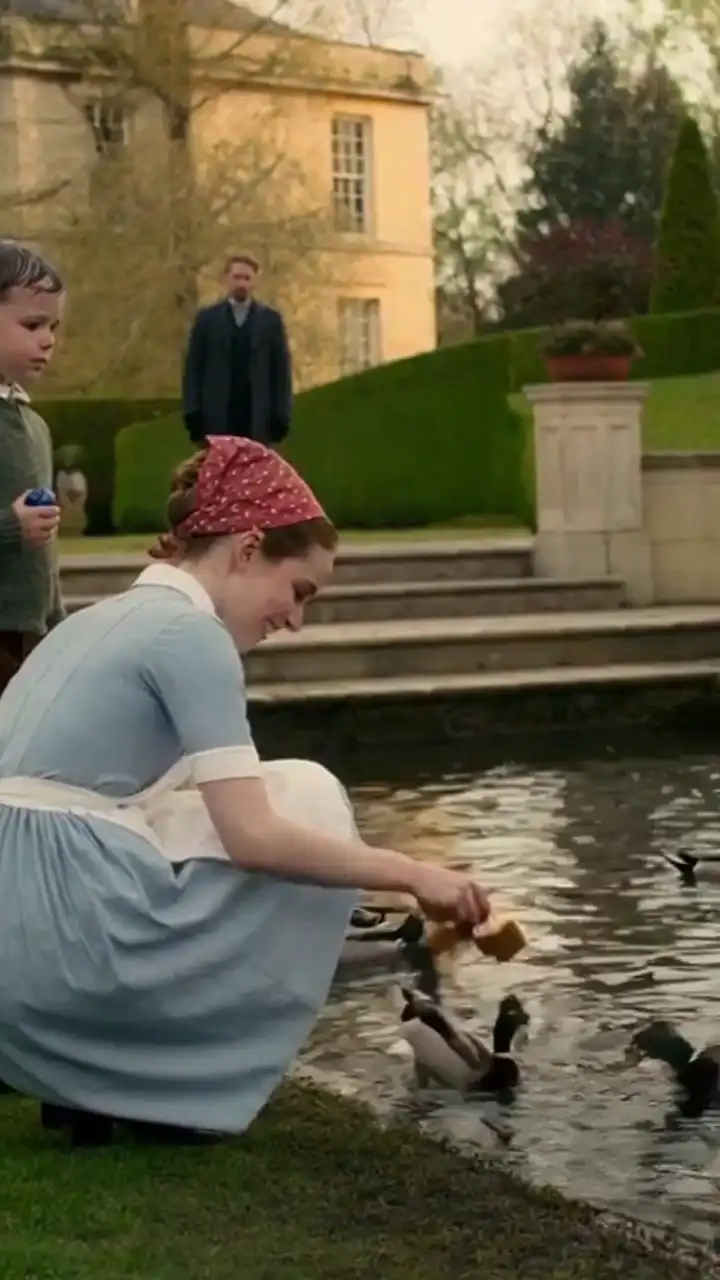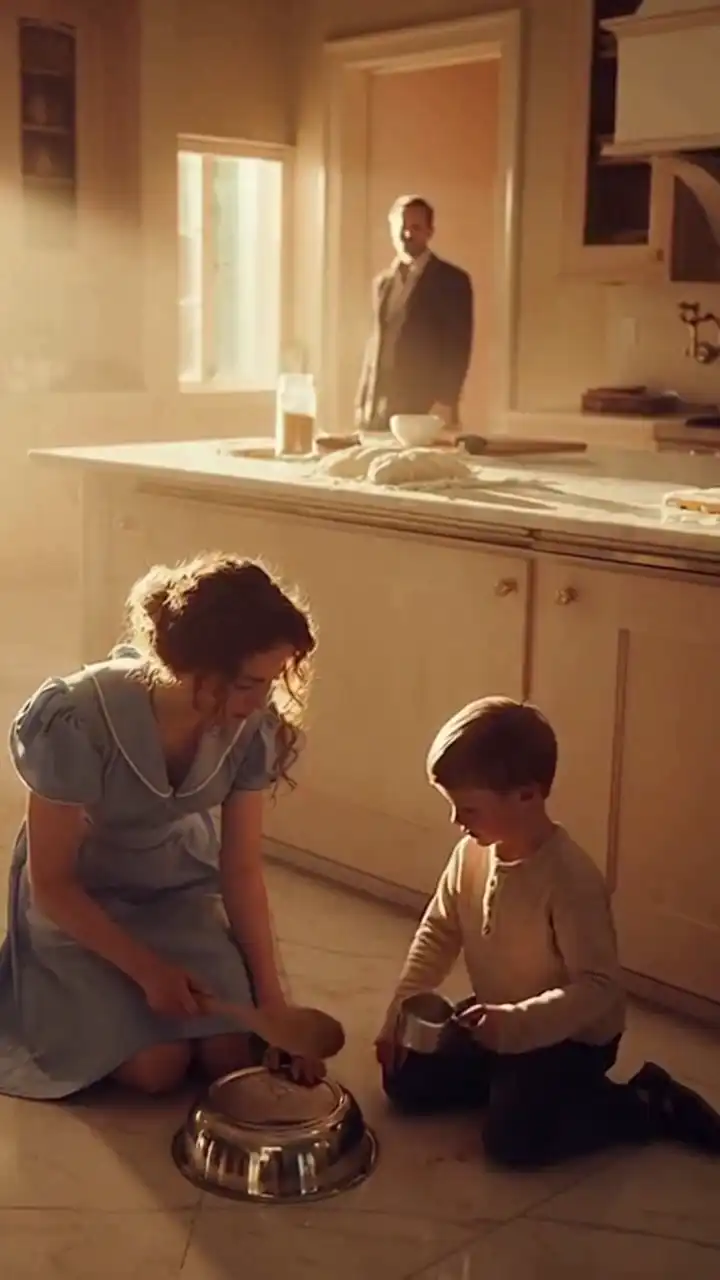
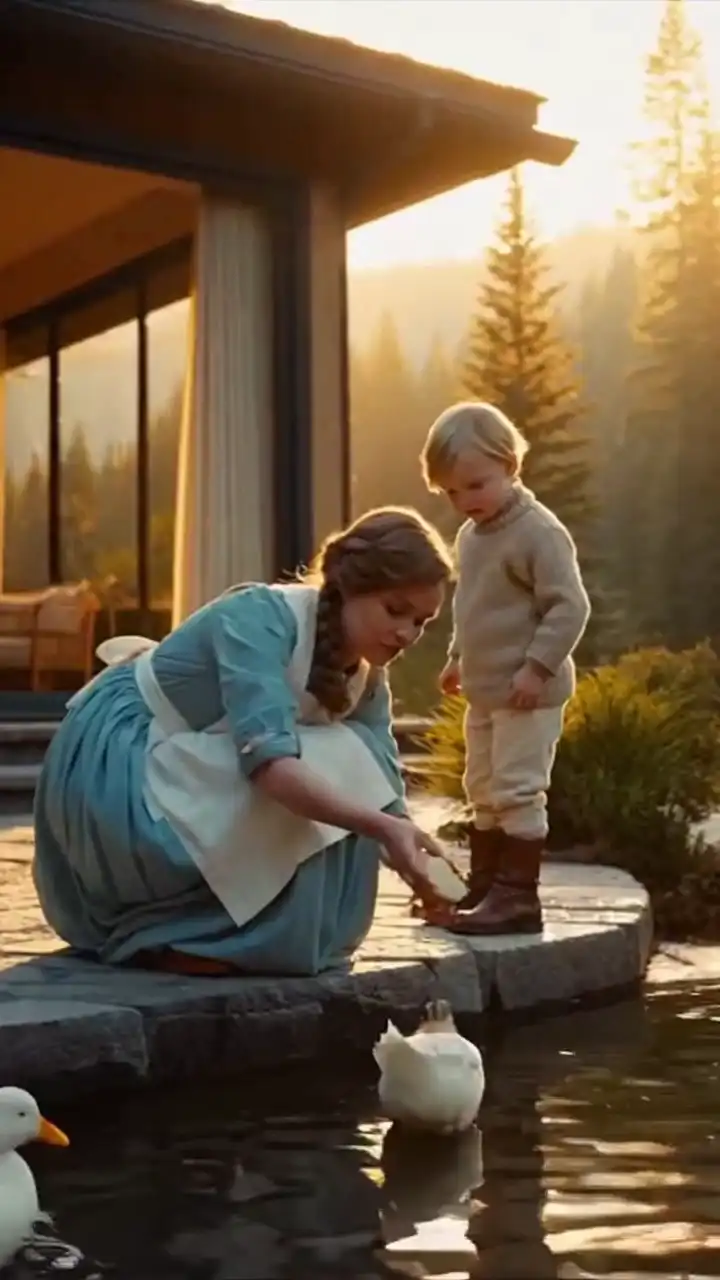
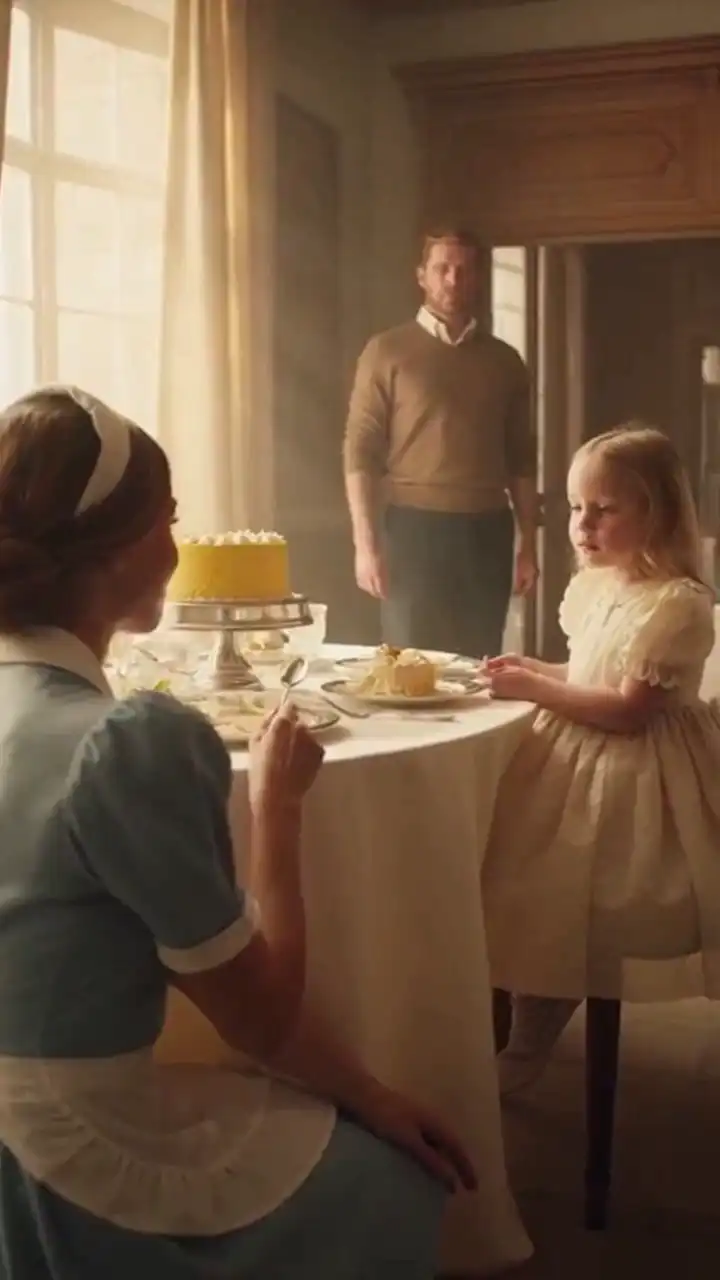

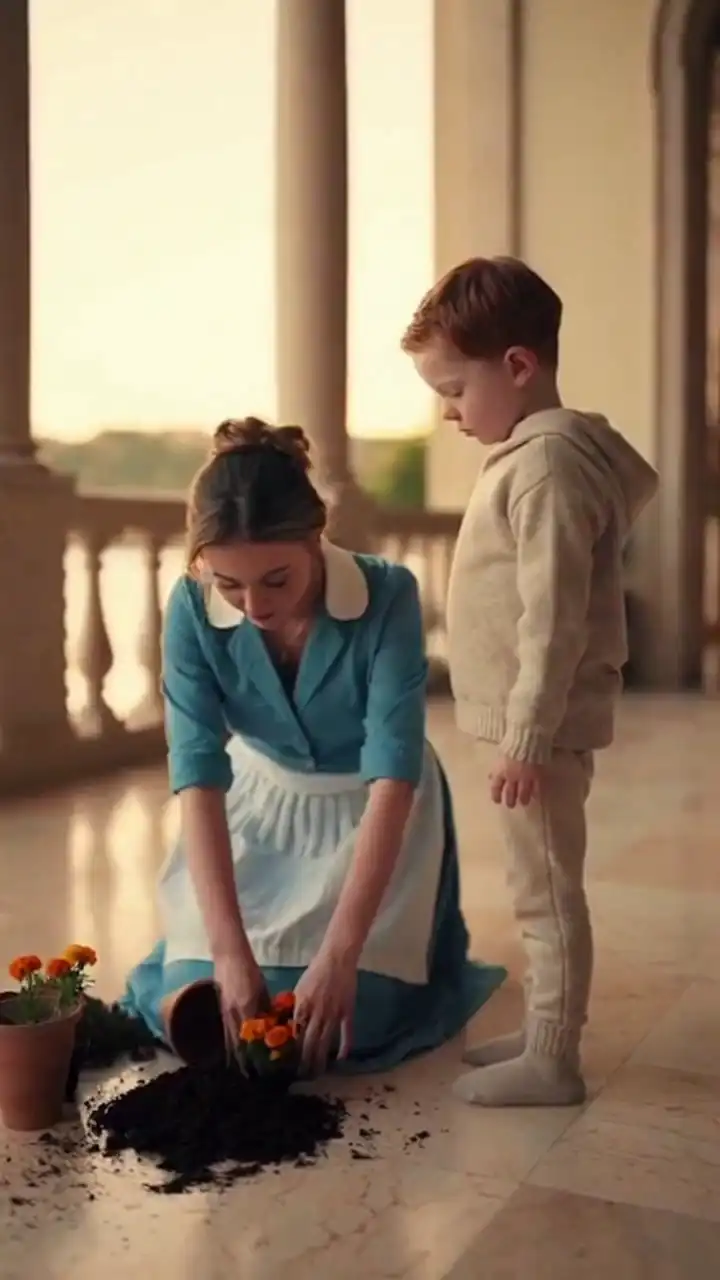
THE DAY A YOUNG NANNY PUT THE HEIR OF A DEAD SILENT ESTATE INTO THE DIRT AND FORCED HIS FATHER TO SEE HIM
[Part2 body] The crack widened before Ethan could close it.
Oliver did not let go of Lily’s apron.
It wasn’t a hard grip. Just two fingers pinching the fabric near her hip, like he needed proof she would stay in that exact place. Lily didn’t turn it into a big moment. She didn’t smile too brightly or praise him in the soft fake voice therapists used when they wanted a reaction. She simply reached for another seedling and said, “This one needs a deeper spot.”
Oliver looked at the plant. Then at the hole in the soil. Then, very slowly, he bent his knees and crouched beside the pot.
Ethan took a step forward.
Lily looked up sharply. “Please don’t stop him because it’s messy.”
“This is not safe,” Ethan said.
“For who?”
The question hit harder than it should have.
Oliver pressed one finger into the soil again. This time he didn’t pull back right away. He dug deeper, dirt packing under his nail. Lily handed him a tiny lavender plant without touching his skin. He stared at it for several seconds, then lowered it into the hole crookedly.
The plant tipped sideways.
Lily didn’t fix it.
She just packed soil around it with her palm. “Good enough,” she said.
Good enough was not a phrase Ethan allowed in his house.
Everything in his world ran on precision. Schedules. forecasts. risk control. contingency plans. It had been the same through Claire’s illness. Every appointment booked. Every treatment compared. Every doctor flown in. He had fought her cancer like it was a hostile acquisition, and when she died anyway, he turned that same brutal discipline on the house.
Nothing unpredictable. Nothing breakable. Nothing that could get worse.
And somehow his son had gone dim inside that perfect control.
Oliver planted three more seedlings that day.
No words. No eye contact.
But each time Lily moved to another pot, he followed by half a step, then a full step.
Ethan stood there watching his son trail mud onto imported stone.
He should have ordered the staff to clean it at once.
Instead he heard himself ask, “Why this?”
Lily rinsed a trowel under the hose. “Because dirt answers back.”
He stared at her.
She shrugged. “Inside, everything asks something from him. Look at me. Answer me. Sit here. Try this. In the garden, he can move without being watched for a result. He can do one real thing with his hands and the thing changes. Soil gives. Water falls. Roots hold. It makes sense.”
That sounded too simple. Too ordinary. Too unprofessional.
Ethan hated that it also looked true.
He let it continue for one afternoon.
Then two.
On the third day, he came home to find Oliver carrying a packet of seeds pressed against his chest while Lily knelt in the vegetable beds behind the greenhouse. She had traded her nice blouse for one of Ethan’s old staff T-shirts, cut at the sleeves. Her knees were muddy. So were Oliver’s socks.
Oliver did not notice Ethan come down the path.
That alone was a shock. The boy used to react to every shift in air, every footstep, every opened door. Now he was focused on dropping bean seeds into a line Lily had made with a stick.
“One, two, three,” Lily said softly.
Oliver tapped the packet against his leg three times.
Not speech. But rhythm. Participation.
“Too much sun,” Ethan said, because control always reached for something.
Lily glanced at the sky. “Then they’ll teach us.”
He had no idea what that meant. He only knew he was irritated by her and unable to pull his son away from her.
That night he called Dr. Warren, the child psychologist he trusted most.
“Is this treatment?” Ethan asked flatly.
“It’s connection,” Dr. Warren said. “Maybe the first real one since his mother passed.”
“By letting him dig in mud?”
“By letting him exist beside someone who isn’t trying to extract a performance from him.”
Ethan ended the call with more anger than clarity.
The real trouble began a week later.
The estate was hosting a small donor dinner on the rear lawn for Ethan’s foundation. Investors, hospital board members, local press. It had been scheduled months before. White tent. String quartet. Caterers moving like clockwork. The garden beds Lily and Oliver had started were close enough to be seen but not, in Ethan’s mind, to matter.
He told Lily to keep Oliver inside that evening.
“Too many people,” he said. “Too much noise. He’ll shut down.”
Lily nodded, but there was something in her face Ethan didn’t like. Not defiance exactly. Just refusal to panic on his command.
At sunset, guests arrived in black cars. Glasses clinked. Waiters moved over the lawn. Ethan was shaking hands with a surgeon who funded pediatric oncology when he saw motion near the herb beds.
Oliver.
He was outside in rain boots, too big for him, standing beside Lily with a dented green watering can.
Ethan excused himself immediately and crossed the lawn fast.
“What did I say?”
Lily kept her voice low. “He asked to come.”
“He doesn’t ask.”
She looked at him. “Not with words.”
Oliver’s shoulders tightened at the sound of Ethan’s anger. His hands clamped around the watering can handle.
Ethan lowered his voice but not his force. “Take him in. Now.”
Then the quartet stopped mid-piece.
A catering assistant, backing away from a dropped tray, startled at the crash and stumbled straight into a stack of metal chairs stored beside the tent. The chairs collapsed in a violent chain of noise.
Sharp. sudden. metallic.
Oliver jerked like he’d been hit.
The watering can fell. Water splashed over his boots. He made a broken sound in his throat and bolted.
Not toward the house.
Toward the far side of the garden, where the old rose wall met a low stretch of turned soil.
“Oliver!” Ethan shouted, already running.
That was the moment every fear Ethan had lived with for a year came roaring up. If Oliver reached the stone path and slipped—if he ran toward the pool—if he vanished into one of those shutdown spirals where no touch, no voice, no command could reach him—
But Lily ran differently.
Not chasing to seize him.
She grabbed the seed tray from the bench as she moved and cut across the garden, getting ahead of him near the vegetable rows. Then, instead of blocking him, she dropped to her knees right in the dirt.
Hard.
Palms in the soil. Breath steady.
“Oliver,” she said, not loud. “The beans.”
He was shaking, eyes wide, trapped in that flooded place beyond language.
Lily slapped both muddy hands lightly onto the earth.
“The beans need covering. Hurry.”
It was an absurd sentence.
A child in panic. A donor dinner ten yards away. Rich people staring. Ethan close enough to grab his son.
And Lily was talking about beans.
Oliver stumbled two more steps, then stopped.
His chest was jumping. His face was blank with terror. But his eyes cut down to the open seed tray in Lily’s hand. Three seeds had spilled into the dirt.
Lily scooped soil over one with quick rough movements.
“One got left out,” she said. “It’ll dry up.”
Oliver made that sound again.
Then he dropped to his knees beside her.
Gasps went up from the lawn. Someone’s phone was already recording.
Ethan stood frozen as his son dug with both hands like the world depended on it.
Lily matched his pace. Fast. Grounding. Scoop, cover, press. Scoop, cover, press.
“Help them,” she said.
Oliver pressed dirt over the seeds so hard it pushed under his fingernails. His breathing stayed ragged, but it changed. Less trapped. More effort. More here.
Lily reached for the watering can, set it beside him, and tipped it toward his hands.
“Too much,” she said. “Slow.”
Oliver’s grip trembled. Water poured in a wild stream, darkening the soil and splashing mud across Lily’s shirt.
She laughed once. Not at him. Just at the mess.
And then the impossible happened.
Oliver looked straight at her.
Not past her. Not through her.
At her.
He lifted the can again, more carefully this time. Water dripped over the planted row.
Lily touched her chest with muddy fingers. “That’s it.”
Oliver’s lips parted.
One word came out, raw and small from disuse.
“More.”
Ethan felt the air leave his body.
The quartet was silent. The guests were silent. Even the caterers had stopped moving.
His son had spoken in the dirt while half the city watched.
Lily did not cry. Did not clap. Did not make it fragile.
She just nodded toward the next dry patch. “Okay. More.”
Oliver poured.
Later, after the guests left buzzing with the kind of shocked story moneyed people repeated for weeks, Ethan stood in his study with Lily while Oliver slept for the first time in months without waking every hour.
“You disobeyed me,” Ethan said.
“Yes.”
“You exposed him.”
“No,” she said. “Life did. I helped him back into it.”
Ethan’s control wanted a target. “You could have made things worse.”
She was tired now. Mud still on her jaw. “Everything in this house is arranged around preventing distress. But children don’t heal by never being startled again. They heal by learning that when they are startled, someone stays with them through it.”
He had no answer ready.
Lily went on. “He didn’t need another room with perfect lighting and expensive objects no one actually uses. He needed work small enough to hold. Something real. Something alive that didn’t disappear because his mother did.”
The mention of Claire landed like a hand to the chest.
Ethan stared at the desk until the grain blurred.
Claire had gardened during treatment when she still could. Herbs in raised boxes. Tomatoes she never got to harvest. Ethan had paid men to maintain every inch of the grounds after she died, but he had quietly ordered those boxes cleared because seeing them made Oliver stand at the window and rock.
He thought he was protecting him.
Maybe he had been erasing her.
The next morning Ethan went to the garden before breakfast.
Lily and Oliver were already there. Oliver was kneeling at the lavender pots, turning one leaf between finger and thumb over and over. Lily sat nearby on an upside-down bucket, not interrupting.
Ethan stood uselessly with polished shoes sinking into soft ground.
Lily looked up. “If you’re going to stand there like security, at least carry something.”
She pointed to a bag of mulch.
No one had spoken to Ethan Cole that way in years.
He almost said no on instinct.
Then he picked up the bag.
It was heavier than it looked. He carried it awkwardly to the bed. Lily slit it open and handed him a small hand shovel, the cheap plastic kind sold in grocery stores every spring.
He stared at it.
She raised an eyebrow. “It still works if it’s not imported.”
Oliver glanced up at that. Only a flicker. But enough.
Ethan knelt.
The first minutes were painful. He was too stiff, too aware, too slow. He asked unnecessary questions. Put mulch in the wrong place. Reached too quickly toward Oliver once and watched the boy recoil.
The old Ethan would have retreated and let staff manage the discomfort.
Lily didn’t let him.
“Don’t make him your project,” she said quietly. “Just stay.”
So he stayed.
Day after day, often badly.
He learned that Oliver liked the sound of water filling metal before it poured. That he hated gloves and preferred cold dirt on bare fingers. That transitions went easier if the tools were lined up in the same order. That he could tolerate birdsong but not leaf blowers. That if a worm appeared, he froze until Lily made space around the moment instead of rushing him through it.
He learned that silence was not always absence.
Sometimes it was listening.
Other times it was effort.
A week later Oliver touched Ethan’s sleeve when he couldn’t open the seed packet.
Two weeks later he stood beside his father while they moved a small terracotta pot together, each holding one side.
Three weeks later he sat at the kitchen island eating strawberries from the garden while Lily washed lettuce and the house—once so hushed it felt embalmed—filled with ordinary sounds. Running water. Drawer slides. A spoon dropping. Ethan asking, “How many tomatoes do we need?” and Oliver tapping the counter four times before whispering, “Four.”
The staff started smiling again.
Not the polished service smiles. Real ones.
There were setbacks. Hard ones.
A thunderstorm sent Oliver into a full shutdown under the breakfast table. A visiting consultant Ethan’s sister recommended spent forty minutes trying to coax him out with reward charts and soothing scripts until Lily finally slid under the table herself with a bowl of snap peas and started snapping ends into a colander. Pop. pop. pop. Oliver emerged ten minutes later to hand her the pieces.
Another time Ethan ruined an entire afternoon by insisting Oliver wear new gardening gloves because the old ones were “worn out.” Oliver threw them, screamed, and would not go outside. Ethan nearly turned it into a lecture about boundaries and cooperation before he saw Lily standing at the doorway, not rescuing him.
“Fix it,” she said.
“How?”
“Apologize to your son, not to your image of yourself.”
So Ethan crouched in front of the closed sunroom door and said, clumsy and plain, “Dad got it wrong.”
The door stayed shut for a long time.
Then it opened two inches.
A muddy glove slid out across the floor.
Not forgiveness. An offering.
Ethan took it like something holy.
By early fall the garden had changed shape.
So had the house.
The herb boxes were thick with basil and mint. Bean vines climbed the trellis. There were child-sized tools hanging beside adult ones in the mudroom because Lily refused to hide Oliver’s things away after each use “like evidence.” A chalkboard by the kitchen door tracked what needed watering. Sometimes Ethan wrote on it himself before leaving for work.
More important, he stopped staying at work just to avoid coming home to grief.
He started canceling dinners.
Started taking calls from the garden bench instead of the car.
Started knowing the difference between parenting and funding care.
One Saturday, his sister Margaret came for lunch and found Oliver and Ethan on the lower lawn, repotting lemon seedlings in mismatched containers. Dirt was on Ethan’s jeans. Real dirt, not staged charity-event dirt. Oliver was handing him pebbles one by one for drainage.
Margaret stared. “What happened here?”
Ethan looked at his son, who was studying a root ball with fierce concentration.
Then at Lily, who was sitting cross-legged nearby painting plant markers on scraps of old wood.
He answered with more honesty than he used anywhere else in his life.
“We stopped trying to keep him untouched.”
Margaret said nothing after that.
Neither did the board members who later noticed Ethan leaving meetings at five no matter who objected.
The final shift came at Oliver’s school review in October.
Before Lily, the recommendation had been clear: specialized residential placement if home engagement did not improve. A beautiful phrase for sending a grieving child away because the adults around him couldn’t reach him.
Ethan had almost signed the papers in July.
Now he sat across from the school director, Dr. Warren, and two specialists while Oliver arranged smooth stones in a line on the rug by the window. Lily wasn’t there. Ethan had insisted this meeting was his responsibility.
The director cleared her throat. “His progress is significant, but consistency is critical. We need to know what intervention changed the pattern.”
Months earlier Ethan would have given them a sterile summary. therapeutic environment. sensory regulation. structured outdoor activity.
Instead he said, “A young nanny ignored my rules and handed my son a seedling.”
The room went still.
He went on. “Then she kept doing the one thing I resisted most. She made space for life that wasn’t optimized, sanitized, or controlled. My son responded because she treated him like a child who could join the world, not a problem to be managed away from it.”
Dr. Warren smiled into his coffee.
The director glanced at her notes. “So you are declining residential placement?”
Ethan looked at Oliver. The boy was pressing two stones together, listening to the click.
“Yes,” Ethan said. “He’s not leaving his home. I’m changing how this home works.”
When they walked out, Oliver hesitated at the front steps of the school. Too much noise. Too many car doors. His body tightening.
Ethan didn’t grab. Didn’t hurry. Didn’t fill the air.
He crouched beside him and held out the small packet he had tucked into his pocket that morning.
Radish seeds.
Oliver looked at them. Then at his father.
“Garden?” Ethan asked.
Oliver nodded once.
That evening they planted in the fading light, all three of them. No gala. No witnesses. Just the scrape of trowels and the smell of cut grass. At one point Oliver pressed seeds into Ethan’s palm, trusting him to place them where they belonged.
Lily watched that exchange and looked away to give it privacy.
She had changed the order of the house without ever asking permission.
Near the first frost, Ethan found her in the potting shed writing in a small sketchbook between chores. Plant diagrams, watercolor swatches, notes on sensory responses, child-sized task sequences. She had pages of ideas for therapeutic garden programs, not just for Oliver but for other children who shut down inside traditional rooms.
“Why didn’t you show me this?” he asked.
She shrugged. “It wasn’t why I came.”
“What was?”
“To do the job.”
He looked at the pages again. “This is bigger than a job.”
By winter, Ethan used his money differently.
Not to bury problems under experts and polished language.
He funded a pilot garden program at the children’s hospital where Claire had been treated. Lily helped design it. Raised beds, tactile paths, simple tools, sheltered corners, staff training built around participation instead of compliance. Her name went on the proposal, then on the program itself.
Mercer Garden Studio for Pediatric Recovery.
She cried at that. Finally.
So did Ethan, though more quietly.
Lily did not become a decorative miracle in their house or a saint people spoke about in whispers. She remained young, funny, stubborn, occasionally late with her coffee, impossible to intimidate, and completely unimpressed by wealth.
Which was exactly why she had been able to save something in that place.
By spring, Oliver was still Oliver. He was not transformed into a chatty movie child. He still had hard days, silent spells, moments when sound or change hit him too fast. But now he reached. Now he followed. Now he placed basil leaves in Lily’s hand and seed packets in his father’s. Now he slept with dirt under his nails sometimes because he forgot to scrub properly after evening watering.
One Sunday morning, Ethan was in the kitchen slicing peaches badly while Lily laughed at his knife grip and Oliver stood on a stool tearing mint leaves into a bowl.
The windows were open.
The back door was muddy.
Someone had left a line of terracotta pots on the counter because there was never enough surface space anymore.
Ethan looked around and realized he no longer wanted the old order back.
Oliver suddenly tugged his sleeve.
When Ethan bent down, his son touched a mint leaf to his palm and said, soft but clear, “Dad. Plant this.”
Just two words before the request.
But the first one was enough to break him open.
Ethan took the leaf, swallowed hard, and nodded.
“Show me where,” he said.
And this time, he meant it in every way that mattered.
Disclaimer: Mention of any brand or trademark is for identification only and does not imply partnership or endorsement
WHEN THE BILLIONAIRE’S SON DRAGGED HIS USELESS LEGS INTO THE MUD FOR THE FIRST TIME, HIS FATHER’S GIRLFRIEND SCREAMED FOR THE NANNY TO STOP

WHEN THE RICHEST MAN ON THE HILL HIRED THE WRONG NANNY, HIS SILENT SON CRAWLED ACROSS THE FLOOR FOR HER
THE NANNY WHO BROUGHT DUCKS TO THE OCEAN HOUSE AND MADE A CHILD WALK TOWARD LIFE